AUTHOR’S NOTE: The concept of facing, gaze or regard has a long history of use with the Tarot de Marseille, although fans of more modern decks tend to disregard it.
Here is a spread that applies the facing and orientation of one of the 16 court cards to choose which of four 3-card sets becomes the reading scenario. It’s important to select a deck in which the court cards exhibit a distinct regard that doesn’t look straight out of the scene. The standard RWS works well because all of the courts except the King of Swords can be assigned a zone of awareness, and the outward-facing King’s raised sword in his right hand shows that his attention lies in that direction. (All images are from the Albano-Waite Tarot, copyright of US Games Systems Inc, Stamford, CT.)
Begin by removing the sixteen court cards from a tarot deck and shuffle them in a way that introduces random reversals. When done, pull one of them and place it face-down in the middle of the table as the “pointer” card (aka “gazer”).
Return the remaining court cards to the deck and shuffle it thoroughly while concentrating on the question or topic (reversals are optional at this point). Deal twelve of them face-down in any order around the “gazer” in the pattern shown below, being careful to get the alignment right. The direction of gaze will be determined when the “gazer” is turned face up.
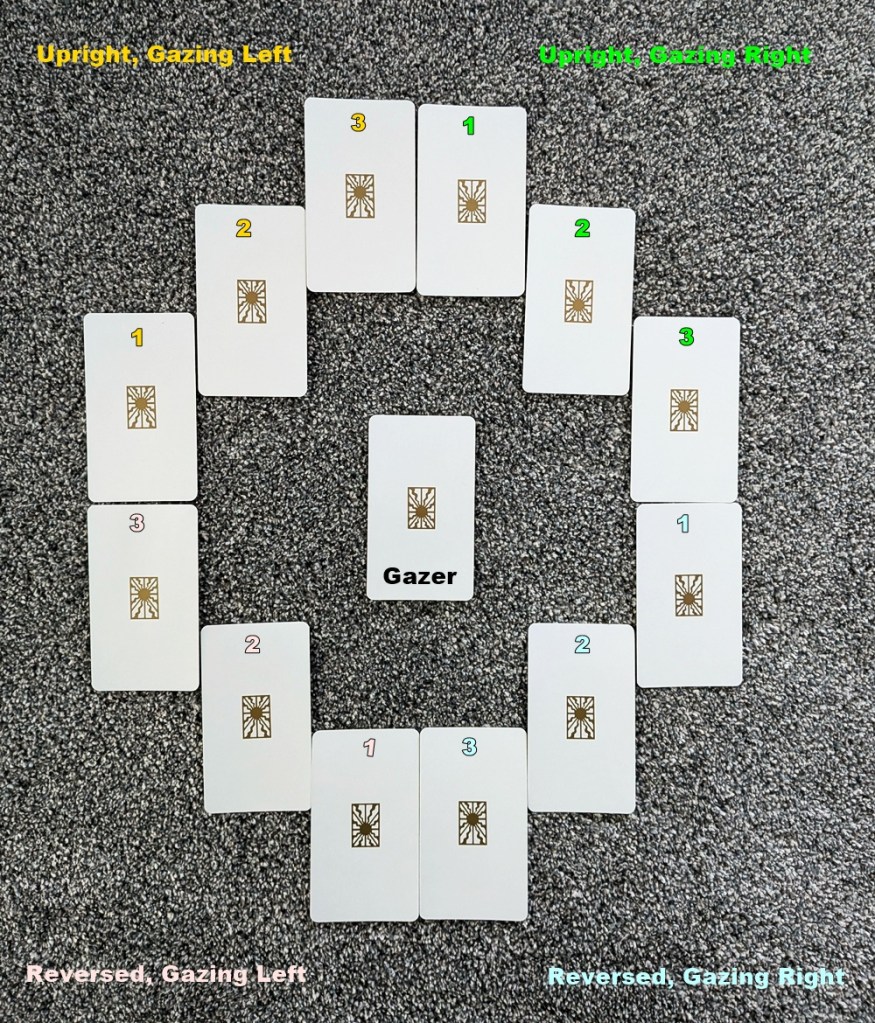
Reveal the center card and follow the gaze of the figure in its upright or reversed orientation to select three cards in the subgroup defined by its facing. Read these cards in a clockwise direction as a three-card arc. (The numbers on the cards show the proper sequence.)
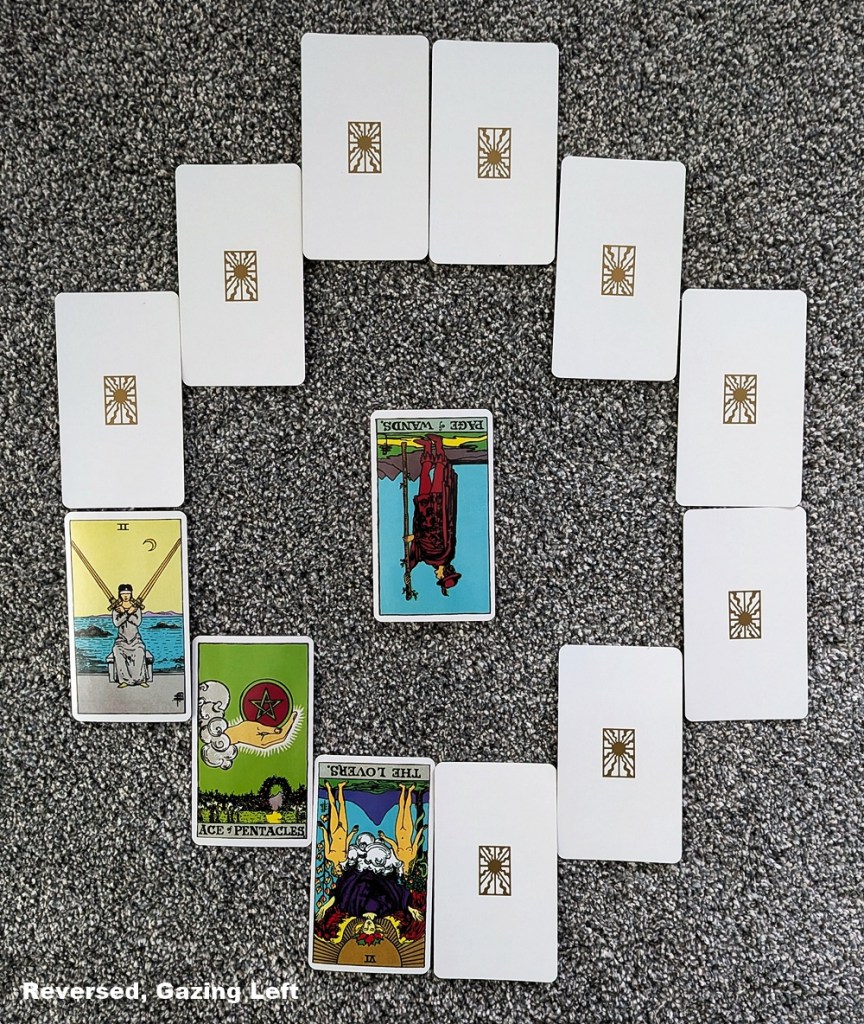
Here is an example reading to illustrate the technique. I asked where I should look for inspiration in a matter of interest to me.
The reading suggests that misplaced ardor (Page of Wands reversed) will run into a double dose of indecision (Lovers reversed and 2 of Swords). The offering hand of the Ace of Pentacles reminds me of the old schoolyard threat to just “take my ball and go home.” With the elemental antagonism between it and the two adjacent Air cards, I should probably not have bothered asking.
Although I didn’t do so for the example pull, another option would be to also look at the three cards directly opposite the focus of the gaze to consider what is not being seen in the situation that may be more important than what is visible. I never use the “shadow card” in my work, but this approach suggests the risk of being “blindsided” and may be a useful addition to the reading. There is no harm in being forewarned of the possibility.
 Parsifal's Wheel Tarot & Astrology
Interesting, I will have to try this.
LikeLike