AUTHOR’S NOTE: A couple of years ago I performed a careful analysis of the Waite-Smith tarot to determine which cards express some kind of active movement. In the end I came up with five Major Arcana, six court cards and ten Minor Arcana as indicators of either acceleration or deceleration in a querent’s affairs. (All images are from the Waite-Smith Centennial Edition, copyright of US Games Systems Inc, Stamford, CT.)
However, not all of the cards picked exhibit a definitive left-or-right direction of travel, so for my purpose here I’m choosing only those that show human figures in linear motion (with a couple of exceptions), and those individuals must be stepping out resolutely toward one side of the scene or the other. Along with the non-hominid cards, I’m excluding those with people who are sitting down or standing still and those with figures that are gazing straight out of (or into) the frame. That leaves me with twelve decisive “movement” cards, to which I’ve added the Wheel of Fortune and the Chariot as archetypal symbols of evolving circumstances. There is a mixture of encouraging and discouraging cards to provide a realistic outlook, but my intention is to read all of them as “motivators,” if only of the “burr-under-the-saddle” or “thorn-in-the-side” variety.
The idea I’m pursuing is the notion that too often a reading will seem aimless when there is no obvious hint of trending developments near the beginning or even well into the spread. To counter that possibility, I’ve populated the matrix below with the fourteen “movement” cards in random order, from which the opening card of a reading will be chosen using a board-game spinner. My premise is that people who sit for a reading usually hope to see positive life-changes ahead or at least no negative tendencies in their future, so by starting with a bang I will show them one potential or the other right away and any additional cards will take it from there.
Once that card is identified, two or four more cards can be pulled after shuffling the rest of the deck to create a three-card or five-card line to read as the narrative for the situation. Thus, the opening statement will always convey either a view of future advancement (right-facing) or a caution against being sidetracked into past issues (left-facing). I’ve labeled each position with a single keyword reflecting its general nature, but feel free to change them to anything you want. (Before anyone asks, I could have replaced the Sun with the 8 of Wands as “Swiftness” but it didn’t meet my selection criteria.)
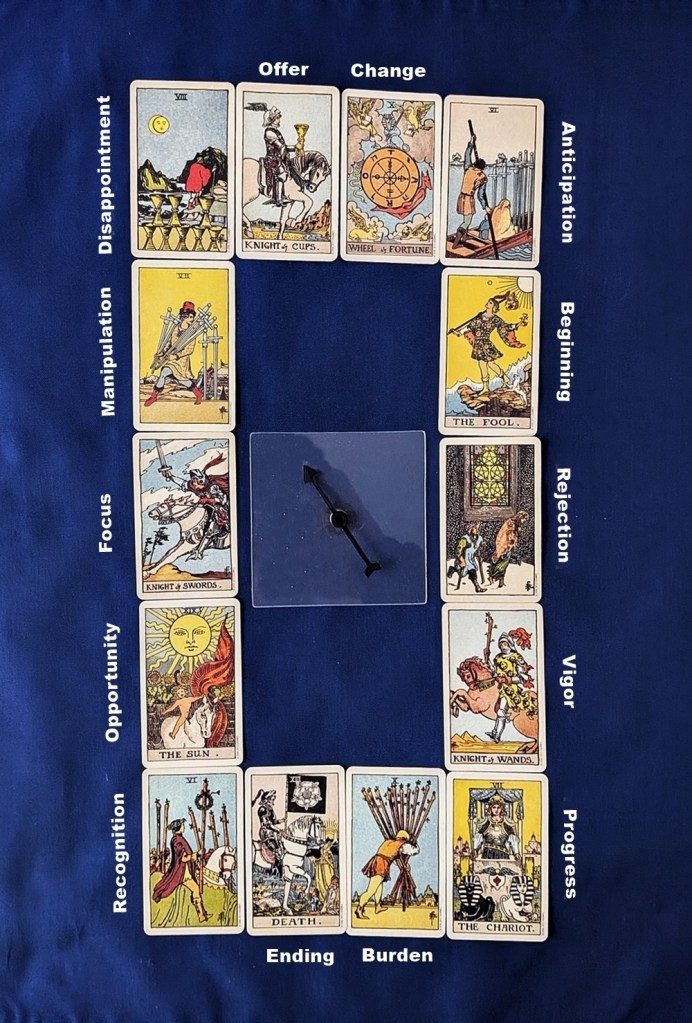
You will need a plastic board-game spinner to perform this reading. They are inexpensive and you can buy a four-pack from online retailers if you can’t find them singly at low cost.
Begin by removing the fourteen designated cards from the deck and shuffling them. Deal these cards in any order you prefer using the pattern shown above. Although I didn’t allow for reversals at this point, they could be introduced to double the past-or-future “facing” possibilities.
Place the spinner in the center of the layout in a way that allows the pointer to land on any one of the cards. Note that the four cards at the corners have limited exposure to selection, so it is a good idea to permit some latitude at those locations, perhaps 25% of a card’s width on either side of the angle as an “access zone” for pointer acquisition. Use your judgment for this call.
Give the spinner a brisk whirl and note the card that the pointer lands on. Remove this card from the matrix and lay it at the left end of a forthcoming line spread.
Shuffle the rest of the cards (reinserting the remaining thirteen from the matrix) while concentrating on the question or topic and deal as many as you need to populate the desired line. Reversals may be applied.
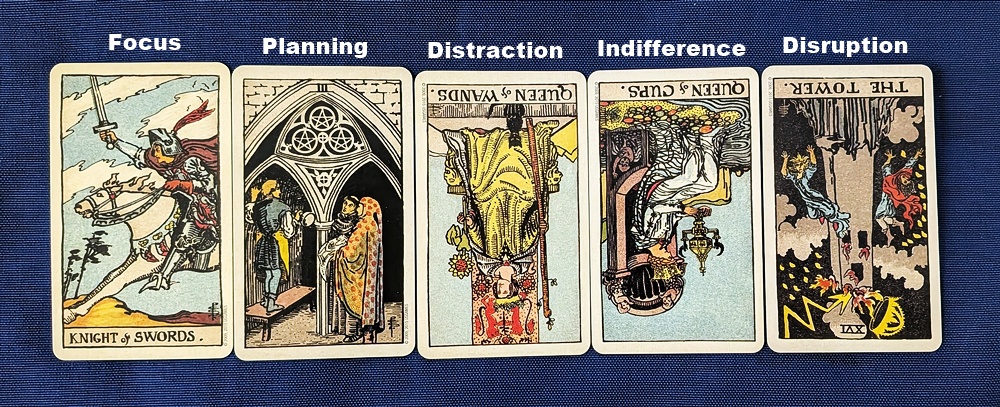
Below is a five-card example reading illustrating the technique. The pointer landed on the Knight of Swords (not as shown above), so the reading begins with an energetic mental focus that appears to be drawing heavily on prior experience and expertise, followed by a “planning” interlude. (Perhaps the planners brought in a “hired gun” to get a stalled project off the ground.) But the two reversed Queens subsequent to that forceful start show lack of enthusiasm for continuing the effort (maybe the Knight’s “take no prisoners” style offended them and they are digging in their heels), and the disruption of the Tower ensues shortly thereafter. It looks like a case of “The best laid schemes o’ Mice an’ Men gang aft agley,” this time in the face of dissenting opinion and a “vote of no confidence” that sabotages the initiative. At least in my book, the reversed Tower suggests a “soft landing,” so all may not be lost. But the only remedy could be to send the Knight of Swords packing.
 Parsifal's Wheel Tarot & Astrology