AUTHOR’S NOTE: We’re often told that “there are two sides to every story” and that we must understand both if we are to effectively defuse a controversy. In this light, although I’m not purposely focusing on conflict-resolution scenarios, I’ve created a new spread that examines the opposite faces of a situation, one overt or readily discernible in its intent and the other more covert or calculating in nature.
In personal terms, one is what we explicitly say we want and the other reveals what we’re really after, while in a more interactive sense one is the stated position or main argument and the other is the hidden agenda or implicit motive on either side of the issue. I also expanded the narrative to consider “big picture” ramifications and a long-range “consequences” forecast, all of which are achieved by calculating “numerical essence” cards using the face values of the rest. (See my previous essays on the “quintessence” derivation.)
You will need two decks to perform this reading, one for the overt scenario and one for its covert counterpart. Shuffle each deck while concentrating on the question and deal three cards from the first deck, left-to-right, into the top row and three cards from the second deck into the bottom row. If you like, you can use a third deck for the “Consequences” card, and you may have to do so if one of the calculated trumps has already appeared in the spread.
Read each row as a narrative running from the inception of the matter, through its transitional surge toward maturity (i.e. ripening or coming-of-age) to its near-term conclusion. The top row shows straightforward aspects of the situation while the bottom row suggests more circuitous factors. These story-lines will describe what we could stand to gain or lose from following one path or the other.
Next, calculate a numerical essence card (always a trump card) from each three-card set. (In my own practice I assign 11 through 14 to the four court cards and I subtract the value of any reversed cards so I can arrive at zero [the Fool] as the result.) These cards should be read as the environmental backdrop or underlying theme within which each conclusion will play out.
Finally, calculate a similar essence card (another trump) from the numerical sum of the two “Big Picture” cards to reveal the long-range consequences of interaction between the two trains of experience.
Below is an example reading to illustrate the method. Here I used US Games Systems’ RWS-based Golden Art Nouveau Tarot and Lo Scarabeo’s Golden Universal (RWS) Tarot, with the “Consequences” card drawn from the Waite-Smith Centennial Edition, also copyright of US Games Systems Inc, Stamford, CT.
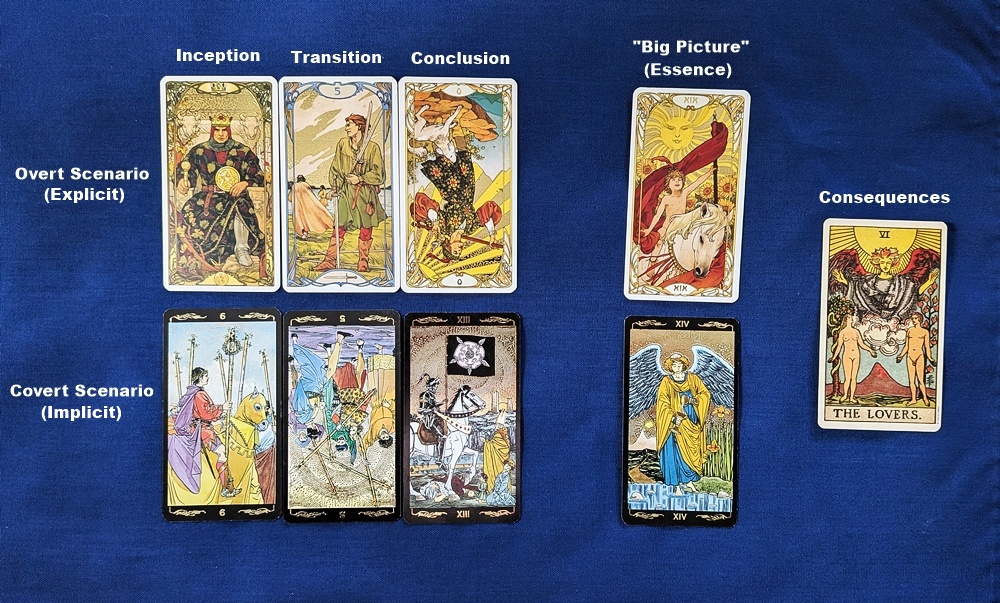
The “overt” scenario starts from a solid footing (or should we say “sitting”) with the upright King of Pentacles: everything is under control . . . until it isn’t, with the elementally-hostile 5 of Swords showing disruption and turmoil. The reversed Fool at the end implies being tossed off a cliff or maybe being “thrown to the wolves.” The Sun as the “Big Picture” card gives the impression that nothing too unpleasant will happen, and that any distress will be temporary and easily dispelled.
In the “covert” scenario, the 6 of Wands is feeling pretty good about its chances for success, but it walks head-on into strife, this time coming from an unexpected quarter in the reversed 5 of Wands. Death at the conclusion portends that the conflict will be unceremoniously squelched by a major departure from the original script – winning or losing is immaterial when the reason for the struggle has been superseded by more pressing conditions. Temperance as the “Big Picture” card shows the need for a delicate finesse in rescuing harmony from the iron grip of Death, and to make matters worse the two are elementally disaffected.
The most interesting thing about this tale is that both rows have a destabilizing Five in the middle, indicating that neither one is situated to make the most of its generally favorable “Inception” card. The Earth of the King of Pentacles is hamstrung by the elemental Air of both the 5 of Swords and the Fool, while the Fire of the 6 of Wands and 5 of Wands is completely extinguished by the Water of Death. If I had to make a choice, I would probably elect to go over the cliff with the Fool since the Sun would be there to catch me. In practical terms, I would stay open and above-board in my dealings and accept whatever comes of it.
Regarding the long-term “Consequences” card, the Air of the Lovers is favorably attuned to the Fire of both the Sun and Temperance, so there is little to choose in pursuing either one to that end. The Sun is almost never unwelcome as an overarching influence in any decision-making situation, while in esoteric language Temperance represents the consummation of the “alchemical marriage” proposed by the Lovers, although here in “cart-before-the-horse” fashion, suggesting that the Lovers will be too impatient to sit still for much “finessing,” which could be its downfall in the “covert” scenario.
The Lovers is closely aligned with the last two Air cards of the “overt” row, particularly with the reversed Fool who could use a helping hand. It is friendly with the first two Fire cards of the “covert” row but Death is mostly indifferent to its agenda. In the first case, the Lovers intimates either a favorable liaison or the next major turning point in longer-range developments (I call it the “crossroads” card), while in the second instance it hints at having to make uncomfortable adjustments or concessions to appease Death.
On balance, if the Fool throws himself into the arms of the Sun and the Lovers, a better long-term outcome will be had than if Death negotiates with Temperance to reach an uneasy truce with the Lovers. The advice in all of this is to “just do it and don’t overthink it.” But the whole thing has an overwhelming aura of unreality about it, reminding me of the Atlantic Rhythm Section song “Imaginary Lover.”
 Parsifal's Wheel Tarot & Astrology