AUTHOR’S NOTE: Upon reading Benebell Wen’s observation in Holistic Tarot that each of the Aces symbolizes “an opportunity presented” (but not yet acted upon), I realized that this concept could be put to use in a decision-making spread with three distinct outcome chains depending on how the opportunity is handled.

The initial position at the left shows the opportunity as it was originally tendered. If there is no identified offer in sight but it is anticipated or hoped that one will soon appear, this card should be pulled randomly. When an existing opportunity is already under review, the card can be chosen intentionally according to the context (one example would be the 2 of Cups for a potential romantic connection). Reversal may be applied in either instance to reflect that there could be aspects of the situation that are not fully understood at the time of the reading. (Reversals may also be used in the rest of the spread for the same purpose.)
The first three-card column to the right describes the possible reactions to the overture: whether to accept it, reject/ignore it or defer action for the time being. The card in this column that is the most favorably attuned to the “opportunity” card according to a variety of factors (compatible nature, friendly element or suit, identical polarity, reinforcing number or rank, etc) should be considered an auspicious harbinger of future progress in the matter at hand. If there are two or three cards so favored, the final step in this process (see below) can aid in arriving at a decision.
The second three-card column provides the likely near-term outcome of the previous initiative in each chain. No “fine-tuning” of the interpretation is necessary here as was done for the first column because this is not a “what-if” scenario but a straightforward indication of probable results.
A view of the long-range consequences of the three proposed actions and outcomes can be obtained by calculating a “numerical essence” card (always a trump card) for each chain using the face-values for the cards in the population, including the “opportunity” card. (In my own practice, I treat the court cards as 11-through-14 and I subtract the value of any reversed cards so I can conceivably arrive at the Fool, or even obtain a reversed trump, as a result.) Numerological reduction may be required to produce a number that falls within the 22-card series
When the most encouraging essence card is in the top row and strongly supports a well-favored “acceptance” card, this is the ideal answer: “Just do it!” If it isn’t so situated, you will have to form a “second opinion” around one of the other responses that offers a better yield in the long run. On the other hand, if there were two or more fortuitous “action” cards in the first column, compare the associated essence cards to the “opportunity” card to identify which one is aligned most cooperatively with the venture it represents and treat that chain of cards as the projected “best case.”
Here is an example reading to show the approach. (All cards were pulled randomly.)
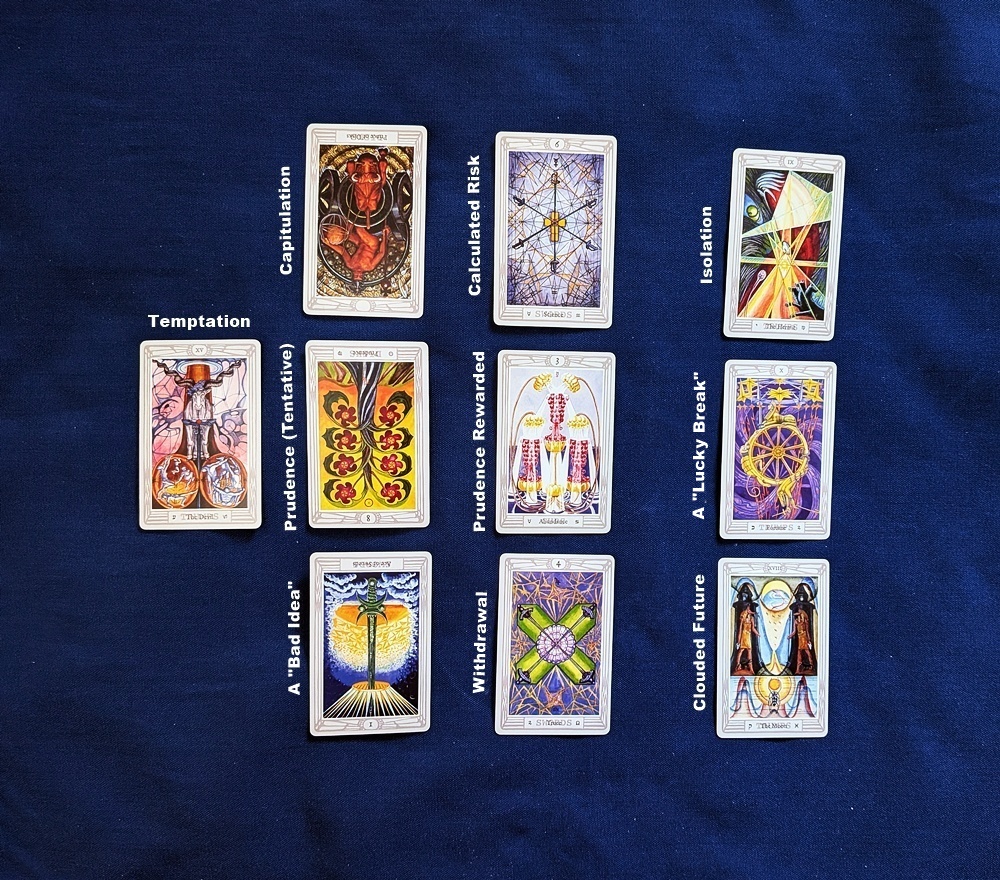
This hypothetical reading involved a “looking-for-love” scenario, but with the Devil in attendance it seemed to immediately turn into a “looking-for-lust” proposition. (Perhaps that’s what it was all along.)
Among the “Action” cards, the reversed Prince of Disks as the “Accept” option looks like the “Devil’s henchman;” it readily caves in to the latter’s allurement, loudly proclaiming “Resistance is futile.” The 8 of Disks reversed in the “Table It” position is also elementally attuned to the Devil, but its title of “Prudence” implies reluctance to act precipitously (although the reversal does “leave the door open a crack”). In the “Reject/Ignore” position, I would see an upright Ace of Swords as the “bright idea” card, but when reversed it can only mean “a bad idea.” (It’s notable that: 1) all of the “action” cards are reversed, making for a hazy decision-making atmosphere; and 2) the Prince of Disks and the 8 of Disks are both elementally friendly to the Devil while the Ace of Swords is hostile, leaving only a two-pronged success path to consider.)
In the “Outcome” column, the 6 of Swords shows that capitulating to the Devil by accepting the offer would be a “calculated risk” since it is elementally unfriendly to both of the preceding cards and also to the subsequent Hermit. The 3 of Cups most likely means that “tabling” the offer out of an abundance of caution could be a rewarding strategy due to the shy “loosening up” shown by the reversal of the 8 of Disks. The 4 of Swords as the upshot of rejecting the offer outright implies becoming “plateaued” in a rather bleak condition.
The “Long-Range Consequences” of mishandling the risk attached to the Devil’s offer would be the seclusion of the Hermit, not the hoped-for romantic liaison since the Hermit is a much more retiring Earth card than either the Devil or the reversed Prince of Disks. Spinning the Wheel of Fortune as a result of deferring action on the opportunity could upgrade the emotional benefits shown by the 3 of Cups to a more stimulating level. (I treat the Wheel as generally positive in accordance with its traditional meaning.) The Moon puts an exclamation point on the realization that engaging with the Devil even for the purpose of rebuffing him would reap nothing but woe since it would almost certainly invite retribution. Best to stay far away.
In summary, the acceptance path in this spread denotes “overplaying one’s hand” by attempting to finesse the situation as indicated by the 6 of Swords and coming up empty. The rejection path was a non-starter from the beginning since there was no guarantee that the disengagement portrayed by its “outcome” card would be even remotely possible to pull off with aplomb. (I’m thinking of Sean Bean’s famous line: “One does not simply walk into Mordor” . . . or away from the Devil.) This leaves the prospect of delaying the decision as the most attractive choice because it appears to hold out the promise of satisfaction in both the near term and the long run. The Wheel of Fortune signifies that “things will eventually come around” to the querent’s point-of-view.
 Parsifal's Wheel Tarot & Astrology