AUTHOR’S NOTE: Although this spread is set up for a specific set of priorities and a single, narrowly-framed question, it is adaptable to almost any kind of analysis. Just change the header titles and the “Query” entry to suit the topical focus. It includes a “response” row; an “advantages” row; a “disadvantages” row; and a “big-picture outcome” row, the last one to be calculated as a “numerical essence” of the other three.
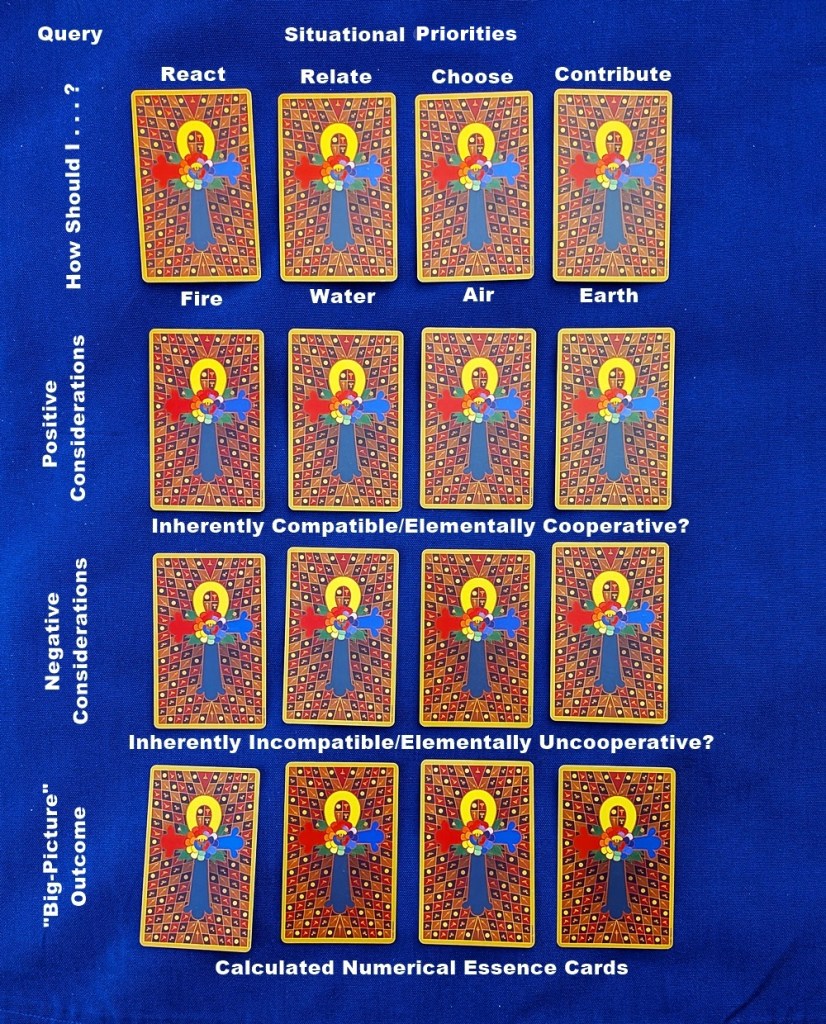
Begin by adjusting all of the titles in the top row and the “Query” description to agree with your objective. I established this spread to examine a matter in which I’m anticipating an initiative or opportunity to arise, and I wanted to see how I can position myself to gain the most benefit from it.
Shuffle the deck while concentrating on the subject and deal three rows face-up, from left-to-right and top-to-bottom.
Then, using the face values of the three cards in each column, identify a trump-card “essence” as the “big-picture” summary for the narrative. It will be necessary to perform a numerological reduction of any total that exceeds 21 to bring it within the required range. (In my own practice I assign 11-through-14 to the unnumbered court cards and I subtract the value of any reversed cards for the purpose of arriving at the Fool as zero, or even a reversed “essence” card.) The example reading will make this clear.
It isn’t necessary to read all four columns in detail if one of the situational priorities in the top row provides the perfect solution. (In my own case, the second column showing how I should “relate” to developments in the matter from an emotional [Water] perspective turned out to be the “best-case” response.) To fill out the scenario, the rest of the columns can be ranked from the “second-best” to the “worst-case” outlook.
Read the card(s) in the top row as the preliminary answer to the query, then review the card(s) in the “Positive and Negative Considerations” rows to see if and how they support or undermine the answer card chosen as the “best-case” response. Form an opinion about whether the highlighted choice is likely to be productive. Beyond the inherent compatibility of the cards in the set, elemental cooperation between them can be applied in accordance with the principles of “Elemental Dignity.”
Finally, read the card(s) in the fourth row to determine whether the “big-picture” forecast is going to be conducive to overall success of the initiative.
Here is an example reading based on the circumstances described above.
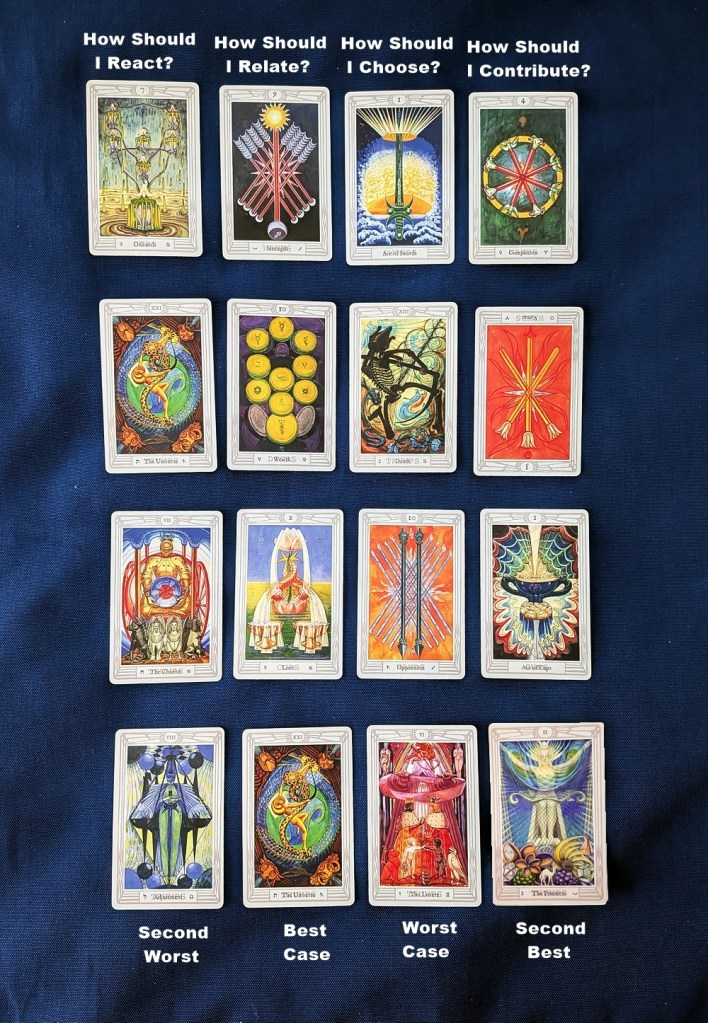
As mentioned, the “How Should I Relate?” query offered the most compelling series of cards, with “How Should I Contribute?” being almost as favorable. The 9 of Wands (“Strength”) advises remaining “calm, cool and collected” while avoiding overreaction. The 10 of Disks (“Wealth”) as an “advantage” has the connotation “Show me the money,” with an agreeable revelation forthcoming. It’s hard to peg the 2 of Cups (“Love”) as a “disadvantage” unless it means that the time is not right to pursue its promise; this is the only card in the column that is elementally hostile to the 9 of Wands. The Universe (9+10+2=21) delivers “all good things to those who wait,” the implication being that satisfactory completion will occur “late in the game.”
The “How Should I Contribute?” column suggests that my forthright participation in furthering the matter via the two Wands would be well-received (Ace of Cups), but the Priestess (4+[-3]+1=2) is inscrutable so the outcome is “up-in-the-air, pushing resolution out even further. The two Water cards at the bottom are elementally uncomfortable with the two Fire cards at the top (two are hot, two are not, and the cool-down is dramatic) implying the need for reconciliation of differences before progress can be made.
The “How Should I React?” column starts out scurrilous with the 7 of Cups (“Debauch”) and then tries to over-correct with idealistic enthusiasm in the Universe and the Chariot that is ultimately slapped down by Adjustment (aka “Judgement” as 7+21+7=35; 3+5=8). It seems that “no pronounced reaction” (or in a word, “deadpan”) as stipulated by the 9 of Wands is the best bet.
The “How Should I Choose?” column with the Ace of Swords and the Lovers (1+13+10=24; 2+4=6) is all about decision-making, but Death (which pronounces its own sentence in its own time) and the 10 of Wands (“Oppression”) mean that trying to force the issue is destined to be a “non-starter” that sends me back to the beginning, making this the “worst-case scenario.”
 Parsifal's Wheel Tarot & Astrology