AUTHOR’S NOTE: I created this simple design some time ago based on a segment lifted from the Lenormand Grand Tableau (GT) and decided to elaborate on its use. I took my original cue from the linear “narrative” approach to interpretation as opposed to the noun/qualifier “descriptive” style of reading, and grafted it onto the structure of the French Cross. (I’ve also used this spread for tarot predictions with a couple of minor adjustments.)
I’ve been scolded by the online Lenormand community for my apostasy in venturing beyond the traditional spreads that originated in the 18th Century, but that hasn’t stopped me from continuing my experimentation. The cards are a wonderful resource that will speak the truth no matter how they are configured, and my goal is to find the most efficient ways to capitalize on that fact. The Grand Tableau will always be my favorite Lenormand layout, followed by the nine-card square, but sometimes I just want a basic forecast without the usual in-depth analysis that is still self-sufficient in its completeness. The three-card and five-card lines have their uses, but they are a bit too one-dimensional for my purpose. Here I’ve adapted the central “cross” structure of the GT and introduced an underlying sixth card.
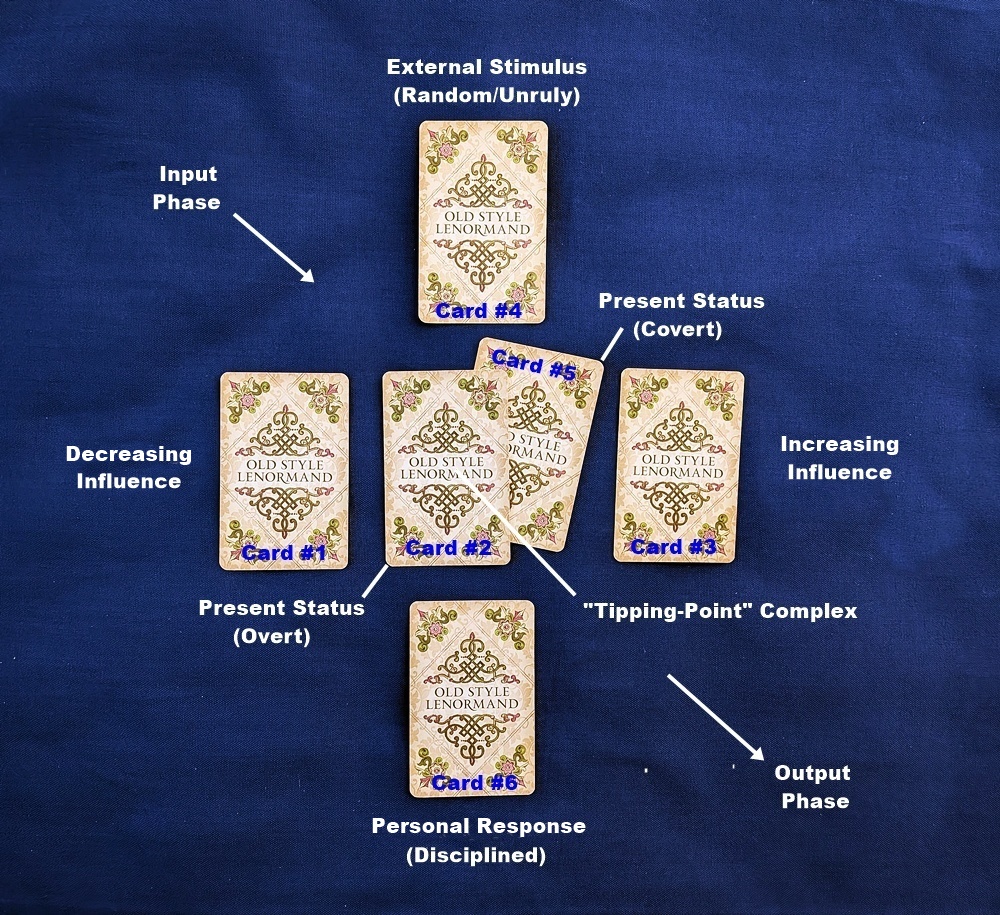
Following the approach of Andy Boroveshengra, I’ve established Card #1 as showing influences that are of decreasing importance to the situation, while Card #3 depicts those that are increasing in significance. Card #4 reflects external stimuli that are outside of the querent’s control and Card #6 identifies personal responses that are amenable to self-direction.
Card #2 and Card #5 form a binary complex describing present conditions from both an “overt” (obvious and intelligible) standpoint and a “covert” (obscure and instinctual) perspective. These cards occupy the “hinge”position of the spread on both the horizontal and vertical axes, representing a “tipping point” in the narrative that partakes of both emerging trends (left-to-right) and responses to stimuli (top-to-bottom).
The left half of the pattern comprises the “Input Phase” of the scenario that describes developmental factors and potential complications (a combination of Cards #1 and #4) leading up to the transitional intersection and the right half, carrying the blended weight of Cards #3 and #6, conveys the “Output Phase” that captures the impact of their merger in the form of likely consequences.
An unfortunate card in the fourth position could indicate something that is “hanging like a cloud” over the querent’s head, while a similar card in the sixth position could identify an inability to come to grips with the burden of that overarching difficulty. Such cards appearing in the first and third positions could degrade the motivational fervor of the horizontal “influence” chain.
The “hub” of the spread serves as the process-control center that brings conscious (Card #2) and subconscious (Card #5) emphases to bear on translating the inputs into outputs. These are the action cards of the layout that lend gravity and traction to its expression. If unfortunate cards appear in these core positions, there is a sense of being “in a bind” and the way to escape it is to seek inspiration from Cards #3 and #6, the closest this spread comes to “outcome” descriptors, assuming that they are not disadvantaged in the same way. If they are, compromises must be found.
Below is a brief example reading using the Heloise Lenormand. The hypothetical question involved how a pending situation is likely to play out.
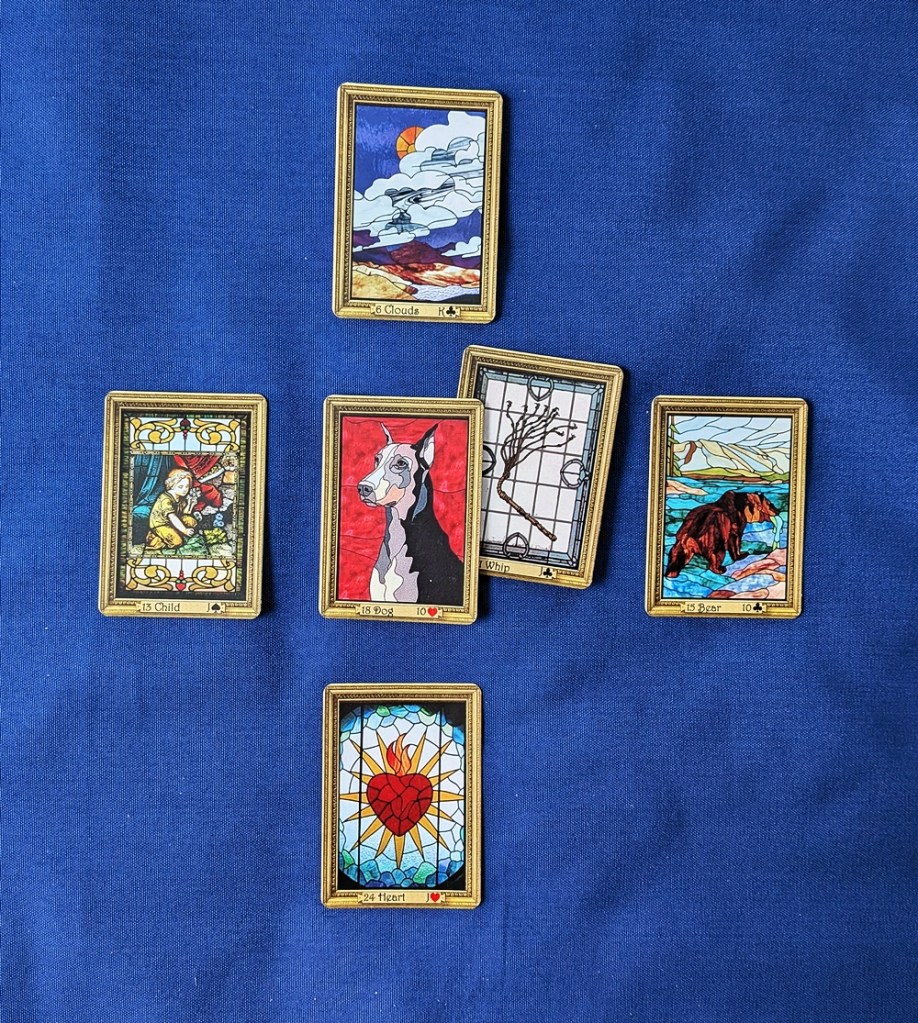
The Child in the “Decreasing Influence” position suggests an opportunity whose time has passed, although the urge has not been completely suppressed.
The Dog in the “Overt Present Status” position shows conscious reliance on a dependable friendship.
The Bear in the “Increasing Influence” position following the Dog signifies the cooperation of a supportive woman. It could also describe the initiative of the Child coming to fruition with the aid of the Dog despite previous setbacks. There is a distinct feeling of maturation to the sequence after the “corrective” of the Whip.
The Clouds in the “External Stimulus” position implies “trouble brewing.”
The Whip in the “Covert Current Status” position is a card of aggrieved unrest, suggesting unsettled conditions under the glum cover of the Clouds. This unpleasant sequence could directly impact the status of the Dog more than the outcome of the situation itself, making for rising discomfort.
The Heart in the “Personal Response” position conveys the idea of “taking heart” under the circumstances and trusting in the Dog/Bear pairing to overcome the negative consequences of the Clouds and the Whip. I’m also reminded of the Motley Crue song title “Kickstart My Heart” that was allegedly written by Nikki Sixx after an overdose incident that involved adrenaline injections directly into his ticker. But I don’t think such desperate measures are called for here even figuratively, the encouragement is just indicative of eventual contentment.
While the “Input Phase” (with Child+Clouds) casts doubt on the viability of the proposal, the “Output Phase” of Bear and Heart bodes well for long-term emotional empowerment once the unrest has blown over. They hint at “the calm after the storm.”
 Parsifal's Wheel Tarot & Astrology