AUTHOR’S NOTE: I’ve written about this subject before, but I’ve just been reading T. Susan Chang’s very precise description of it in her book, Tarot Correspondences: Ancient Secrets for Everyday Readers, that brought me back to my own assumptions.
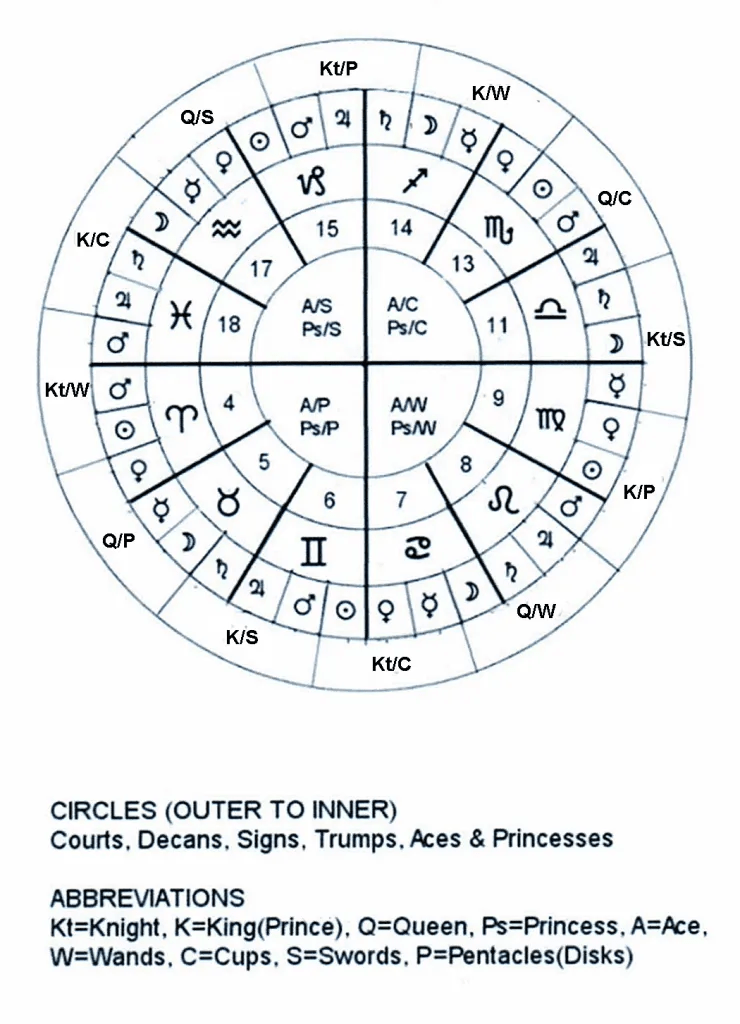
In the Golden Dawn’s Chaldean model of zodiacal associations for the tarot, all of the court cards except the Princesses (RWS Pages) are split between two signs, two-thirds of each card occupying the first twenty degrees of a sign and one-third slipping clockwise back into the last ten degrees of the previous sign. Chang likens it to a “seasonal segue” (my phrase, not hers) that merges different paradigms and emulates the way Earth’s climate behaves, either moderating or intensifying from month-to-month (or it did before we began obsessing over climate change and now observe every off-normal glitch with beady-eyed suspicion).
I previously parted ways with the Golden Dawn on the alignment of the court cards with the astrological modalities (aka quadruplicities) designated Cardinal, Fixed and Mutable (again excluding the Princesses, but more on that later). In astrology as I learned it, the Cardinal signs begin at the seasonal equinoxes and solstices (Spring, Summer, Autumn and Winter) and are considered “action-oriented;” the Fixed signs cover the middle month of each season and are described as “security-oriented” and the Mutable signs end each seasonal period, bearing the connotation “people-oriented” or chameleon-like in nature as befits their transitional state.
Consequently, I’ve never agreed with the patient, contemplative Queens being predominantly Cardinal, the restless, mobile Princes (RWS Knights) appearing as largely Fixed, and the stern, steadfast Knights (RWS Kings) displaying mostly Mutable qualities. The first adjustment I made was to move the Queens to the four Fixed positions that better suit their exemplary composure, followed by allocating the footloose Princes to the Mutable quadrature, which left the commanding presence of the Knights to the Cardinal modality of Mars-ruled Aries, Cancer (think “Chariot,” not “Mother”), Libra (the abode of stiff-necked Saturn in its exaltation), and Capricorn (with Saturn, the “Great Teacher,” as its ruler). To this astrologer’s sensibilities, these assignments are eminently preferable.
The Princesses are a special case because they sit at the center of the wheel alongside the Aces and coincide with entire three-sign quadrants. The Princess of Disks (RWS Pentacles) relates to the Spring season; the Princess of Wands to the Summer period; the Princess of Cups to the Autumn months and the Princess of Swords to the Winter span. However, it’s notable that in each case the element of the Princess aligns with that of the middle Fixed sign in its quadrant, and in my revised scheme these signs belong mainly to the Queens, making for a neat convergence of esoteric feminine principles as a secondary, slightly-skewed Fixed axis in opposite-but-complementary signs, offsetting the primary Cardinal/Mutable axis that is unequally bracketed by the Princes and Knights.
In Golden Dawn mythology, the young Prince dethrones the old monarch (Knight/King) and takes his place with the encouragement of the Queen, which is another vote in favor of the altered sequence although the elemental shifts in this redeployment add another layer of complexity to the anthropological (and Oedipal) basis for the evolution.
Here is the graphic I used in a previous essay:
 Parsifal's Wheel Tarot & Astrology