AUTHOR’S NOTE: I recently performed a Grand Tableau (GT) in which all of the negative cards were scattered far-and-wide throughout the population. Few of them appeared in close combination with either the topic cards or each other, making for what I told the sitter looked like a “roller-coaster ride” of ups-and-downs with only a couple of breathtaking ascents and scary descents among them. While I was trying to sort out their significance, my client (who has experience with Lenormand reading) said, “Well, they all have to show up somewhere.” Although not exactly positive, there was very little about the forecast that was worse than neutral.
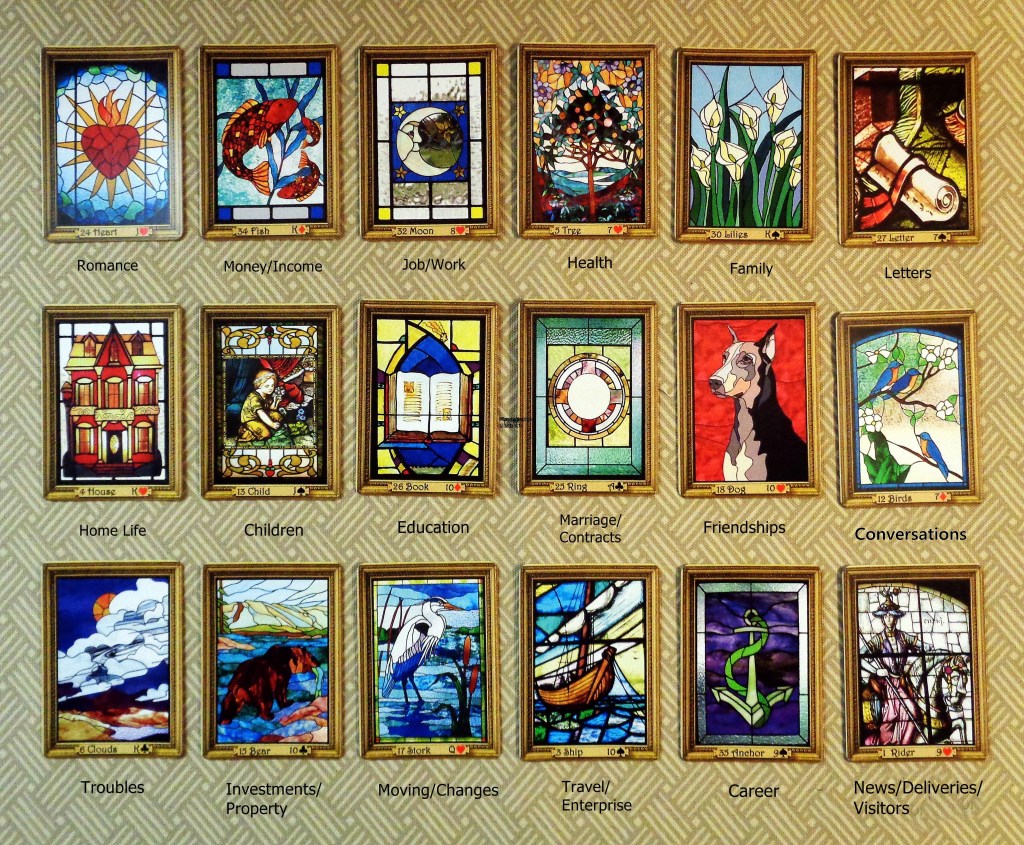
I thought about this for a couple of days, then decided to create an 8×4+4 tableau in which all of the non-topic cards, those I think of as “satellites” orbiting the major hubs in greater or lesser proximity, will always encounter meaningful interaction within the spread (the “normalizing” of the title). In my system of interpretation, there are 18 main topic cards plus the Gentleman and the Lady (of which only the Clouds is negative, while the Tree, the Birds and the Book are neutral-negative depending on their association with other cards). There are also 16 “satellite” cards (of which 7 – the Coffin, the Scythe, the Whip, the Fox, the Mountain, the Mice and the Cross – are negative while one – the Snake – is similarly neutral-negative). Below is a graphic showing the principle topic cards. (All images are from the Heloise Lenormand, copyright of Lynn Boyle.)
To set up the “prepared” tableau, separate the 16 “satellite” cards from the deck, shuffle them, and deal them from left-to-right and top-to-bottom in a 4-4-4-4 layout equivalent to the following pattern. This will ensure that they receive only incidental engagement with their peers, such as diagonal “near/far” chaining and sporadic intersection; none of them will be affected by knighting or mirroring, making their eventual connection to the topic cards of paramount importance. If you like, you can shift the “off-and-on” interval of the satellite cards to begin with the Clover position and not the Rider, which will alter the “house” emphasis for the topic cards. (When using the 9×4 GT design, some adjustment to the satellite-card arrangement may be necessary to balance the grid.)
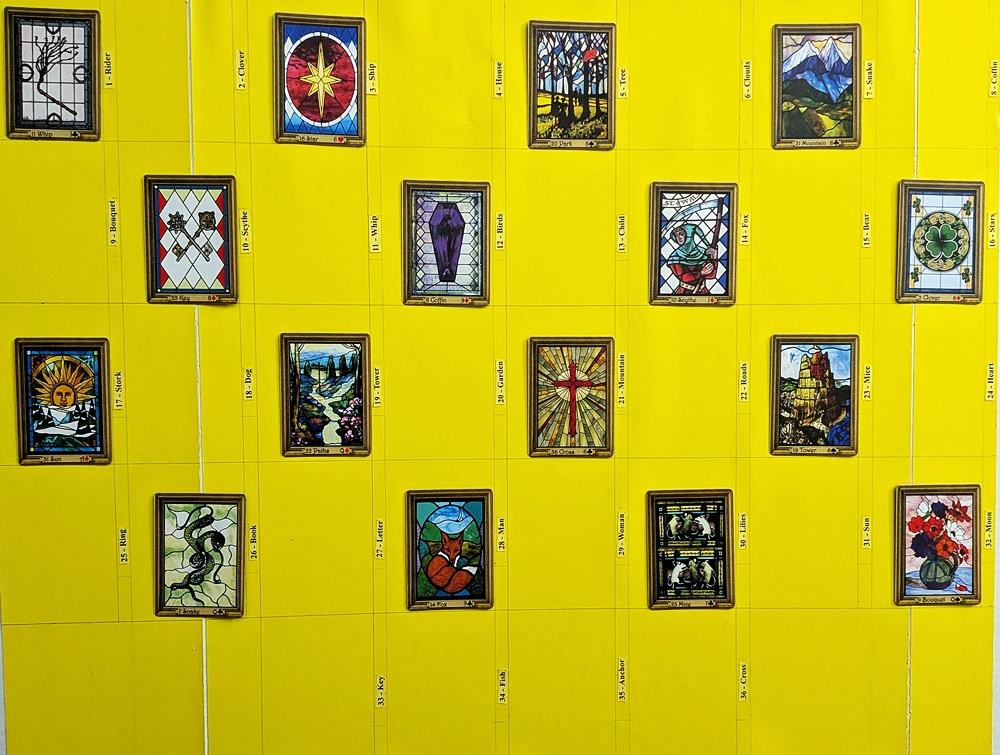
Shuffle the remaining 20 cards and deal them from left-to-right and top-to-bottom between the “satellite” cards and also into the four-card “destiny” row at the bottom. Read the array as you would any Grand Tableau by radiating outward from each topic hub using the “method of distance” and secondary considerations. Note that in this experimental model the first three cards – the “message for the querent” – will always be centered on a topic card attended by two modifying satellite cards, while the “four corners” will contain two topic cards and two satellite cards. The likelihood of receiving an encouraging “destiny” line is also increased, in which case it could be instructive to look at the condition of the occupants in the fixed “houses” for these four cards to obtain “the rest of the story.”

 Parsifal's Wheel Tarot & Astrology