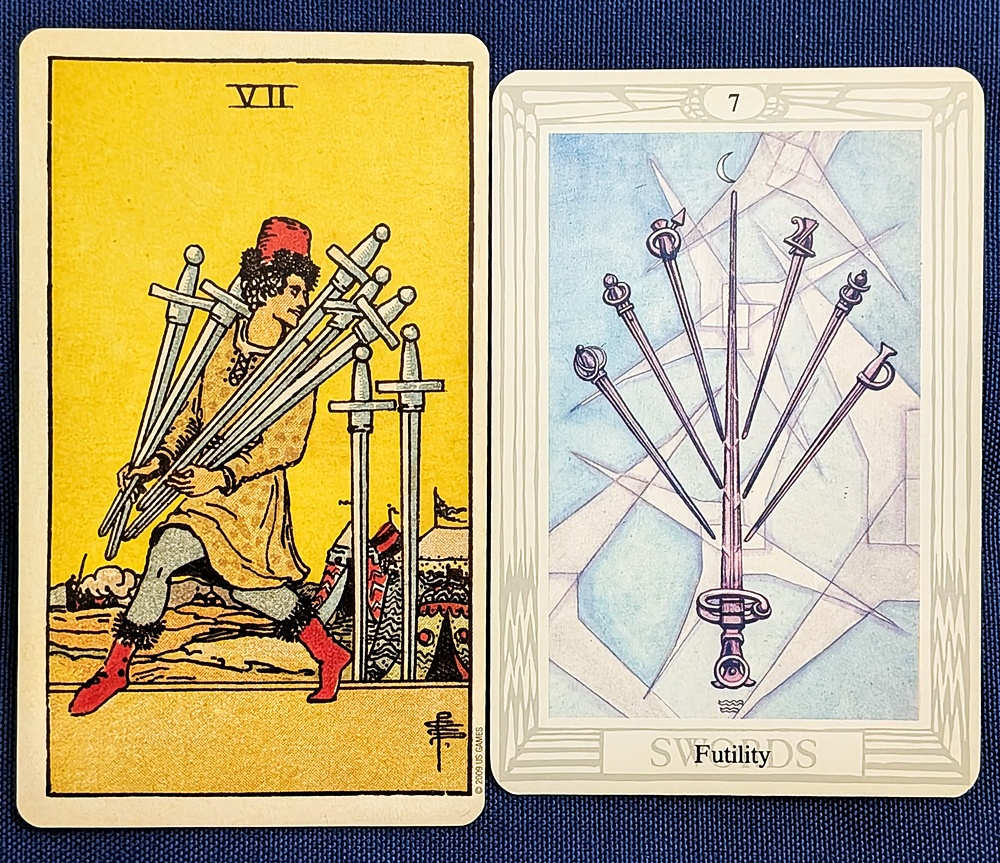
AUTHOR’S NOTE: Many tarot readers find malice or deception in the Waite-Smith 7 of Swords, but I see mainly avoidance. The notions of an underhanded plan and potential theft almost certainly stem from the man’s sly expression, his furtive body language and the fact that he has been “caught in the act” with an armful of stolen swords; he is obviously up to no good. But this is one of those cards that we tend to over-think; even Waite acknowledged that “the significations are widely at variance with each another” (meaning that no two of his sources agreed on their import).
The man in the image has dipped one foot in the future and, although tempted to advance, is now tip-toeing away from commitment, retreating toward known territory with one eye cast over his shoulder at the unrealized bounty he is abandoning. This is a card of insecurity about one’s decision to sidestep both opportunity and possible confrontation, in which the man’s posture conveys being of divided mind.
The Thoth version’s title of “Futility” and Crowley’s rationale for vacillation, enfeeblement and appeasement strongly confirm this emphasis on equivocation. An uneasy feeling of unfinished business permeates both cards that offers no straightforward path to resolution, and there is little encouragement to be found here unless it is the dubious relief of being able to dodge responsibility for one’s weak stance in the matter at hand.
Reversal of this card implies being “cut off at the knees” in the attempted escape, and perhaps being forced to move forward against one’s will while looking back ruefully toward safer ground. Maybe the man has made false promises and is now being compelled to “step up to the plate” and deliver on them.
Upright or reversed, the risk of self-sabotage is all too evident in the appearance of willful deflection before the consequences are clearly understood. It comes across as premature withdrawal in one case and halfhearted follow-through in the other.
 Parsifal's Wheel Tarot & Astrology
Very thoughtful
LikeLike