AUTHOR’S NOTE: I recently came across the concept of “weaving differences into harmony” that is a perfect expression of the tarot reader’s art. The relevant post disappeared from my Facebook feed immediately after I viewed it so I’m unable to cite the inspiration for this essay other than to recall that it was related to a celebrity chef’s way of combining grossly incongruous ingredients.
There is little that is more instructive (as well as professionally gratifying) in the realm of reading for others than successfully bringing incompatible cards together in a way that creates a logical synthesis of meaning. I may not be able to redeem their disparities completely but I can perhaps make them mesh a bit more cooperatively.
This demonstrates my assumption that every card will find its own level of alignment when mated with another card of dissimilar nature. Because they are all part of the grand scheme in its interlaced complexity (which is more apparent in the Tarot de Marseille than in decks with scenic “pip” cards), there is a natural affinity that will work itself out if given a chance. Seasoned readers simply take this in stride.
I decided to set up a challenge to demonstrate how this works. I laid out two columns of five random cards each and attempted to find the card to place between them that integrates and harmonizes their symbolic differences. This is something I do in a small way every time I contemplate the interrelationship of two cards in series within a spread; one hands off to the next in a way that must be blended into narrative coherence.
In some cases, I chose the intervening card that best expresses this theoretical mediation, while in others I simply picked the card that sits mid-way between the two from a numerical perspective, or that partakes of the numeration shared by the other cards. (This forced aggregation turned out to be harder than I expected.)
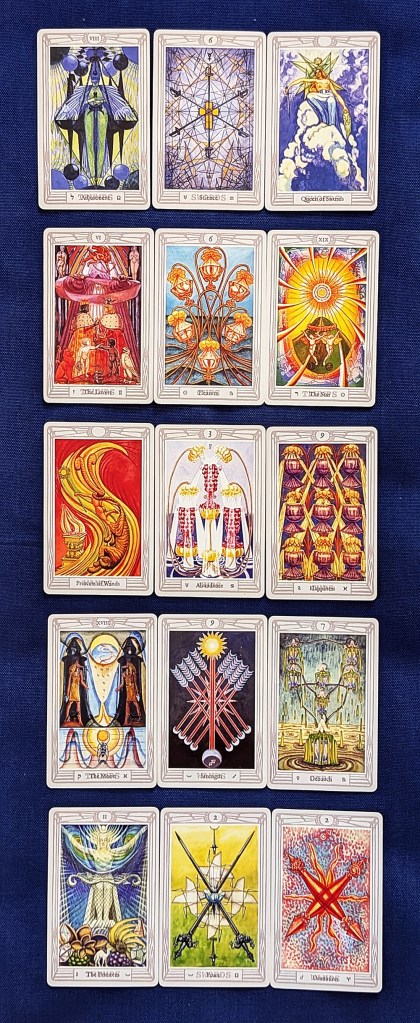
In the top row, the 6 of Swords (Science) is the perfect mediator between Adjustment and the Queen of Swords (two purveyors of Libran justice) since it weighs in with the testimony of intelligent Mercury in scientific Aquarius to augment the deliberations of the two judgmental doyennes, suggesting the need for forensic evidence in their joint adjudication.
In the second row, the 6 of Cups (Sun in Scorpio) reinforces the premise that the Lovers (archetypal Gemini) and the Sun (archetypal Sun) are both expressions of harmonious “six-ness” in different ways, adding another dose of solar energy as well as being consonant with the sensual purview of the Lovers.
In the third row, the 3 of Cups (Abundance) sits at the numerical midpoint between the Princess of Wands and the 9 of Cups (Happiness), thus representing the ancient Greek philosophers’ “First Perfection” while the 9 of Cups embodies the “Third Perfection.” This suggests that the youthful restiveness of the Princess of Wands can be tamed by an abundance of compassion that will yield happiness for everyone involved. (All she needs is a little love to straighten her out.)
In the fourth row, the 9 of Wands (Moon in Sagittarius) occupies the numerical midpoint between the Moon trump and the 7 of Cups (Venus in Scorpio), and it is a more upbeat lunar card that reins in the Moon’s perfidious temperament and purges the debasement of the 7 of Cups.
In the fifth row, the Priestess (archetypal Moon) and the 2 of Wands (Mars in Aries) are both emblematic of “two-ness,” while the “Peace” of the 2 of Swords (Moon in Libra) between them is an additional lunar antidote that offsets and mitigates the domineering influence of powerful Mars in its own sign while also echoing the placid composure of the Priestess.
This exercise can be performed for any two adjacent cards in a spread to explore their more rarefied interaction, in which the agency of a deduced third card conveys the degree of affinity or aversion between the two extremes at a subtle level. The middle card – which is to be arrived at logically as I’ve done here – represents the “act of knowing” that operates in the invisible dimension bounded by the pair of known concepts or circumstances as described by the outer cards. Its energy cycles endlessly between the two poles, filling the interval and bringing reciprocal, compensatory or contradictory emphasis to bear on their shared potential; this third factor serves to further define the quality of their relationship.
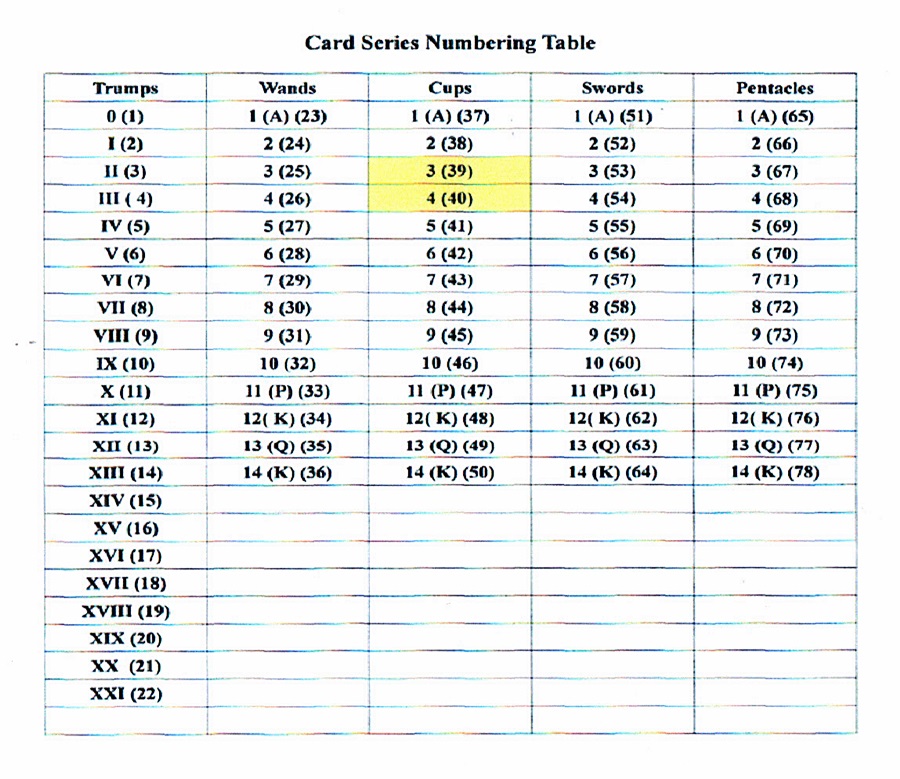
Below is a table that can help with location of the midpoint when using that method. Mutual affinity or aversion can be assessed according to Elemental Dignity or numerical sympathy and antipathy (for example, “active” odd versus “passive” even). In the examples above, the cooperation between the Water of the Moon and the 7 of Cups is compromised by the interstitial Fire of the 9 of Wands, while the Priestess, the 2 of Wands and the 2 of Swords are all expressions of the binary root number, Two.
 Parsifal's Wheel Tarot & Astrology