AUTHOR’S NOTE: I’ve written about the tarot Fives a number of times from an esoteric perspective, and also from a pragmatic point-of-view as indicating the need to “break eggs (the stagnant Fours) to make omelettes (the harmonious Sixes).” I’ve often called them “can-openers” and “nutcrackers.” Their disruptive nature comes from their association with the sphere of Mars on the Qabalistic Tree of Life, although some mundane definitions simply mention necessary “change” following the inertia of the Fours.
It will be instructive to perform a visual and verbal comparison of the Fives from the three major decks in use today: the Thoth, the Waite-Smith and the Tarot de Marseille:
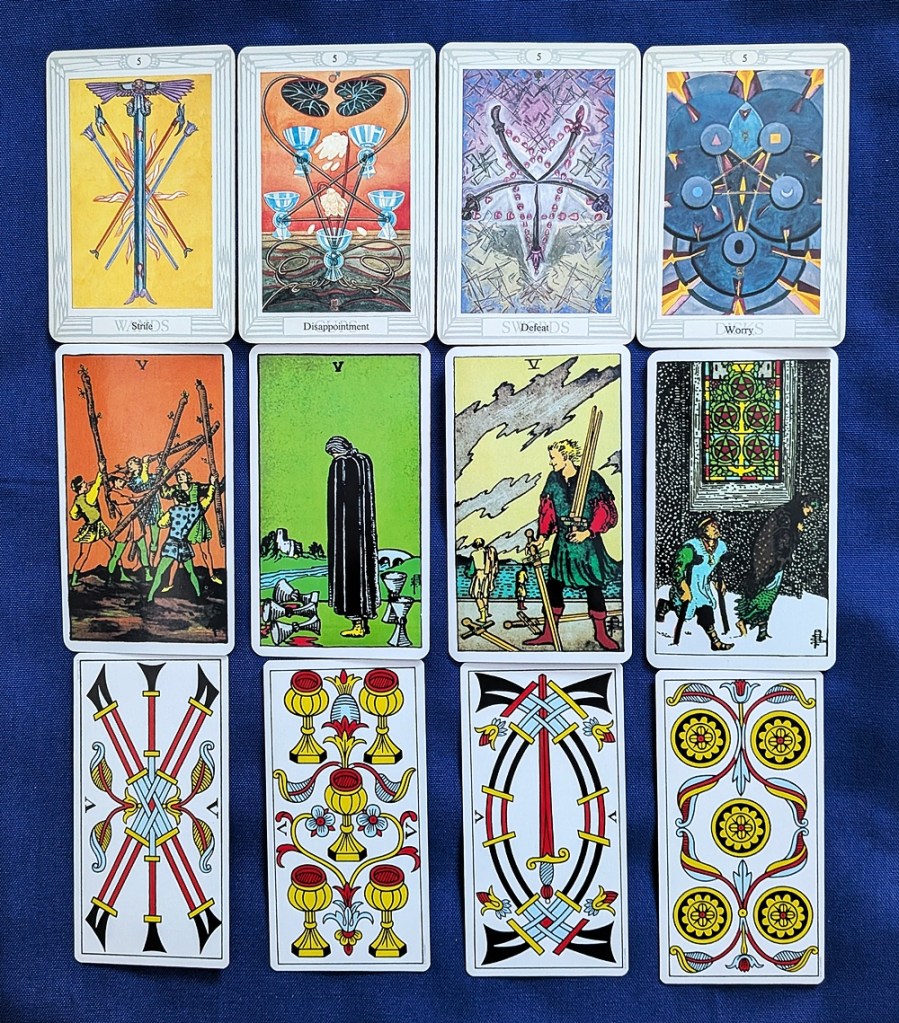
Regardless of what you may think of the practice, the Thoth cards have the advantage of on-board titles that steer the reader toward their creators’ intent. The RWS cards “say it in pictures,” while with the TdM we must coax it out of the graphic designs. All of the TdM cards convey the idea of “One-among-Many,” whether in shielding and protecting the isolated singletons (Cups and Coins) or interdicting their aggressive behavior (Batons and Swords).
Aleister Crowley was fond of inverted pentagrams to convey mayhem, so only the 5 of Wands is comparable to the TdM version* while the RWS card accurately prefigures Crowley’s title of “Strife.” But somewhere in his writing, Crowley stated that he saw “strife” not as the antagonism displayed in the RWS card, but more as striving toward a goal. Some writers interpret the scene in the RWS card as showing a “sham battle” or lighthearted “play-acting,” but I see nothing in the tarot as a whole to justify this assumed triviality. In the TdM card, the vertical stave is girded by the four diagonals, thus being both propped up and constrained. The definition of this card in my TdM book is “The Five conveys the misfortune of poorly coordinated, uninspired or ill-timed action that is likely to incite stiff opposition.”
Both the Thoth 5 of Cups (“Disappointment”) and the RWS version clearly indicate dejection, while the central chalice in the TdM card looks like it is being sheltered and nurtured by the surrounding “arabesques” (the coddling blossoms arising from the base hint at “licking one’s wounds” while the chalice puts forth the fruit of its cultivation). But from a less encouraging angle, I had this to say about the card in my book: “The Five seems pinched and duty-bound; we might say that “duty is the death of love.”
The Thoth 5 of Swords (“Defeat”) minces no words in its nomenclature, and the image exudes fractured disarray. The RWS card, on the other hand, is ambivalent in depicting the aftermath of a “beat-down:” Who is the victor and who the vanquished? The Golden Dawn’s title was “Lord of Defeat” but it certainly looks like Smith’s central figure is gloating over his fleeing adversaries and savoring his conquest. It takes rigorous mental gyrations to equate the scene to its Golden Dawn roots, which I’ve tried to do in past essays. My published description for the TdM version is “The Five sows argument and discord.” The vertical blade aspires to bend the four peripheral swords to its will but they appear to be more than a match for it.
The pictorial presentation in the Thoth 5 of Disks, with its title of “Worry,” implies that someone smashed a bunch of crockery to smithereens and is now brooding over the inevitable punishment. The RWS card conveys despair in the form of utter destitution with no relief in sight. The central emblem in the TdM 5 of Coins looks like an egg being incubated under the watchful eye of four sentinels. However, my formal description is much less salutary: “The Five conveys poor judgment and wasted effort with little to show for it; in the worst case it could mean dishonesty, such as “cooking the books;” alternatively, breaking out of the financial doldrums without regard for consequences could be indicated (i.e. impulsively quitting a job).” The four leaves look like they’re about to unfurl to create an exit.
At least for me, this comparison points out the inherent commonality between all three decks as well as their distinctive anomalies that don’t entirely diverge from the main theme. I’m thinking about doing it for the rest of the “pip” cards.
*Crowley’s stated objective when setting out to create the Thoth deck was “to execute a pack after the tradition of the Medieval Editors,” and I did a comparative analysis of the Thoth and TdM pip cards a few years ago that showed his relative success in all but the suit of Swords and those instances where he inserted his occult symbolism: inverted pentagrams, geomantic figures, Egyptian iconography, Tree of Life diagrams, etc,
 Parsifal's Wheel Tarot & Astrology