AUTHORS NOTE: Not every journey goes smoothly. Mid-course corrections are often necessary to continue making progress toward the destination after running into roadblocks. Some – like potholes in the road – can be “toughed out” and overridden, while other require a more roundabout approach. Here is a spread that follows a developmental arc from beginning (at the bottom) to end (at the top) that either stays on the “straight-and-narrow” or is forced to deviate in order to subdue challenges on the right or to sidestep them on the left.
Departures from the steady-state advancement shown by the middle column are indicated by the “facing” of the human figures or other “pointers” on the cards. When they are left-facing, the action will resume with the next card above in the left-hand column, while if facing right, the next ascending card in the right-hand column will be activated. If they are facing straight out of or into the scene, or if there are no directional indicators on the card, the upward path will stay on its present course. The flow of events and circumstances will also move straight up if a card is adjacent to the outside edge of the layout with no card in the “facing” direction. (Reversal will reorient the focus accordingly.)
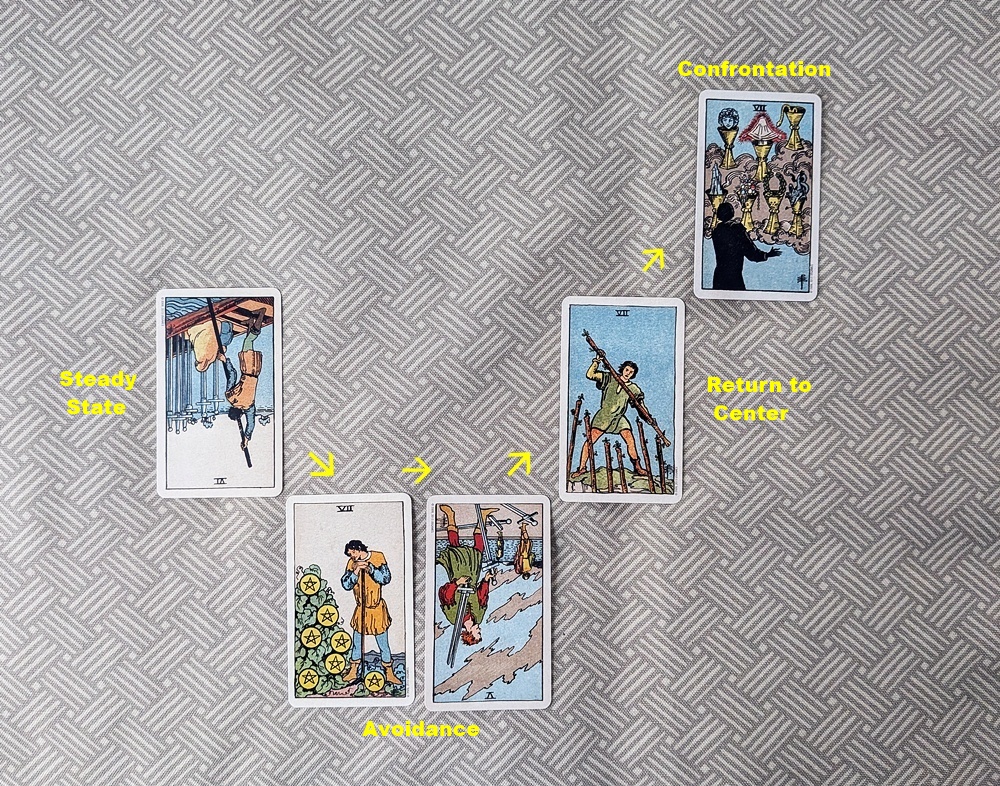
The five-card narrative should be read as either an uneventful straight line from bottom to top or as a serpentine trajectory that swings between bold confrontation, return to center, and prudent avoidance.
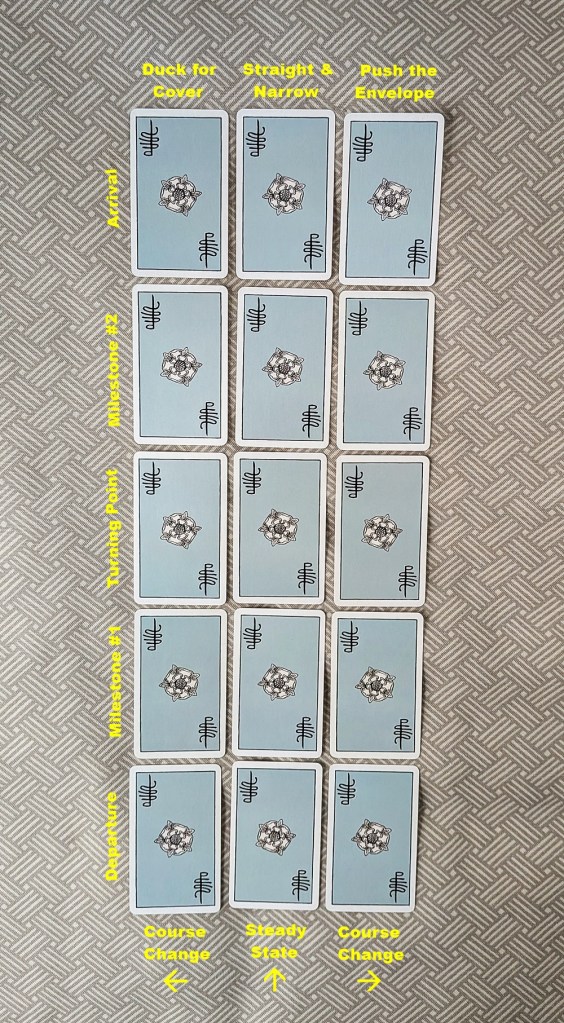
Shuffle the deck and deal 15 cards face-down in any order as shown above.
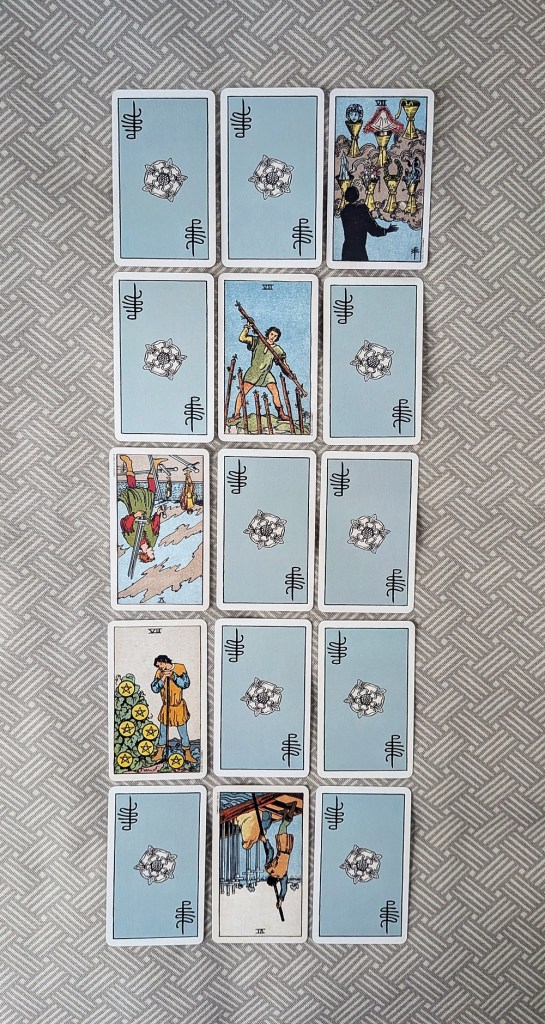
Turn the bottom-center card face-up and examine it for any directional features. If one is found, follow its gaze or telltale sign to the next card above in the left or right column as indicated. If there are no “pointers,” move straight up the middle column for the next card. Continue turning over cards and switching back and forth or ascending straight up until the top row is reached.
For ease of interpretation, remove the five selected cards from the spread and place them from left-to-right in the three-tiered array shown in the bottom image.
Here is an example spread that looks at how a particular situation is likely to unfold. After its inception with the reversed 6 of Swords looking for an escape route, the matter moves into “avoidance” mode (7 of Pentacles and 5 of Swords reversed) where the situation is less-than-satisfactory, then re-centers itself (7 of Wands) to retaliate and ends in a state of confused confrontation (7 of Cups). The two reversed Air cards bracketing the hostile Earth card suggest a mental quandary that exacerbates the frustration of “unfulfilled success” and provokes a strong reaction that ultimately fizzles.
 Parsifal's Wheel Tarot & Astrology