AUTHOR’S NOTE:This spread examines the conceptual divide between our private self-image and the public self-projection that signifies – in tarot author Joe Monteleone’s memorable phrase – “how we happen to the world.” The degree of separation or integration is determined by comparison of two parallel columns of trump and pip cards.
In one model of esoteric thought, the first ten trump cards – Zero (the Fool) through Nine (the Hermit) – define our subjective self-development, while the last twelve – Ten (the Wheel of Fortune) through Twenty-one (the World or Universe) – reveal the nature of our interaction with objective reality, a process of maturation that often involves exercising expedience and accepting compromise.
The pip cards can be brought into this paradigm to identify the “real-time” strategies, tactics and trajectories that are both preferred and prudent in making the archetypal transition. Special attention should be paid to any pips that repeat the number of the associated trump card since it will show factors that are closely aligned between them, making successful realization of the trump’s agenda more likely. Note that in order to relate the pips to the trumps numbered 10 or greater, it will be necessary to perform “Theosophical reduction” on the trump to arrive at a single digit for comparison (e.g. “X” or 10 equals 1+0 or “1,” while “XVIIII” or 19 equals 1+9, which reduces to 10 and collapses further into “1” as before, in both instances specifying an Ace.)
Finally, a “numerical essence” can be calculated from the face-values of the pip cards to derive a third trump card that I’m calling the “fulcrum of transition” to depict how the leap from one state to the next can be facilitated, deferred or resisted outright.
Begin by separating the trump cards of a tarot deck into two sub-packs as explained above. Shuffle the “0-IX” group and deal one card into the “Internal Development” column. Repeat this with the “X-XXI” population for the “External Projection” column.
Remove the pip cards from the deck, shuffle them and deal three cards from top-to-bottom below the “Internal Development” trump. The second pull of three cards can be performed immediately for the “External Projection” column, or the remaining pips can be re-shuffled before proceeding. (In the example reading I did the latter.)
Total up the face values of the six pips; reduce as needed to a number less than 22; determine which trump card the final number represents; and place it at the bottom of the layout. (It may be necessary to take this card from a second deck if it has already been pulled for the reading.) Since this method can never arrive at zero (the Fool), it may be better to use “casting out nines” (subtracting increments of nine), in which case you can get all the way down to the Fool if you so desire. (You’re frequently offered two different trumps with this technique and can choose the one that best fits the overall narrative.)
The image below illustrates the result of following these steps. Let’s assume that the hypothetical querent is a male who faces an emerging situation in which his reputation might be compromised by a radical shift in public perception if he decides to proceed. He can either stay true to his convictions and confront the criticism head-on or bow to the demands of external pressure and back away from involvement. The narrative will attempt to determine which is the most auspicious path to take, and the querent can be advised accordingly.
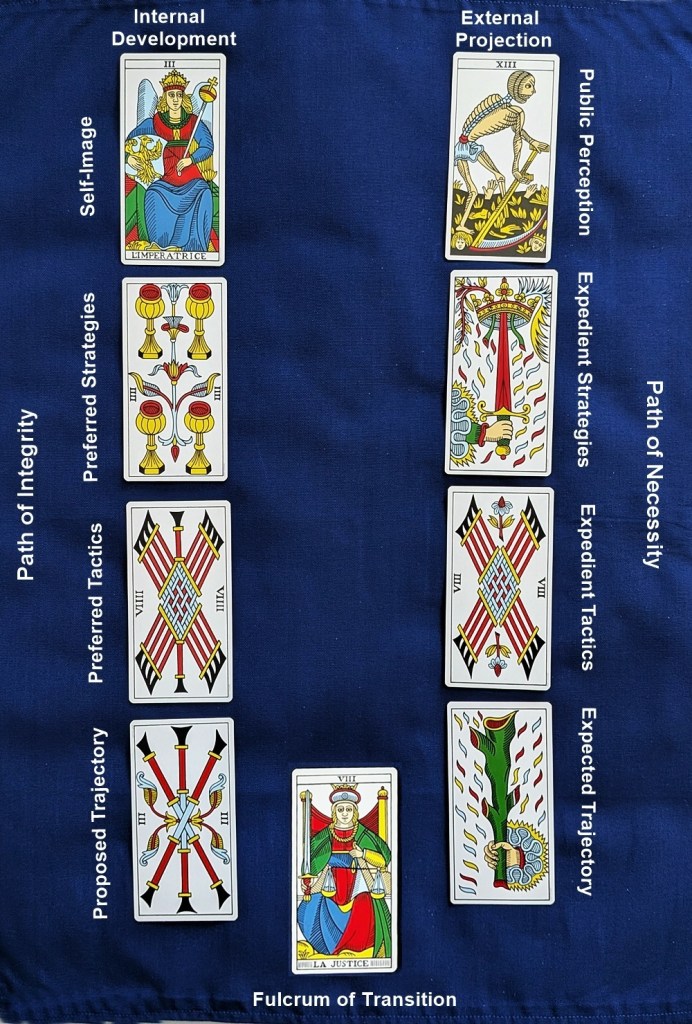
With the Empress, this individual has established a self-identity that is composed and comfortable in its own skin. But as he begins to engage with external conditions he may be perceived as a “bad actor” when trying to affect the transformation stipulated by Death.
In the realm of high-level (and high-minded) “strategies,” with the 4 of Cups he would prefer to remain even-tempered and poised in his approach to the outer world. However, the Ace of Swords urges taking a decisive stance against any tendency toward timidity. He will most likely be goaded into defending his position.
When it comes to pragmatic “tactics,” there isn’t much to choose from between the 9 of Batons and the 8 of Batons except to note that the Nine may be a bit more comprehensive in its action while the Eight is marginally more expeditious. Either one will fall within the same tactical purview, that of ambitious striving.
Regarding the opposing trajectories, the 3 of Batons echoes the confidence of the Empress (another “3”) but with less complacency and a more enthusiastic aspiration driving it. The advice for the querent is to remain firm but flexible in his resolve while not sitting on his hands. If nothing else changes in the querent’s plans, the Ace of Batons as the projected result of pursuing this path implies coming across as a brash upstart who may “burn some bridges behind him.” Death would not disown him for doing so.
Justice (4+9+3+1+8+1=26; 2+6=8) as the “Fulcrum of Transition” favors the intent of the Empress to stay calm, cool and collected and not forego equanimity by charging headlong into drastic change. In this case, a judicious patience is not only a virtue, it enables a wise detachment from the implacable exhortations of Death, which can’t be walked back once turned loose. (Although the outcome was entirely random, Justice happens to sit at the numerical midpoint between the Empress and Death, providing reinforcement for the observation.)
The counsel I would give the querent in this matter would be to avoid overreacting if the situation seems about to propel him into doing something he might regret. The “Path of Integrity” is clearly more stable and unforced than the “Path of Necessity” with its “pushy” Aces, and there is no reason to be hasty in leaving it. Death will come calling in its own time.
 Parsifal's Wheel Tarot & Astrology