AUTHOR’S NOTE: Here is a three-deck comparison of the Threes similar to the one I recently posted for the Fives.
When applying esoteric number theory to the forty Minor Arcana of the tarot, the number One represents the Point and the four Aces that describe the “prelude” to the action signified by their suit but not the initial act itself. Momentum and direction enter the picture with the four Twos and the Line that joins two non-adjacent points, exhibiting length but no width or depth. Adding a third point at a distance from the Line but around the same axis creates a triangular, two-dimensional Plane that introduces surface area but still no depth. By adding a fourth point above or below this surface and connecting it to the other points, a three-dimensional polyhedron is produced that foreshadows the number Four, the Cube and the concrete “world of form.”
But there is another metaphysical paradigm that can be brought to bear on the number Three. If we assume that the Plane is an equilateral triangle, we can put the three points into circular rotation around the center to generate a perfect circle, then project it vertically above and below the plane to make the Three a self-contained and self-sufficient “sphere of influence” that, as long as it remains in constant motion like a spinning top or gyroscope, will delay succumbing to the stagnation of the Four. We might also think of it as “triangulating the circle” as distinct from “squaring” it, which has a counterpart in the fortunate trine aspect of astrology.
When considered in terms of energy, the tarot Threes are still moving but follow a more oblique trajectory than the direct thrust of the Twos, so more attention must be paid to tangential factors such as “third parties.” I like to think of the Threes as being dynamic rather than settled in their focus since they represent growth, expansion and opportunity; if we keep advancing outward from the nucleus without stumbling we will expand the field of experience they portray. This is true even for the 3 of Swords, the most resistant to a positive interpretation.
Here I will examine each of the Threes across the Thoth, Waite-Smith and Tarot de Marseille decks using Aleister Crowley’s “whirling emblem” metaphor for all of the suits to define rotation in the form of centrifugal (outward) and centripetal (inward) orientation.
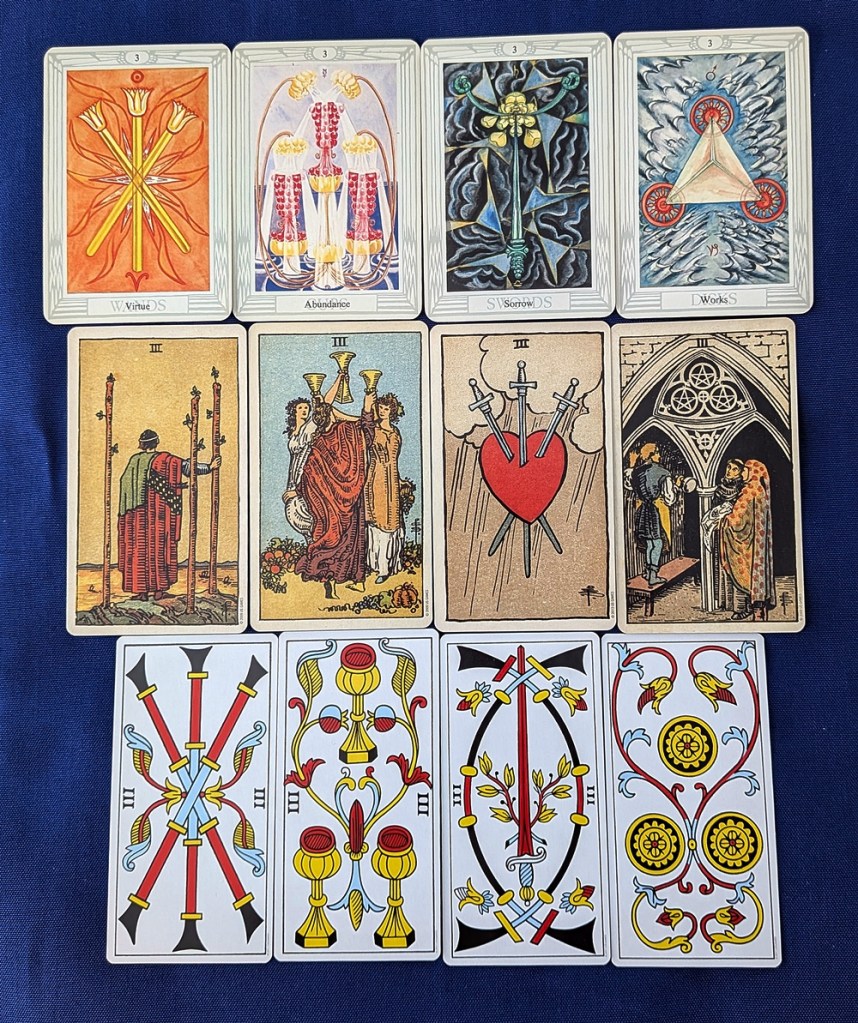
In the fiery Threes, the rotational emphasis encourages leveraging one’s ambitions in an “inside-out” fashion. Growth, expansion and opportunity here have to do with entrepreneurial pursuits, or at least the aims and aspirations of vested self-interest.
In the watery Threes, the circulating flow suggests emotional immersion, with the expansive urge being toward self-expression and self-appreciation as an outgrowth of sympathetically shared values (the old “I’m OK, you’re OK” aphorism).
In the airy Threes the circuitous impulse is gathered up and encapsulated in the central features: dissected rose, pierced heart, wreathed aureole. Growth, expansion and opportunity are driven by intellectual curiosity and a willingness to “take things apart to see what makes them tick.” However, there is no possibility of advancement unless they are put back together correctly.
In the earthy Threes the arrangement of “whirling” suit emblems is momentarily transfixed in a triangular pattern. When reactivated, the induced momentum of the three sigils imparts the centrifugal force that creates an ever-expanding field of mundane opportunity and “material growth writ large.”
If I were to choose a single word to characterize the nature of the Threes, it would be “anticipation.” Particularly in the centripetal suit of Swords, I’m reminded of one of my favorite metaphors for reductive tarot analysis: a buzzard warily circling a dying animal, waiting patiently to swoop in for the feast.
Card-by-Card Analysis:
The Thoth 3 of Wands is a virtual copy of the Tarot de Marseille version (which was Crowley’s original intent), but the hint of rotation is more pronounced in the top-to-bottom disparity between the lotus-blossom heads and the unadorned handles. The fitful flames also convey motion but it is more irregular and multi-directional. This subtle mobility could be interpreted as “The best defense is a good offense” as well as “It’s hard to hit a moving target.” The title of “Virtue” could also be seen as “staying above the fray and not getting one’s hands dirty.” It brings to mind the witless command of the mayor to his underlings in the old TV series Carter Country to just “Handle it, handle it.”
The rotational emphasis in the RWS card occurs between the four ships and the expectant posture of the merchant who is watching them leave. The variable height of the three staves also contributes to the impression of clockwise gyration. Further action is deferred until the man’s “ships come in,” so I see it as a card of stoic forbearance or even resignation.
In the TdM deck, I draw a distinction between the outward surge of the Batons and the inward preoccupation of the Swords. The three staves in the image are “busting out in all directions,” with the four “arabesques” providing some minor restraint on the centrifugal trajectory that reins in and coordinates this eruption of enthusiasm. In this card the central hub is more significant than the extremities, reminding me of the point-of-contact for a baton-twirling majorette.
The Thoth 3 of Cups is all eddying light that penetrates and invigorates the pool at the bottom. Prismatic refraction reunites in “white-light” bliss. The cascading fountains remind me of the searchlights in the old 20th Century Fox opening credits. This implies trying to find one’s emotional center.
The RWS card captures this idea in the three raised chalices and the clockwise facing of the three women, who seem like they are about to start dancing in celebration. The idea here is that emotional fulfillment is never static, it benefits greatly from engagement with kindred spirits.
Although less energetic, the TdM version conveys a bottom-to-top migration and coalescence of force similar to but opposite that of the Thoth 3 of Wands, an emphasis that is reinforced by the flowing arabesques.
Although the movement in the Thoth 3 of Swords is erratic, the eight geometric shapes surrounding the array of swords impart a rotational bias that loosely resembles a lemniscate tying together the fragmented rose petals and the grip of the main sword. This suggests a way to countenance the mental disarray shown by the overall image.
The RWS card reminds me of undergoing a biopsy on an internal organ. There is a surgical precision to the intrusion of the three blades that disrupts the regularity of the cyclical heart-beat. This has always signified “no pain. no gain” to me, and it is more mental than emotional or physical.
The TdM 3 of Swords epitomizes what I think of as the “centripetal” or inward-drawing intent of the peripheral swords when they are envisioned as being thrust into motion. Even more than the RWS version, this card symbolizes “striking right to the heart of the matter,” but in a more rational and less reactionary way. I liken the vertical swords in the TdM deck to “lightning rods” or conduits of cosmic inspiration, although in the 3 of Swords its insights are not so much mystical as logical, drawn directly from the encircling aureole of actionable ideas.
The suit emblems on the Thoth 3 of Disks sit in the middle of an energy field that reminds me of what happens when you place a magnet in the middle of a scatter of iron filings. Curved arcs of ferrous particles form around the opposite ends and between the poles that reveal the concentric forces extending beyond the physical envelope of the magnet itself. In mundane terms, it suggests economist Adam Smith’s “invisible hand” that moves markets. One of the early definitions of “work” (the title of this card) was “the exertion of strength, gravitation, impulse, or pressure, as to produce motion,” and in tarot terms it represents the directed force of Mars in the utilitarian realm of Capricorn; Aleister Crowley described it as “the constructive energy of the builder or engineer.”
The RWS card repeats the tripartite array of suit emblems (all three versions have the apex emblem pointing upward from the base, suggesting aspiration, but the overall feeling is of “unity in diversity”). The arrangement and facing of its three figures are loosely depicting clockwise (aka “dexter”) rotation, which was traditionally viewed as fortunate since it followed the primary movement of the Sun. The scene repeats the “constructive” motif of the Thoth card, with a craftsman carving wall art under the guidance of a cleric and what appears to be an architect. I call this the “plan the work and work the plan” card.
Due to the rectangular dimensions of the TdM card, the triangle of suit emblems does not appear to be equilateral but instead emphasizes the rising trajectory of the topmost sigil. The pattern of arabesques seems to be opening at the top to let the captive “seed” energy germinate and morph into full flower. To me, this is the least constrained and most encouragingly natural of the Earth-based Threes because it isn’t harnessed to an engine of productivity. It suggests the old Paul Masson wine slogan “No wine before its time,” meaning that gradual nurturing brings perfection.
 Parsifal's Wheel Tarot & Astrology