AUTHOR’S NOTE: I recently learned about the “Answer Spread” developed by Kapherus (J. David Arcuri) from Regina Russell’s earlier design, so I went to his Art of Cartomancy FB page to check it out.
I’m a relentless spread creator with over 300 original patterns to my credit and more awaiting my attention. I knew before I saw it that I would probably want to make some tweaks to the Kapherus/Russell layout to align it with my personal preferences.
I found that the two-card columns of the model are a bit too open-ended for my taste since two cards in combination present the conundrum of which one should take precedence in a reading, and there is no mention of a sequential order of interpretation in the supporting text (although I assume top-down).
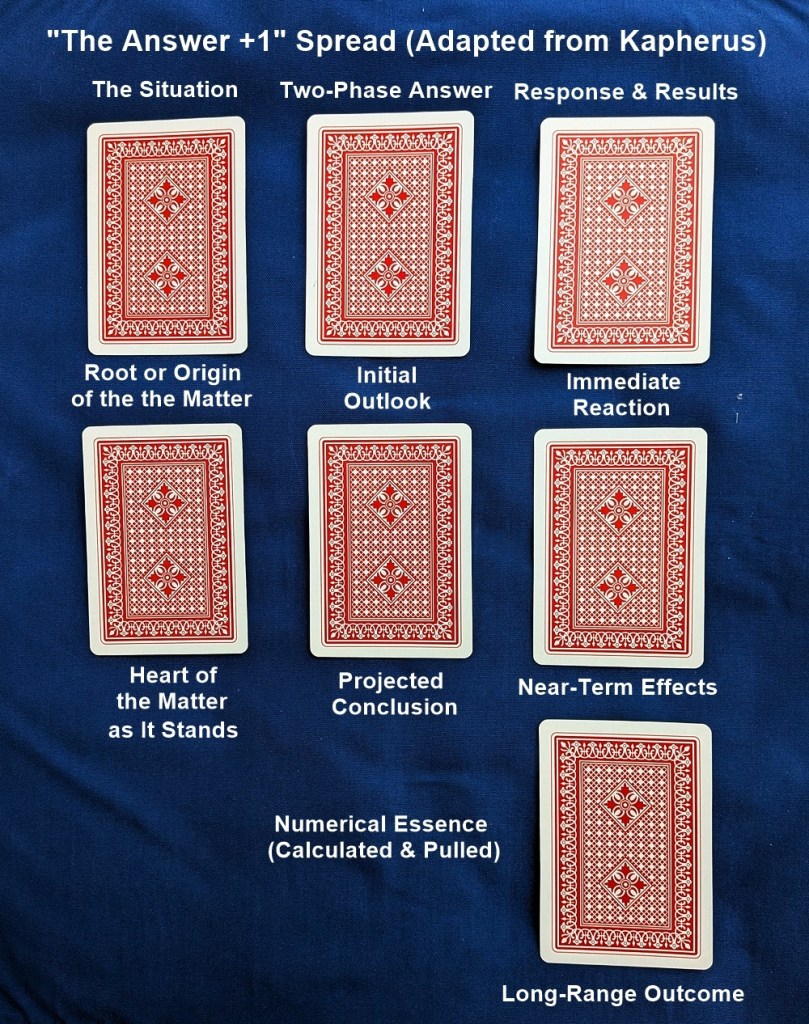
I decided to retain the 3×2 structure and the nominal focus of the three columns, but I gave each card a specific positional meaning that broke the columns into two phases to be read from top-to-bottom. The position definitions should be self-explanatory, and I arranged the flow so the upper card feeds into the lower one both in timing and logical progression. Together, these adaptations add some formality to the reading. (Although it isn’t intended by Kapherus, this architecture also supports reading from left-to-right.)
Then, rather than treating the bottom-right card of the six-card array as the final result, I postulated a seventh card to be calculated from the face values of the other six as a “numerical essence” or big-picture roll-up showing the long-range consequences of the near-term forecast.
To bring this number within the ten-card span of the “pips,” I propose to reduce the total to within a value of 1-to-10 using Theosophical reduction. (Note that if the cards sum or reduce to “10,” the aggregate can be left that way for a ten-spot or reduced further to “1” for an Ace; the card that fits the narrative best should be used or both can be included as complements of the “alpha-and-omega” kind.) Obviously, if the calculation yielded 11 through 13 the indicated face card can be applied with no additional manipulation.
Finally, to assign a suit to the product of this calculation, I plan to remove the four cards of that number or rank from the deck (or from a second deck if necessary), shuffle them, and pull one randomly to populate the “Long-Range Outcome” position.
This spread should be usable with any deck.
 Parsifal's Wheel Tarot & Astrology