AUTHOR’S NOTE: Not long ago I started following an online conversation about Israel Regardie’s development of the material for his first volume of Golden Dawn knowledge (dubbed “the brick,” I assume for its impressive girth and density). I had just begun re-reading Regardie’s Eye in the Triangle when this exchange grabbed my attention.
During his literary excursion Regardie allegedly relied in part on the manuscript collection of one Carr Collins, to whom he alluded in correspondence as “a friend from Texas” and “a rather wealthy man,” although judging from Collins’ biography any interest in antique metaphysical mss was most likely pecuniary and not scholarly. But one participant in the discussion mentioned that “Carr Collins dedicated his life to helping others toward the light.” This was refreshing to hear since the sub-rosa community of the era that fathered the Golden Dawn seems to have been a hotbed of self-important posturing and in-fighting among warring factions (or maybe that prickly attitude among the mystical elite was uniquely – and pervasively – “British” at the time).
When I contemplate the imposing intellects and outsized personalities of those who were involved in the early days of the Occult Revival in England (notably Mathers, Crowley, Waite, Yeats and sundry lesser cultural lights of the period, joined in later years by Dion Fortune, Franz Bardon, William Gray, Paul Foster Case, Gareth Knight and Regardie himself, to name a few), I realize just how small a part most modern pretenders to their eminence have played in the Western Mystery Tradition of the 20th Century and beyond. (That said, contemporaries like Robert Wang, Donald Tyson, Lon Milo DuQuette, the Thelemite Jim Eshelman, Paul Hughes-Barlow, Pat Zalewski, Nick Farrell, Regardie associates Christopher Hyatt and the Ciceros, and a number of others deserve a nod of appreciation for their more recent contributions to Qabalistic lore.) I’ve been a student of the esoteric arts since 1972 and, while I’m well-versed in the precepts, I often find the practice painfully overwrought.
Fast-forward a few years and I was in hot pursuit of the mysteries of ceremonial magic and its goal of evoking angelic and demonic figures to do the magician’s bidding, but I’ve never been one to become easily “inflamed” by the grandiose rhetoric (an apparent prerequisite for illumination thereby) and the elaborate rigamarole of magical ritual (most of which is entirely too sacramental in tone for this irreverent skeptic), and I have since acknowledged that a knack for divination (and proclamation of its virtues) is enough of a sacred calling for me. I’m not a purveyor of spiritual guidance except by unassuming example when it comes to “helping others toward the Light” since I’m devoutly non-religious and, as a Spinozan sympathizer, not much of a “starry-eyed mystic” to boot.
In my own eccentric view, deity in the philosophy of Baruch Spinoza is an immanent (i.e. indwelling) “download” of Cosmic Consciousness (a necessary diminution of its “high-proof” celestial magnitude akin to the reduced voltage from a “step-down transformer,” one that echoes the warning of Exodus 33 about not “looking upon the face of God “). This numinous presence invests all Earthly things, both animate and inanimate, at varying levels of sentience, which makes more sense to me than the typical “God-in-the-image-of-Man” personification that ignores or demotes the rest of the noumenal and phenomenal spectrum. (I’m thinking of the 1964 poem “Pride of Man” by Hamilton Camp, later captured in song by Quicksilver Messenger Service.)
Praying to an external entity seems pointless when we have the “root-and-branch” of that wisdom within us, and the tenets of Hermeticism identify ways to access it, whether by meditation and subliminal discernment or more deliberate techniques. The Kybalion makes a valiant effort to codify the general principles at work in this rarefied environment, although when I chanced to revisit it after many years had passed I found its language just a bit musty.
Enlisting the ethereal aid of angels and their front-line minions, so-called “spirit guides,” is too credulous for me (as well as much too trendy). Don’t those celestial celebrities have better things to do than coddle naive supplicants? While I believe there is an astral plane lying behind physical existence, I wouldn’t trust its denizens even if I could see them in the flesh. The first objective of scrying in the spirit vision is to get past the “welcoming committee” (aka gatekeepers that aren’t the “High Priestess”) and move on into deeper engagement, something I think most dabblers in the realm of Spirit don’t comprehend.
I hear all the time from tarot neophytes that “their guides told them so” and they swallow it without a thought about whether they’re getting the whole truth or even a fraction of it. They’ve been assured that such disembodied beings are invariably benevolent and that’s good enough for them, but the reality is less sanguine and “psychic self-defense” is imperative when attempting to pierce the Veil. Although he was too much of a New-Age populist for me, Edwin Steinbrecher tried to make that clear in The Inner Guide Meditation.
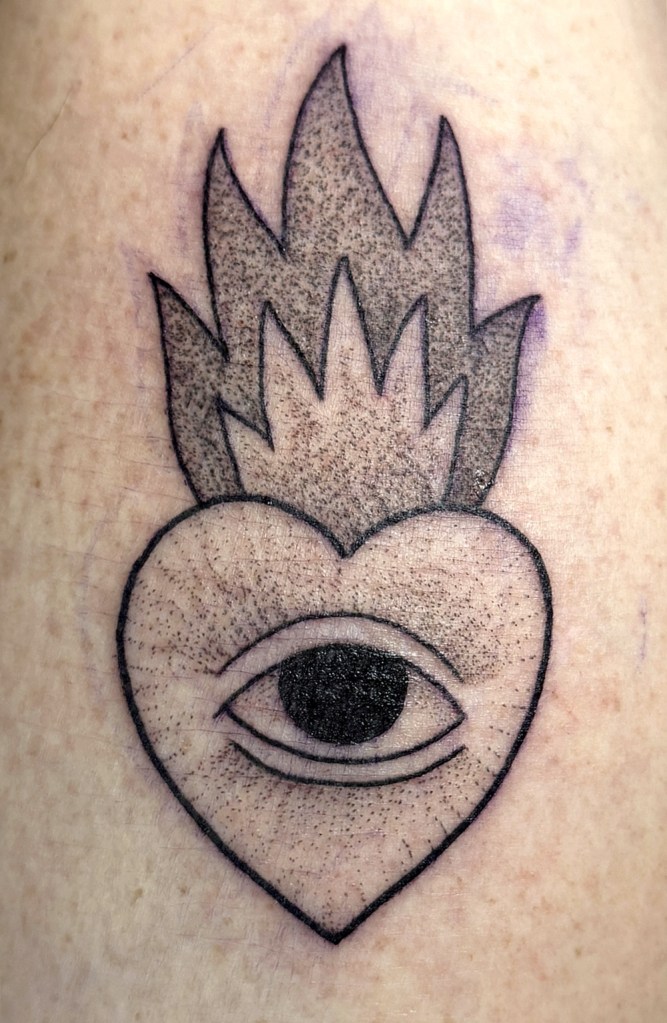
The closest I’ve come to any kind of proselytizing is writing for this blog, in which I’ve posted both my carefully-considered opinions about esoteric adventuring and my personal experiences in walking that path. I’m not particularly interested in “raising up” anyone else (I’ll leave that to the self-proclaimed “light-workers,” another blissful sub-group within the “It’s all good” demographic about which I can’t help quipping “It’s all good . . . until it isn’t”), but I do aspire to instill in them the same curiosity and desire to explore those matters on their own that I stumbled upon in my early twenties. Perhaps the tattoo I just received from my professional tattooist daughter says it best. I call it the “Mark of the Seer” in which the eye signifies “insight,” the heart “compassion” and the flames “inspiration.” (For the record, it’s an adaptation of the card back from the Tarot del Fuego; see the full story in the link below.)
 Parsifal's Wheel Tarot & Astrology