AUTHOR’S NOTE: As evident in the online tarot community, current practice reflects the general agreement that “if Nine is good, Ten must be better” (with the obvious exception of the suit of Swords). The genesis of this idea most likely goes back to the assertion of Pythagoras that Ten is the “perfect” number, as symbolized by his “tetractys” model.
There is considerable support for this premise in both classical philosophy and esoteric thought, and it has even entered popular culture in the “holy hand-grenade” segment of Monty Python and the Holy Grail with its allusion to the Hebrew Sepher Yetzirah (Book of Formation). The ancient Greeks considered Nine to be the third of the “Three Perfections” after Three and Six, while cartomancers also positioned it as the third of the “Three Harmonies,” so its pedigree is assured. But later scholars had to figure out what to do with the remainder. Ten is “one more than needed” and thus resembles a guest who overstay his welcome and must be shown the door in order to get on with the house-cleaning. In more literal language, it denotes a surfeit that invites gluttony and becomes a superfluous “postscript” to the “perfection” of the Nine.
My own approach to the subject is heavily influenced by decades of exposure to the Qabalistic Tree of Life and the Hermetic theory of the “Descent of Spirit into Matter,” in which Nine represents fulfillment of the promise of an elemental force that emerged from the Ace, and Ten shows its inevitable depletion when fully engaged in mundane affairs. Aleister Crowley once mentioned that Nine is the “best that can be achieved” in elemental evolution, so Ten consequently portends a “fall from grace” as the energy decays. On the Tree of Life, the ninth sephirah sits on the Middle Pillar, directly in line with the emanation of spiritual largess from the “Crown of Creation,” and it constitutes a return to equilibrium after the divergence of the Seven and Eight.
In a recent professional reading I characterized the Nine as a “catch-basin” or “settling-pond” that captures, consolidates and conserves whatever encouragement comes its way. The tenth sephirah depends from the bottom of the Tree’s architecture and is the field of earthly experience in which the creative urge is finally spent. If they were fruit, the Nine would be perfectly ripe while the Ten would display the first whiff of corruption, demonstrating the principle that “this too shall pass.”
In the annals of esoteric tarot literature, Crowley made the most lucid attempt to keep all of this in perspective when describing the nature of the forty Minor Arcana in The Book of Thoth, while the Golden Dawn’s system of “lordships” occasionally dipped into Pythagoreanism. For example, Crowley’s title for the 10 of Cups was “Satiety,” implying an excess of pleasure that carries the risk of overindulgence, while in the Golden Dawn’s Liber T tarot curriculum it was named “Lord of Perfected Success.” It’s easy to see that Crowley was more attuned to the Qabalistic vibe in this case as in many others. It will be instructive to undertake a visual comparison of the Nines and Tens from the Thoth and Waite-Smith decks to see where the emphasis lies between the Hermetic and Pythagorean worldviews. (Except for the Thoth titles in quotation marks, the definitions are mine.)
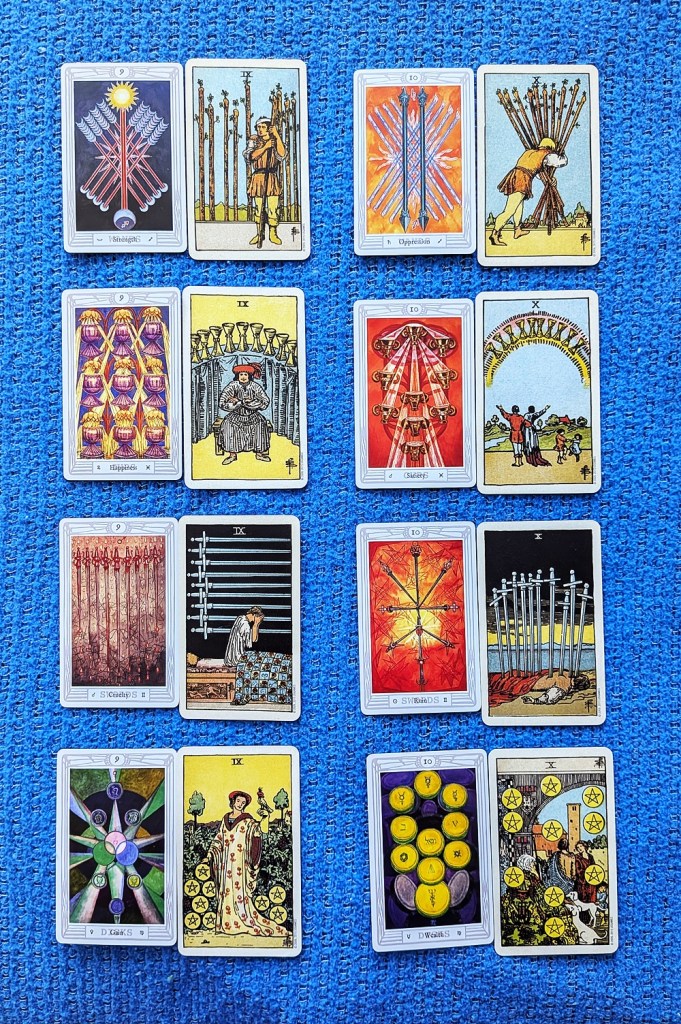
Thoth 9 of Wands: Fortitude (“Strength”)
RWS 9 of Wands: True Grit
Thoth 9 of Cups: Well-favored (“Happiness”)
RWS 9 of Cups: Self-satisfied
Thoth 9 of Swords: Painful Realization (“Cruelty”)
RWS 9 of Swords: Rude Awakening (“Dark Night of the Soul”)
Thoth 9 of Disks: Steady Accumulation (“Gain”)
RWS 9 of Pentacles: Languorous Self-indulgence
Thoth 10 of Wands: Persecution (“Oppression”)
RWS 10 of Wands: Overburdening Hardship
Thoth 10 of Cups: Gluttony (“Satiety”)
RWS 10 of Cups: Familial Bliss
Thoth 10 of Swords: Devastation (“Ruin”)
RWS 10 of Swords: Dim Prospects
Thoth 10 of Disks: Obsessed with Money (“Wealth”)
RWS 10 of Pentacles: Contentment/Complacency
 Parsifal's Wheel Tarot & Astrology