AUTHOR’S NOTE: A few years ago while reading the companion book for the Voyager Tarot by James Wanless, I encountered the concept of the second number in a two-digit tarot trump creating a kind of “numerological counterpart” between that card and the single-digit trump of the same number (for example, the Hanged Man as 12 would be the counterpart of the High Priestess as 2, even though when using Theosophical reduction it relates to the Empress as 1+2=3). Some time later I discovered the same idea in Alejandro Jodorowsky’s Way of Tarot. The second number defines the focus of the first number, and the same logic can be applied to the second digit of the court cards when they are given the values 11 through 14.
I’m currently re-reading James Ricklef’s Tarot Reading Explained, in which he refers to this type of correspondence as “transcendence” in that the second digit extends, expands, and elaborates on the significance of its previous occurrence. Since all but two of the two-digit trumps begin with “1,” I once observed that in each case (except Judgement and the World that start with “2”), the Magician is in the “driver’s seat” as the master-of-ceremonies or conductor and the card represented by the second number is the “back-seat driver” who comments on what the Magician is doing.
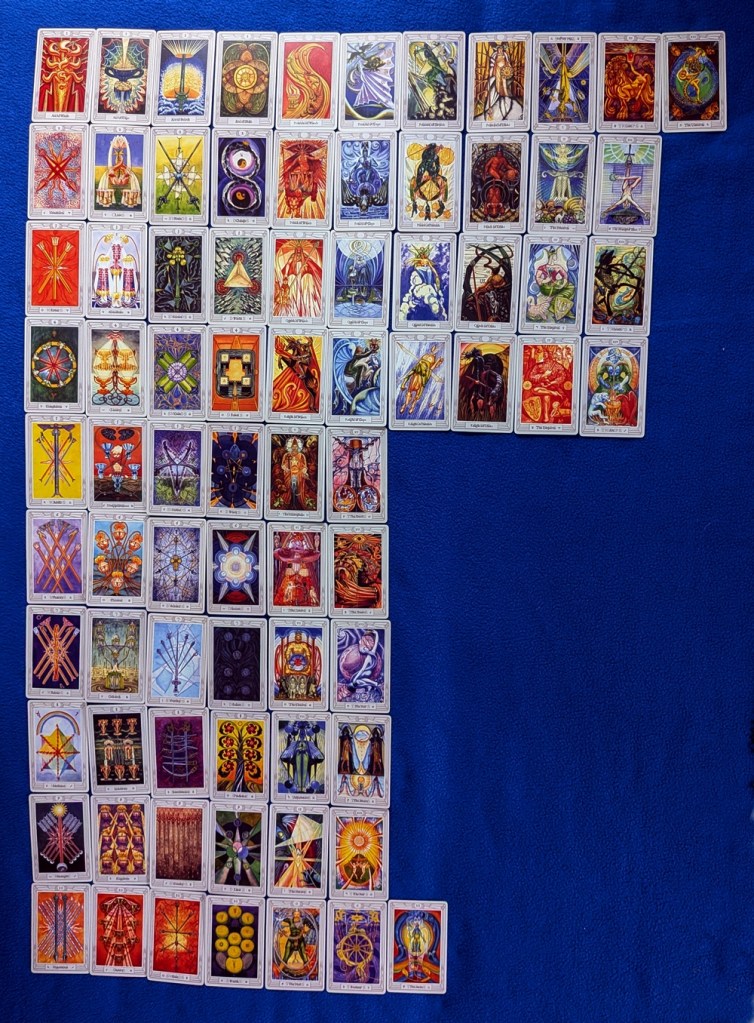
The term “transcendence” accords the second number a more exalted status, as if it is the primary basis for the meaning of the image although it is still influenced by the purposeful action of the first number. Ricklef proposed laying out all of the pip cards and court cards according to the alignment of the numbers, and here I’m bringing in the trump cards as well, as identified by the “transcendence” of their second digit. Note that the Fool, the Wheel of Fortune and the Aeon (Judgement) are special cases that I associated with the zero of the Tens; my thinking is that the Tens portray the “last gasp” of their elemental energy and must be regenerated via the symbolic roll-over shown by the three trump cards.
As for how to use these correspondences, the Emperor provides a useful example. Four is the number of stability in the pip cards, and of “law-and-order” in the Thoth Knights and the Emperor, while Art (aka Temperance) administers that societal power in an even-handed manner. Or how about the Hierophant? Five is the number of disruption in the pips, and the Hierophant is the “band-aid” moral fix that does nothing to deter the Devil and its “front-man,” the conniving Magus, from continuing that trend.
 Parsifal's Wheel Tarot & Astrology