AUTHOR’S NOTE: When it comes to developing a personalized set of meanings for the tarot cards to be used in divination, I’ve always advised beginners to follow the lead of the Lenormand system and choose only one or two key words or phrases to internalize for each card; apply those for a while in practice; and slowly accumulate more interpretations based on the experience gained.
The starting point for this effort should be the best repository of knowledge the neophyte can find, whether in books or online reading exchanges that analyze contributor’s spreads. (I would avoid YouTube and other social-media platforms where self-styled experts are only adapting the same material to their own opinions; why not go straight to the source and draw your own conclusions rather than waiting to be spoon-fed?) The long-range goal should be to have the “best of the best” at the top of one’s head for instant access in the middle of a reading.
In his book Tarot Reading Explained, James Ricklef acknowledges that we will occasionally run into definitions that do not square with anything we’ve learned up to that point, and it seems impossible to integrate them into our personal storehouse of tarot wisdom. In my own practice I “take them under advisement” and file them away for future reference if and when the context of a reading calls for them. But Ricklef proposes a novel approach that he picked up from another author, and he uses it whenever a card with indigestible content shows up in the pull. The approach is to establish the problem card as the focus for a short “side” reading that attempts to give that card a clearer “voice” regarding what it portends for the matter at hand.
It could also be used to squeeze additional information out of a contrary card that defies synthesis with the rest of the cards in a spread, such as the proverbial “bad card in a good position.” I typically follow Ricklef’s advice for unintelligible cards to “let them simmer in your consciousness; they will eventually make sense, they always do,” so I prefer to avoid pulling random “clarifiers” until something clicks. It may seem like only a different twist on the same concept (i.e. “clarifiers-on-steroids”), but this intriguing technique, which Ricklef describes as letting the card itself tell you what its presence should mean, offers a similar vantage point within a more structured vignette.
Ricklef recommends not assigning predefined position descriptions to the spread used for this reading (e.g. no “past-present-future” format), and just reading the layout as a narrative. But if we’re going to hand the subject card a metaphorical microphone and a “bully pulpit” to state its own case, I think it behooves us to provide at least a rudimentary outline for the presentation. In a three-card line, the rhetorical discourse might begin at the left with “What have I advised in the past?” It would continue with “What am I trying to say in the present?” The right-hand card would convey “What am I likely to mean for the future?” (Ricklef notes that other spread designs can be used but the three-card draw seems adequate for the purpose, and I concur.)
While it would be tempting to dredge up previous encounters with the card in each position, it would be best to forget prior struggles with its less obvious implications and just read the cards in the spread as they lie for a fresh perspective. When their import is understood, anything that was learned from them can be brought back to the “editorial desk” for formal integration into the diviner’s repertoire. In an ongoing reading, the traditional descriptions for the card (as a prelude to addressing any problematic impressions that arose from later additions) can be guided toward a more coherent awareness of how those puzzling aspects might play out in the current situation.
For example, let’s take everyone least-favorite “outcome” card, Death. I’ve found it to provide an inconclusive answer to the question in many cases. OK, something “big” will come to an end as suggested by the preceding cards, but its impact on the future remains unknown. It stands to reason that no sitter wants to be told there is no “hereafter” to be obtained from the forecast, so some readers will pull extra cards to reveal “the rest of the story.” Ricklef’s innovation offers an alternate solution. Here is a hypothetical reading that explores this premise.
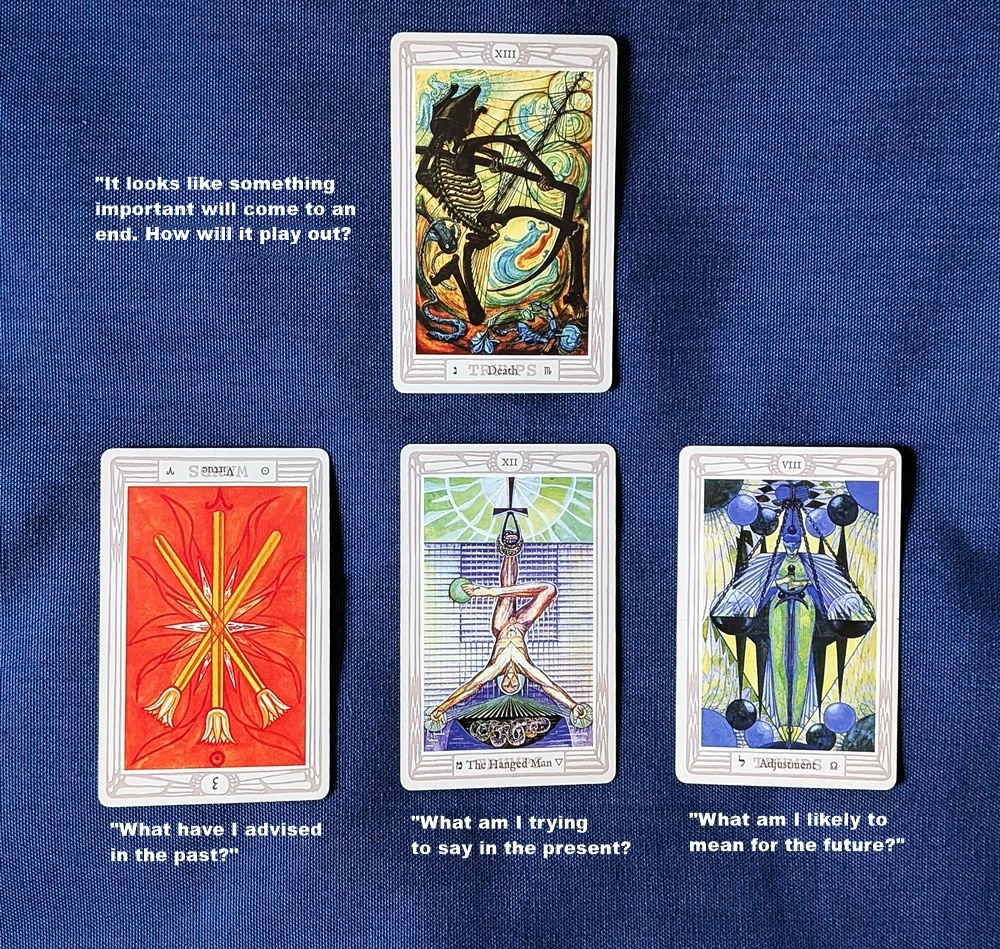
While its consequences are uncertain when considered independently, Death seems to be saying:
3 of Wands reversed: “I keep telling you, ‘Don’t count your chickens before they hatch.'”
Hanged Man: “You aren’t facing an imminent ending, just an indeterminate suspension. Prepare for delays before anything develops.”
Adjustment: “You will have to endure a trial before this is over, in which you will receive your ‘just desserts’ for good or ill. This could occur during the upcoming September-October timeframe if that seems reasonable; if this projected interval is either too short or too long under the circumstances, allow it eight weeks to unfold.”
Armed with this information, the querent will be better-situated for what comes next as part of the “end-game.”
 Parsifal's Wheel Tarot & Astrology