AUTHOR’S NOTE: I’ve written in the past about the relationship between the tarot Fives, Sixes and Sevens (linked below), but my recent introduction to the art of playing-card divination brought a fresh perspective to my take on the subject.
In standard cartomancy, the Fives and Sevens are eight of the most dissonant “pip” cards in the deck (arguably superseded in misfortune only by the 10 of Spades). They both represent “discord,” with the Sevens being more contrary than the Fives. This is obviously modified by suit association, with Spades as the most negative of the bunch and Hearts the least. The Sixes (representing the second of the three “harmonies” in the deck) symbolize a more benign transition between the two.
This aligns with Qabalistic number theory, in which the Fives disrupt the stability of the Fours and clear the way for the renewed harmony of the Sixes, while the Sevens overthrow the entrenched complacency of the Sixes in the form of a “test” and a step in a new direction that is “checked and adjusted” by the Eights, while both are reconciled by the Nines.
It also agrees with the numerological approach of Joseph Maxwell in his Tarot de Marseille book The Tarot. All of the odd-numbered integers except One (the “unitary” root of the numbers) and Nine (expressing equal sets of Three) are unbalanced and actively seeking a return to equilibrium, while the even-numbered integers (except Six and Ten, which are not exponents of Two) are symmetrically balanced and passively focused on maintaining that state of equanimity. In the present case, the mild-mannered Sixes are wedged between the harsh ministrations of the Fives and Sevens, which is why Aleister Crowley warned that “all success is temporary, how brief a halt upon the Path of Labour!”
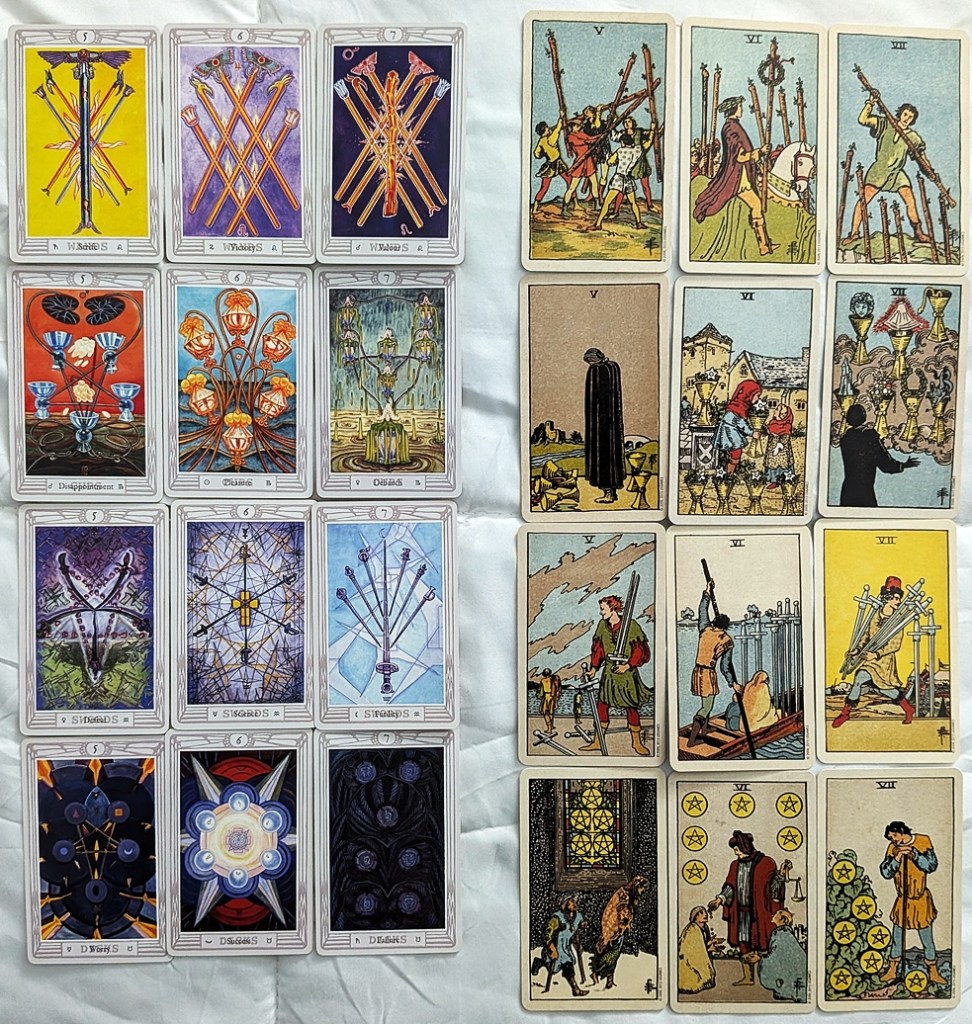
A quick review of examples from two of the most popular scenic and semi-scenic tarot decks clearly demonstrates this sense of harmony (or at least tranquility) sandwiched between bouts of discord. The Sixes can be likened to a brief “rest stop” along a hard road.
 Parsifal's Wheel Tarot & Astrology