AUTHOR’S NOTE: I recently came across two online questions that I’ve merged into a single essay. The first involved the blending of astrology with tarot, and the second inquired whether the 6 of Swords is a favorable card.
In thinking about this topic, it struck me that in astrology the sextile aspect (60 degrees of separation) between two or more planets offers a mildly fortunate incentive for achievement as long as we actively seize the initiative in order to squeeze the most from its benefical influence, unlike the 120-degree trine aspect where the benefit just falls into our lap with little or no effort. In short, the sextile isn’t a “slam-dunk,” it takes some work! As do the Sixes of the tarot; while they are considered (at least from a numerological perspective) to be balanced and harmonious, they are largely passive and can become complacent.
In either case some resolve is required to move matters along to a successful conclusion. Both are somewhat sluggish and “risk-averse” due to their benign nature, and I can draw a parallel between the two by noting that “60” reduces to “6” by Theosophical reduction. As we shall see, in astrology this becalmed state finds its outlet through the opposition, while in the tarot it dissolves under the disruptive stimulus of the Seven.
In transferring this idea to the Chaldean wheel of correspondences, we can see that each of the decans (along with its Minor Arcanum) has two “sister” decans and their associated cards that form a three-point sextile pattern with it, and a fourth decan/card combo in opposition to the original “focus” decan. In graphic terms, it looks like this:
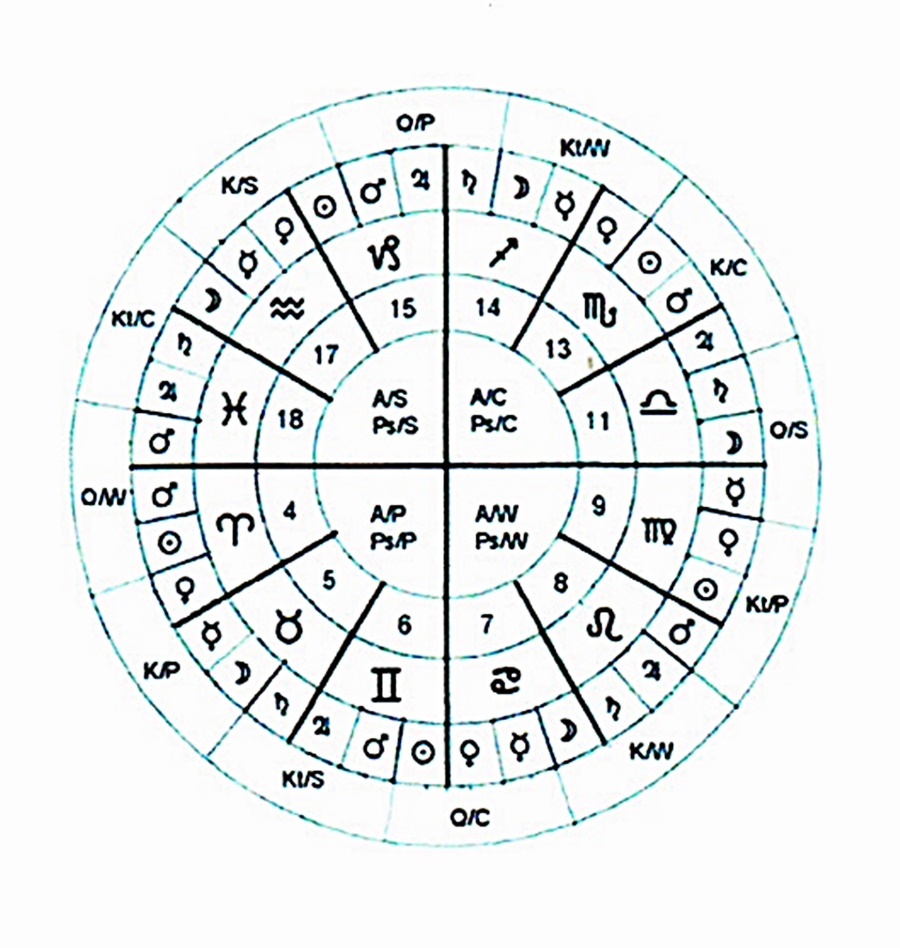
In this model, the 6 of Swords (titled “Science” in the Thoth deck) occupies the second 10-degree decan of Aquarius and is associated with analytical Mercury in “Fixed” Air. Its “sextile counterparts” are the 3 of Wands, titled “Virtue,” in the second decan of Aries (the authoritative Sun in “Cardinal” Fire) and the 9 of Wands, titled “Strength,” in the second decan of Sagittarius (the emotive and changeable Moon in “Mutable” Fire). A number of interesting concepts can be found in these arrays.
All of the cards are expressions of the number Three: the integer 3; its additive 3+3=6 and its multiplier 3×3=9, each of which was considered by the ancient Greek philosophers to represent one of the “Three Perfections.” Three is also interpreted as a number of expansive growth and opportunity.
These cards are situated in positive Air and Fire decans (in a “”1-to-3” ratio) and are therefore elementally compatible (aka “friendly”) symbols of practical intelligence inflamed by enthusiasm; the empty “leg” of the configuration is formed by the second decan of Leo and the 6 of Wands, titled “Victory” (magnanimous Jupiter in “Fixed” Fire), producing the classic “bow-and-arrow” aspect pattern with the trine between the Sun and Moon supplying the “bow” and the opposition of Mercury and Jupiter serving as the “arrow.” The assumption is that the “bow” provides “creative tension” and the point of the “arrow” (Jupiter in this example) shows where and how that tension will be released. With Mercury “drawing and aiming” the figurative shaft, the 6 of Swords is in an excellent position to press its agenda with conviction and flair (but perhaps with little precision since it is being goaded to perform). We could say that this Mercury “thinks big” and is empowered by the Sun and Moon in bringing its ambitions to fruition in a grandiose Jupiterian manner.
The nature of the planets can also be brought to bear; the Sun and Moon are a formidable pair and Mercury and Jupiter are zodiacal opposites in both their modern and traditional signs of rulership. Consequently, the four in concert yield irresistible motive force and impeccable “aim” for the discharge of the accumulated energy. The narrative for this potent assemblage might read “Science, constrained by its emblematic ‘Method’ but emboldened by Virtue and Strength, achieves Victory by ‘striking to the heart’ of the matter.” The same blueprint can be used with any 60-degree offset between decan/card pairs and they will always be in elemental agreement. The planetary components of the “bow-and-arrow” may not be quite as compelling as they are in this example, but basic astrological knowledge is all that is required to make sense of their interaction.
In practical use, whenever any of the cards in these arrays appear together in a reading they could be accorded special significance as collaborative energy signatures since they will generally be “friendly,” or at worst “neutral,” from an elemental standpoint. Furthermore, comparable assumptions can be applied to the Ptolemaic trines and squares, as well as to their major aspect patterns, the Grand Trine and the Grand Cross; in the first case the Elemental Dignities for the affected cards will exhibit optimal “friendliness” while in the second instance they will be a mixed bag of “friendly,” “neutral” and “unfriendly,” with the least cooperative attitude in the minority. The final Ptolemaic aspect, the opposition, will always display a Fire-and-Air or Water-and-Earth alignment, making the opposing pairs convivial companions despite their differing outlook on life.
 Parsifal's Wheel Tarot & Astrology
Excellent! Funny enough this is the second post related to exactly “six-ness” Love seeing the captured words of collective healing messages ✨always enjoy your posts 🤍
LikeLike
“It can not and will not move forward” no mergers.
LikeLike
If I may add my own intuits “March” to one’s own beat in times of militant strictness in the external experience., refuse to do the dance Ring Around the Rosy Eyes. It’s a Suction of Interference
LikeLike
For the internal experience it is distraction, which causes the body to fight with itself. The Gift is the SIXth Sense. And you’re part is major of the arcana in healing ✨🤍😇☺️
LikeLike
That last sentence was a very terrible pun 🤭
LikeLike