UPDATE:
Well, this certainly turned out to be an interesting reading. It was right about the game going into overtime for only the second time in 58 Super Bowls but slightly wrong about the score, entirely due to the fact that the NFL changed the overtime rules this year. In past seasons it was a “sudden death” affair in which the first team to score won the game, and in this case it would have put the 49ers on top at the end by three points, 22 to 19. But now the other team gets a chance to retaliate and the Chiefs did, overcoming San Francisco 25 to 22. Otherwise, my prediction of the 49ers winning by a touchdown instead of a field goal would have been close enough to claim success, which I did when the Patriots beat the Falcons by the same margin in the first overtime episode several years ago.
ORIGINAL POST:
AUTHOR’S NOTE: 49ers by a touchdown! You heard it here! Or, if not . . . well, I never said that.
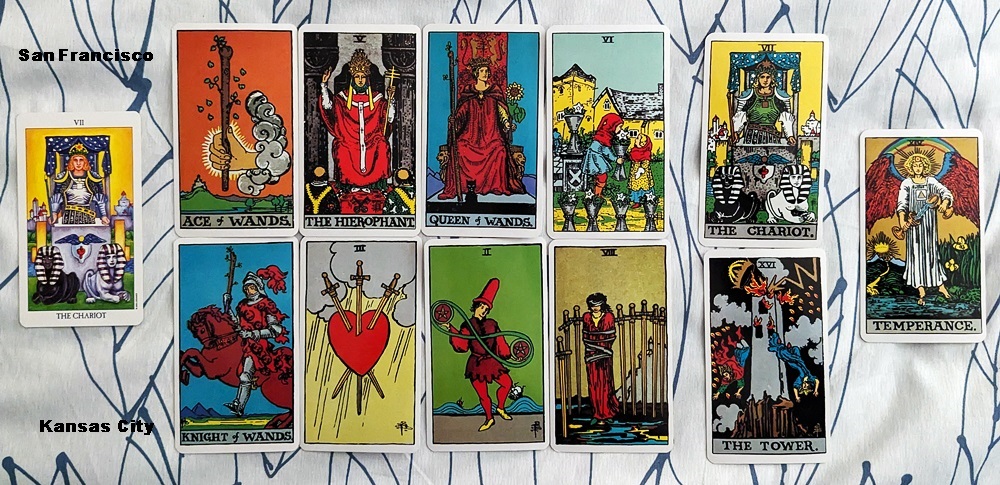
As I do every year at this time, I’m using my “Enemy at the Gates” conflict-resolution spread to judge the likely outcome of the Super Bowl. Since the 49ers have a slight edge in the betting odds, I placed them in the top row of the layout. I didn’t use reversals this time around. As is my custom, I positioned the Chariot (indicating “Triumph”) to the left as the “Opportunity” card reflecting the stakes in the game. Although I’ve been using this spread for years, it will always be about as theoretical as one can get with sports forecasting (although I’ve had some remarkable success with it for World Series predictions).
ANALYSIS:
A quick overview of the four “line” cards in each row shows San Francisco to have a much more robust series going for them, with no challenging cards in the set. Kansas City, on the other hand, has two difficult Swords and one unstable Pentacle in their population. (The fifth card in each row is the calculated “quintessence” for the other four.)
The first column shows the “Strengths” for the opposing teams. It looks to me like Kansas City will excel at their running game (they could score early and often) while San Francisco’s passing game (or possibly one standout player) will be their main advantage.
The second column suggests each team’s “Weaknesses.” Kansas City may not be able to pull off the “big play” (such as a “third-down conversion”) when it’s needed. The “three” in the painful 3 of Swords seems to bear this out: three downs and then punt. San Francisco may become bogged down in overly conservative offensive tactics.
The third column implies the “Edge” that each team enjoys in the game. San Francisco shows poise and command of the field. Kansas City has versatility going for them, an ability to change things up when something isn’t working.
The fourth column displays “Allies’ Power” for each adversary. I always take this to mean the potency of each team’s lines, both offensive and defensive. San Francisco displays a more confident and optimistic posture while it looks like Kansas City can’t get it together, either coming or going.
The “”quintessence” cards are intended to reveal the “Chance for Success” for each team. The calculation posed a dilemma since both four-card rows totaled “25,” indicating a deadlocked score (note that I include court cards in the derivation). I resolved this by using “Theosophical reduction” in one case and “casting out nines” in the other to arrive at two different “quints.” Because San Francisco makes a much stronger showing in the on-field display,” I reduced their “25” to “7” by adding together the digits, giving me the Chariot, a repetition of the “Opportunity” card and a powerful harbinger of victory. For Kansas City, “25-9=16” produced the Tower, an equally decisive testimony to failure (of course this could be reversed by switching the numbers, so it’s a judgment call).
The “Grand Quint” calculation came to “23,” which could reduce to either “5” (The Hierophant) or “14” (Temperance). Since the Hierophant had already appeared in the reading, I decided to go with Temperance, a Fire card. The idea is to see which team’s cards are most favored by this roll-up card; I gave a slight edge to Kansas City’s Fire and Air cards in this regard, allowing them to at least stay in the game; there are no elementally unfriendly pairs among them, while San Francisco has two contrary Water cards to overcome.
The quarter-by-quarter scoring differential could very well mean a tied score in regulation play, necessitating a “sudden death” overtime period; however, this has only happened once before in Super Bowl history (a game that I called correctly using this spread) so it isn’t likely. The raw numbers (before rounding) show the leading team to have quarterly advantages of +11; +9; +2 and 0 (tied score).
The first quarter shows the team that’s ahead to be up by approximately ten points (rounding down according to the standard scoring model), basically a touchdown and a field goal. At halftime this stays stable, with the same team in the lead by nine (although they lose their “mojo” slightly). By the end of the third quarter, the other team “comes alive” and goes up by a field goal, essentially scoring two unanswered touchdowns in the period to their opponent’s single field goal. By the end of regulation play it is entirely possible that the teams will be tied at around 24 points, although it could be 21 or 28 in line with typical scoring conventions. If it comes to that, the Chariot as the 49ers “quint” card should carry the game for them in overtime; its number is “7,” suggesting that they will win by a touchdown.
Conclusion: On balance , San Francisco mounts a much more consistent attack throughout the game as shown by their favorable cards, while Kansas City is substantially more unbalanced. Still, the game could very well be a close one, all things considered.
 Parsifal's Wheel Tarot & Astrology