AUTHOR’S NOTE: Although horary astrology is much better for it, I sometimes work with tarot as a means of finding lost items or people. I once applied the left-or-right gaze of the human figures on the cards to indicate a past or future bias in a querent’s situation. Here I’m bringing it to bear, along with reversals, on directionality in the mundane sphere. I have several more complex spreads for this, so the one described below could be considered a first step or place to start.
In ballistics, hitting a target is largely a matter of trajectory (or aim) and distance (or range); there is more to it but I’m not going to get into elevation and windage at this time). Finding lost items or people with tarot reading is no different. Here is a spread that uses the facing or gaze of the figures on the cards to suggest the direction in which to look, and a variety of individual factors to project how far away to begin searching. It also provides an indication of the likely as-found condition for the missing subject.
Reversals can be used for two purposes with this spread: one is to swap the direction of the gaze from left-to-right and top-to-bottom, or vice versa, and the other is to describe how well-hidden the objective may be. The classic Waite-Smith deck is a good choice for this because most of the images convey a well-defined directionality. Using standard Northern Hemisphere astrological notation, left represents East, right West, above South and below North.
Begin by shuffling all 78 cards and then pull one to place at the center of the spread. If the figure on the card (whether human or inanimate) faces or gestures to the viewer’s left (East) or right (West), proceed in that direction with the search, alternating for reversal if necessary. If the figure is facing straight out of the picture (many of the Major Arcana do so) or exhibits no distinct orientation (5 of Wands, 3 of Cups, etc), look to the South if the card is upright, or to the North if it is reversed.
Then deal another card in the direction indicated to show the approximate distance of the target from its last known location; if that card is neutral or inconclusive in character (such as the 2 of Swords or the 7 of Cups) draw additional cards until you get one that shows definitive movement. If the ultimate “distance” card is reversed, relocation at a considerable remove is less likely, or at most gradual.
Finally, pull a card that is intended to show whether the subject of the inquiry is compromised in some way: broken or damaged if inanimate, ill or deceased if animate. The typical optimistic or pessimistic nature of this card will reflect the condition of the target at the time of discovery. (Death or the 10 of Swords would not bode well, while the Empress or the 9 of Pentacles would be much more favorable.)
Regarding distance, a low-numbered minor card in that positions implies that the subject is nearby and a high-numbered card that it is far away, with the rest depicting a middle distance; a Page suggests “not far off” while a mounted Knight can cover a lot of ground and a staid King or Queen is more likely to be close than not. (A court card could also reveal that another person was a party to the disappearance, particularly if reversal suggests “something to hide.”)
The element of a suit will add inflection: the active Fire and Air cards are prone to move farther away (and much more rapidly) than the passive Water and Earth cards. Among the Major Arcana, elemental correspondence is not a reliable measure of distance. (For example, the watery Chariot is dynamic and the airy Justice is not). In such cases, look first at the relative mobility of the figure and any hints that might suggest either advancing or staying put. Several key considerations are “walking/riding” “standing still,” “seated,” and “gesturing/pointing.” Elemental energy would then be a secondary contributor that will incline the decision one way or the other.
Will the object of the search be found in good condition? Apply the following “Yes/Maybe/No” table to the final card to gain insight into whether or not that conclusion is probable. Factor in the emphasis of reversal to indicate whether concealment (such as burial or inadvertent dumping) is a possibility.
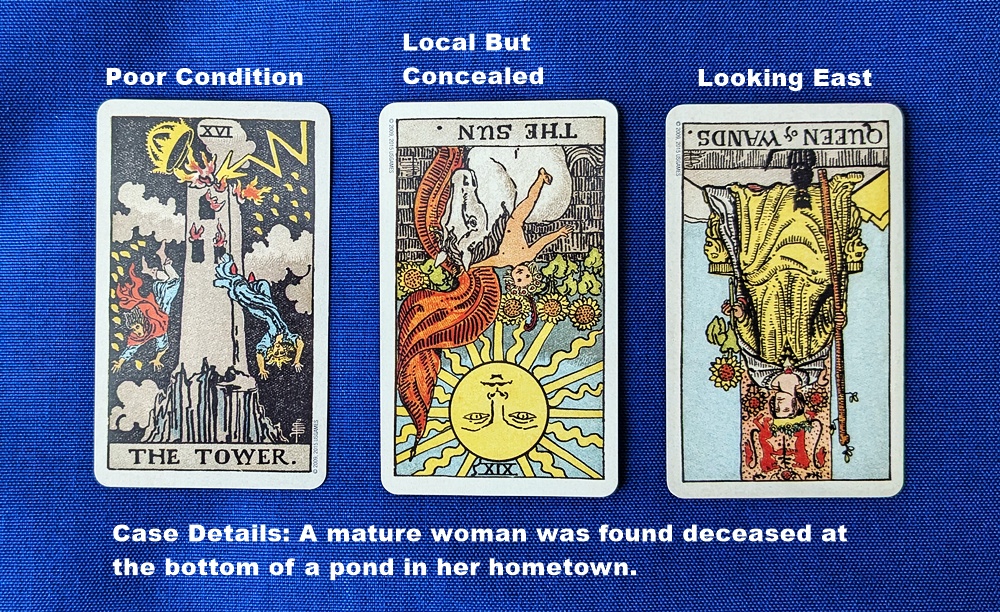
Here is a short example reading about a missing-person case for which the outcome is already known. I previously examined this matter with a different spread and determined that the victim had been “transported over water” and was (at that time) “in a wet place.” Reversal of the Sun in this reading could mean that she was moved to her final destination under cover of night.

 Parsifal's Wheel Tarot & Astrology
Whoa! This is very interesting
LikeLiked by 1 person