“Roundin’ third, he was headed for home
It was a brown-eyed handsome man.”
– from “Brown Eyed Handsome Man” by Chuck Berry (who wasn’t talking about the Knight of Swords or Pentacles but certainly could have been)
AUTHOR’S NOTE: As always, my title is a “lure” to spark interest but the objective is nothing more than coming up with a semi-accurate way to predict the outcome of Major League baseball games that are played on a grass-and-dirt field known in the vernacular as a “diamond.” I’ve had some success with forecasting US football’s Super Bowl games and baseball’s World Series games but I wanted something that works more effectively with tarot’s unique properties.
My problem has been that baseball has similarities to hockey and international football in that it isn’t uncommon for one team to rack up only a couple of “runs” (baseball’s point system) and the other to score none during the course of nine periods of play (called “innings” or, more colloquially, “frames”), each of which is divided into two halves where the team on offense gets a chance to increase its “run” total while the other team on defense tries to prevent it. In contrast, US football and particularly basketball are more prolific in their scoring, which lends itself much better to tarot’s 78-card range. After some thought, I realized that a court-card-specific approach could be the solution.
Rather than trying to figure out precise scores in terms of which team has more “runs” than the other at the end of nine “frames,” thus winning the game, I decided to use the “point-gap” system I developed for football predictions that considers only the numerical separation between the teams’ status at the end of the two halves of each inning. To do this, I set out to work with the 16 court cards and two of the four Tens (it doesn’t matter which of the suits the latter are from) that would give me 18 cards to spread across nine innings, one card per team per inning. Because the “point gap” between any of these 18 cards can be no more than four when the Pages through Kings are valued at 11 through 14, this scheme fits more precisely into baseball’s normal inning-by-inning output. There is still a chance to produce an inflated – and therefore unrealistic – outcome using this method, but I’m hoping that it will be more balanced than otherwise.
I began by removing these cards from a tarot deck, shuffling them, and laying them in nine two-card columns from left-to-right. (These can be dealt either in two nine-card series or in top-to-bottom pairs.) Typically, the “visiting team’s” status (the team “on the road”) is shown by the upper row of this layout, reflecting the results of the “top half” of each inning, while the “home team’s” condition is indicated in the lower – or “bottom half” – row.
Next, I determined which team received the higher-ranking card in each column, suggesting that the score at the end of the inning would be in its favor. Then I tabulated the “point gap” separating the two cards to show by how much that team would be ahead. At the end of the eighteen-card sequence, I totaled up the “gap” entries to come up with an overall degree of separation between the winner and the loser. The goal was not to arrive at an exact score for each competitor but merely to declare the victor. (I’ll leave the intricacies of “point spread” up to the gamblers.)
The process is best illustrated by an example reading. For dramatic effect, let’s assume that the Boston Red Sox are hosting the New York Yankees at Fenway Park, an intense rivalry that goes back to the days of George Herman “Babe” Ruth. Note that there is no reason to use reversed orientation in this abstract outlook. For the record, I dealt the cards from top-to-bottom in columns moving from left-to-right.
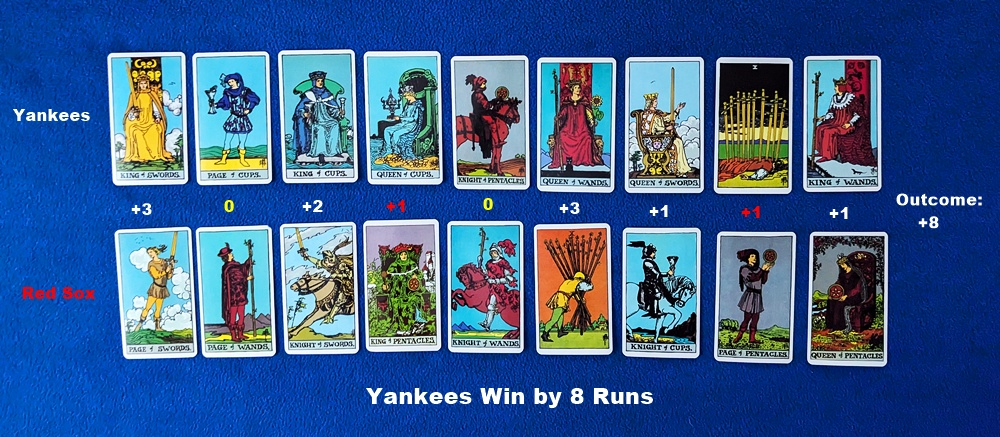
I think this looks promising. An eight-run spread at the end of a game is not unheard-of when the teams are unevenly matched. The hapless 2024 Red Sox can certainly vouch for that fact. In this theoretical reading, the Yankees got off to a hot start with five unanswered runs and added five more in the last four innings, while the Red Sox only managed to claw back two meager runs against the Yankee’s onslaught, which isn’t saying much for their offense.
 Parsifal's Wheel Tarot & Astrology