UPDATE: In practice, the original spread did not lend itself to a clean judgment regarding the forces at work, so I created an alternate version. Each “Upper Hand” card has been changed to a “Defense Mode” indicator for the partner on that side of the layout, with the idea that it will counter the other partner’s “Attack Mode” card. The “Upper Hand” will be decided by doing a numerical “essence” calculation for the population of eight cards that will yield a trump card to be compared to the two “Partner” cards to see which it favors. Various methods for determining the “favored” partner can be applied, particularly inherent compatibility and commonality across different forms of esoteric correspondence. (I did not re-do the example reading.)
AUTHOR’S NOTE: During a recent online conversation, I mentioned that ” . . . when I do relationship readings I look at interactive factors, like what one party may be ‘doing’ to the other and vice versa, kind of like an old Three Stooges episode where Moe hits Larry but Larry is afraid to hit back so he hits Curly instead. It can become a shell game where the target keeps moving around, and transference of blame is more likely than cooperation.” I decided to take those thoughts and build a tarot spread around them.
Once the initial euphoria wears off a romantic liaison, any glaring flaws in the relationship can loom large between the participants, sometimes becoming a weapon with which they beat each other up. This vindictiveness doesn’t seem to be entirely willful, it’s mainly a byproduct of human nature when perceived needs aren’t being satisfied by the other party. Who remembers the old Michael Douglas/Kathleen Turner film War of the Roses? Now there was a toxic relationship!
Years ago I created a needs-analysis spread titled “Feeding the Elephant” that viewed a faltering partnership as the “invisible elephant in the room” that the couple refuses to acknowledge even though all their friends know it’s hopeless (see the link below). This one is a new take on the subject of shared experience and the individual needs that seek but don’t always find fulfillment. The goal is not reconciliation; its aim is to show which partner has the upper hand in “weaponizing” a dysfunctional relationship and how the other person might cope with it.
I see this spread as applicable to any head-to-head conflict, not just unhappy romantic entanglements. For example, adversarial business, employment, political or sports scenarios would be ideal candidates. In an actual spread, the meaning of each position should be “dialed in” according to the context of the question and the nature of the card that lands there, which would be read for its contribution to the thrust of the overall narrative. Although I didn’t do so in the example reading, reversals may be used. (All card backs are from the Retro-Thoth Tarot (privately published) and the card faces are from the Thoth Tarot, copyright of US Games Systems Inc, Stamford, CT.)
Original Spread Design:

Alternate Spread Design:

The layout resembles a “lemniscate” or infinite double-loop. (All cards except the two “Partner” cards and the “Relationship” card do double-duty as offense on one side and defense on the other.) The relationship is “weaponized” as a tool for manipulation or conquest. Partner #1 “attacks” along the upper-right, downward-pointing trajectory and defends along the lower-left, upward-pointing angle, while Partner #2 does the same in “mirror image” fashion. The “Mode of Attack” shows the strategic and tactical vigor of each attack, while the “Upper Hand” identifies which partner is best able to press the offensive to his or her advantage, putting the other party on the defensive.
The “Partner” positions define the roles of the two participants; it doesn’t matter which is which as long as each one fits the prescribed profile shown by the card in that spot, which can be determined after the deal as I did below. (In some cases – like sporting events with their “home” and “visiting” teams – these assignments can be made in advance.) Here is an example reading that demonstrates the spread’s use; all cards were randomly drawn.
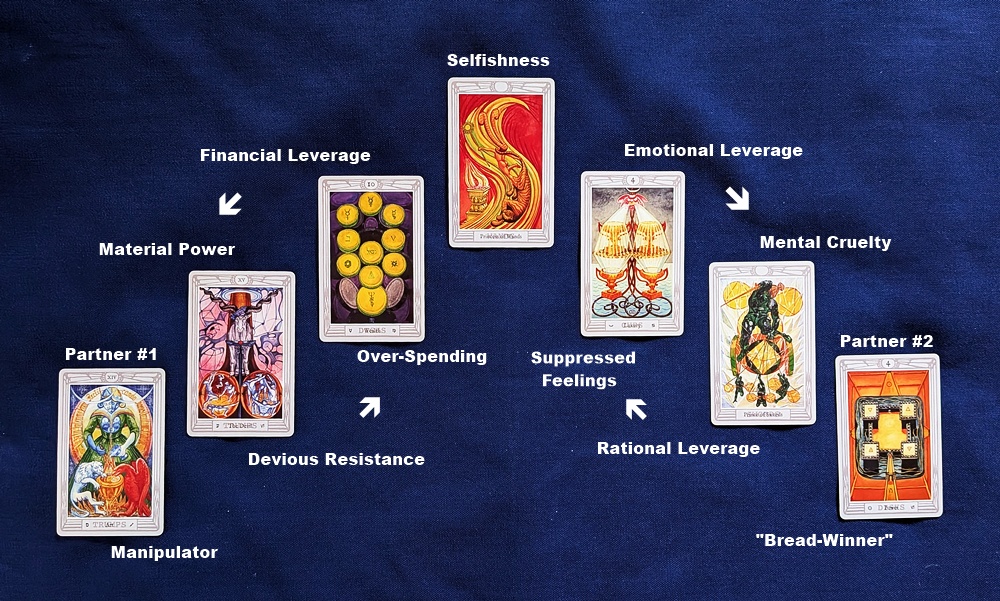
Here we have a couple who is strongly motivated by selfishness (Princess of Wands). Partner #2 is the unsentimental “bread-winner” of the pair (4 of Disks, titled “Power”) who uses money (10 of Disks, “Wealth”) and material subjugation (Devil) to attempt controlling Partner #2 (Temperance), while believing that this stance is entirely rational (Prince of Swords) and keeps the lid on excessive emotion (4 of Cups, “Luxury”).
Partner #1 is forced into the role of “Manipulator” (Temperance) by the relentless financial brow-beating and resorts to devious defensive measures (Devil) by slyly over-spending (10 of Disk) at every turn and applying emotional pressure (4 of Cups) and mental cruelty (Prince of Swords) to wear down Partner #2.
This relationship scenario looks like it’s on a free-fall “crash-and-burn” spiral. At the moment it seems that Partner #2 can assert the upper hand by tightening the purse-strings and no longer acting as Partner #1’s “cash cow,” while viewing Partner #1’s objections as just so much whining. I suspect Partner #1 would walk away before too long if that happens.
 Parsifal's Wheel Tarot & Astrology
That’s interesting
LikeLike