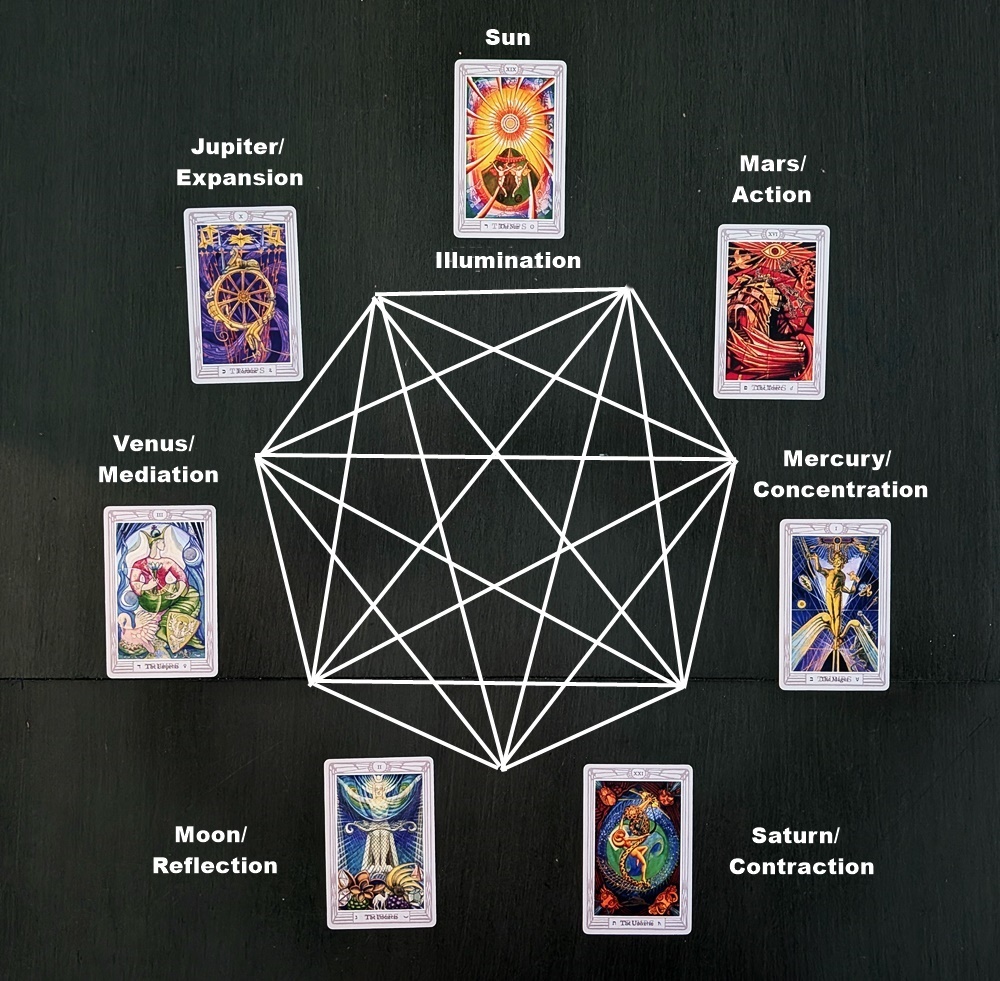
AUTHOR’S NOTE: This mandala-style layout is another of my attempts to organize the tarot cards around the principles of astrology. I have no particular purpose in mind for its use, although it could be applied as a template on which to deal random cards and then look for convergence between their symbolism and the planetary archetypes, with an eye toward fashioning a 3-card or 5-card narrative vignette from the keywords and the planet/card meanings for those that are most closely attuned. The graphic is not quite perfectly symmetrical, but it’s close enough. The keywords are my own adaptation of the traditional attributes given to the seven classical planets of antiquity.
The internal architecture should be apparent: the Sun, Mars and Jupiter cards in the upper hemisphere are elementally active, positive and masculine, while Mercury, although similarly disposed, is qualitatively neutral (it’s a metaphysical “chameleon”) and more restrained in its action. The Moon, Venus and Saturn cards on the lower arc are passive, negative and feminine. These distinctions could add nuance to any reading derived from this pattern. It is also instructive to split the design into a “day” half – Sun, Mars and Jupiter – and a “night” half – Moon, Venus and Saturn – following the rules of classical astrology, with Mercury sitting on the “Western horizon” as the “solar messenger” between them.
This model can be expanded by placing one of the “Primary Element” trump cards – the Fool as Air; the Hanged Man as Water or the Aeon as Fire, depending on the context – at the center of the array. For the purpose of divination I would populate this position with the calculated “numerical essence” card derived from the face values of the seven random cards. (If one of the planetary trumps shows up in the math, I would take it from a second deck.)
This “seven-pointed-star-within-a-heptagon” arrangement is a potent image for meditation, and the primary energy-bearing “lines of force”‘ between the pairs of opposites – Sun/Moon; Venus/Mars and Jupiter/Saturn – are also worth exploring. (I deliberately aligned the points with the interstices between the cards to make this more complex and profound, For example, the Sun forms a triangle with the Moon/Saturn midpoint; the Sun-Moon connection is obvious, while the Moon in secondary, or symbolic “day-for-a-year,” progression and transiting Saturn are on the same 28-year cycle. Similarly, Venus forms a triangle with Mercury and Mars, all three comprising the other “personal” planets after the Sun and Moon.) As you can see, there is a “method” to my “madness.”