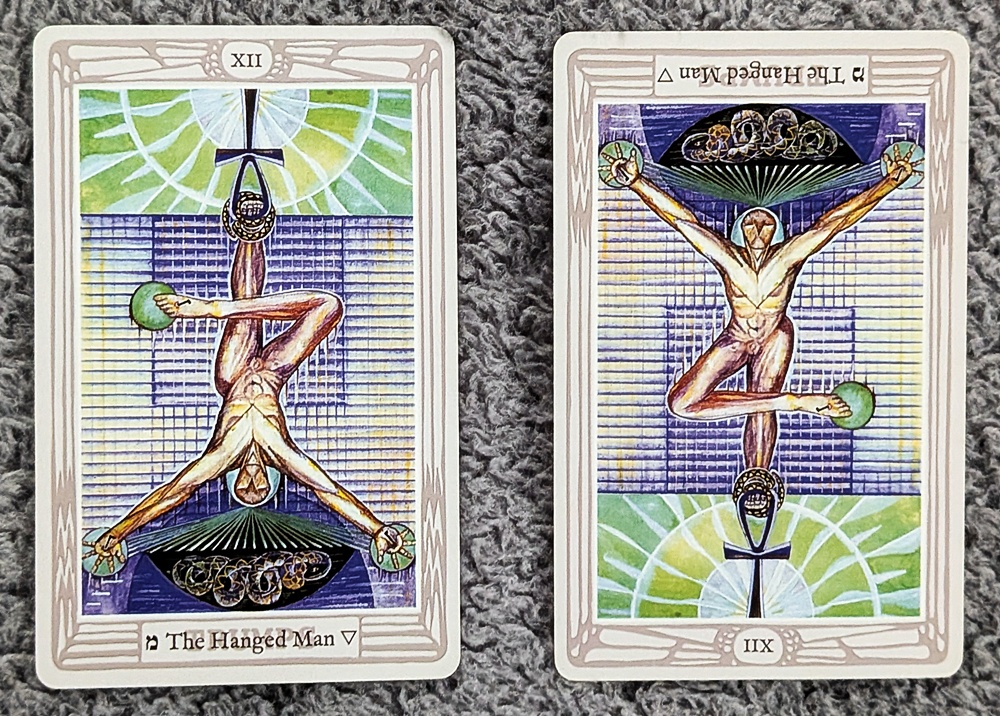
AUTHOR’S NOTE: I’ve just encountered another instance of the reversed Hanged Man in a tarot reading, and decided to revisit my past assumptions about it.
There are three ways to approach it: practical, psychological and spiritual. In divination I usually consider its practical implications first and its psychological impact next, while spiritual consequences are not on the mind of the average seeker and rarely make an appearance so I don’t try to press the issue, although philosophically I’m fond of Aleister Crowley’s concept of being immersed in the waters of the Unconscious and experiencing a profound initiation.
From a mundane perspective, other than suggesting unavoidable sacrifice (which I seldom find to be applicable in real-life situations), the upright Hanged Man is usually interpreted as reflecting a becalmed condition of inactivity that demands patience, or as the need to look at one’s circumstances from a different angle in order to make sense of them. Reversal of this card is often viewed as aggravating the state of forced inertia by placing the root of the malaise further out of reach. But even though I don’t subscribe to the old idea that reversal can actually mitigate an unfavorable effect, I take a different tack in this case.
In a reading I prefer to see the Hanged Man come up reversed and not upright. In this orientation the figure on the card has his head toward the sky and is “returning to the light” after having surrendered to the depths of despair. He is able to cast off the shackles of morbid preoccupation and transcend the limitations they impose. In my estimation, he is resurfacing and bringing with him the wisdom he acquired while trapped in the throes of involuntary inertia and its inescapable navel-gazing. For too long he has been hung out to dry while unsure of his chances for redemption, and now he is about to “come down off the cross.”
One of the most compelling arguments I’ve seen for this turnaround in fortune occurs in the Thoth version of the card. When it is upright, the crossed legs of the Hanged Man form the glyph of Saturn, which is symbolic of restriction. When it is reversed, however, this discouraging sign is transformed into the symbol of Jupiter, a benevolent purveyor of largess. We could say that leaden Saturn “sinks” while buoyant Jupiter “floats,” and the newly unencumbered captive is clearly rising to the occasion. (For those who remember, he looks like Richard Nixon proclaiming victory.)
The Waite-Smith card does not partake of this symbolism because the legs of the victim are facing in the opposite direction, making it a mirror-image of the Thoth rendering. But when reversed the RWS scene shows the previously suspended figure being irresistibly lifted by the halo around his head (while he seems to be dancing a jig), which accomplishes the same thing. Not unlike the often-misjudged Tower, there is an epiphany about the experience of liberation from bondage, here offered by reversal, that should not be overlooked.