AUTHOR’S NOTE: I continue to draw inspiration from revisiting James Ricklef’s Tarot Reading Explained, and in his description of the mental and emotional attributes of the King of Cups I found a brief mention of the “Zen practitioners whose pursuit of enlightenment values meditation and stillness of mind.” I’m not a Buddhist, but that stillness is something I’ve been cultivating in my own spiritual practice through philosophical contemplation.
For decades I chose the King of Cups (actually it was the Thoth Knight of Cups) as my personal significator or tarot avatar because I identified with his “kind, generous and merciful” nature. (Reminiscent of Al Capone’s caveat about mistaking kindness for weakness, I used to position myself as “strong enough to not mind being seen as weak,” although in retrospect my attitude fell somewhere between Nick Lowe’s “you gotta be cruel to be kind in the right measure” and “chastise them according to their desserts.”) Recently I’ve been thinking of the easy-going King as the “Dick van Patten” of the tarot court who could use a little more backbone.
A couple of years ago I was reconsidering Aleister Crowley’s moral characteristics for the Queen of Cups and was struck by the realization that many of her qualities reflect my own self-image, especially given the Golden Dawn’s designation of the Queens as “Brooding Power.” Thus, I spurned the King as a figment of Robert Palmer’s imagination in his song Bad Case of Loving You: “You think I’m cute, a little bit shy/Momma, I ain’t that kind of guy.” (Although I was definitely shy at one point in my life, now I’m merely reserved, and “cute” was always debatable, although when I was 14 a slightly older nurse at a hospital where I had surgery told me something I never forgot: “Some have it and some don’t, and you have it.” Now I just have to figure out where I put it . . . )
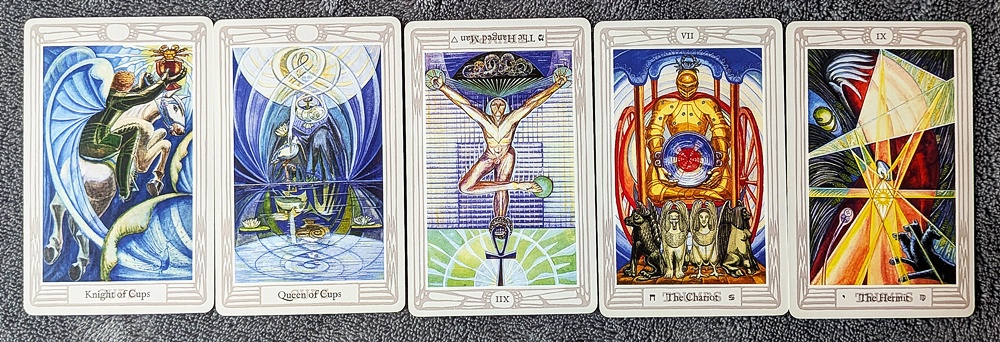
Not long ago my wife said “You could be a hermit because you live almost entirely in your head.” Guilty as charged. I decided to put together a sequence of cards that conveys my evolution from the Knight/King of Cups to the Hermit. The Knight and Queen show the “horns of the dilemma;” the reversed Hanged Man as the “turning-point” in the five-card series indicates my post-epiphany “transcendence” (I always say the reversed figure resembles Richard Nixon celebrating victory); the Chariot delivers the motivation to “redeploy;” and the Hermit portrays the “stillness of mind” I’ve achieved as a result, with wise and prudent Earth grounding all that dynamic Water. (I suppose I’ve made my peace with being a “queenly dude” in mystical terms even though physically and psychologically I’m nothing of the kind.)