AUTHOR’S NOTE: The accuracy of timing in divination is one of those perennial topics that has come up once again in the online tarot community I frequent. While there are ways to finagle the answer by cleverly wording the question, here I’m going to tackle it head-on as comprehensively as I can from a literal perspective.
I’ve tried all of the standard predictive methods for the timing of upcoming events with the tarot cards and have created a few of my own, almost always with mixed results. The main problem with the linear models is that they aren’t context-sensitive because they don’t take into account that some scenarios are more volatile than others, with a shorter fuse due to their inherent instability. The analysis I’m presenting here is the product of years of experimentation involving actual cases.
With the Minor Arcana, it’s common to consider the numbers as identifying units of time and the suits as showing the temporal ranges within which those units operate: Wands/Fire = Very Soon/Days; Swords/Air = Moderately Soon/Weeks; Cups/Water = Moderately Delayed/Months; Pentacles/Earth = Greatly Delayed/Years. The numbers run from a very short turnaround (Ace as “one unit”) to a markedly prolonged deferral (Ten as “ten units”). Improbability arises when, for example, we encounter the 10 of Pentacles and say apologetically to the sitter: “You can expect to hear about your job application in ten years. Don’t hold your breath.” This is patently absurd and nothing I would ever propose in a real-world setting if I intend to gain the person’s trust.
The pragmatic dimensions of the kind of question typically brought to a tarot reader tend to compress the most protracted end-date into a range of a couple of weeks to a couple of months because sitting for a reading often entails a degree of exigency; as Aleister Crowley once observed, “the fact of consultation implies anxiety or discontent,” and – if the event is still expected to occur – turning to divination may be a last resort. Under these circumstances, a common division might be 80/20 between sooner-rather-than later and its opposite, whereas the suits split the timing window qualitatively into nominal 25% increments with their attendant numerical quantities. Within the cards pulled for this purpose there is frequently a complete failure of the three to coincide. To complicate matters, the farther one advances from the date of the reading, the less reliable the timing prediction is likely to become since external conditions can change.
Indefinite inquiries (e.g. “What kind of job can I expect to find if I relocate?”) are the easiest to accommodate because the objective has no time-dependent constraints and the reader can “ballpark” the forecast if the querent also wants to know “how soon,” while questions that are time-delimited (e.g. “What will happen to my business proposal since I’m pretty sure I missed the submittal deadline?”) tend to crowd into the low end of the spectrum because their nature is more urgent. It’s easy to see why the customary “hardwired” techniques don’t work. (To this caveat I would add all of the astrological timing theories of the Hermetic Order of the Golden Dawn that suffer from the same weakness.)
Is there a solution that offers a more rational approach to timing? The only way I’ve found that imparts some hope of consistent results is to “finesse” the conventional methods by applying a “sliding scale” to the suit-and-number-based projections within the context of the matter at hand. I’ve created tables that attempt to capture this concept in visual form with an increasing degree of subtlety as my thinking evolved. You will find them under the Tarot Timing header in the “Categories” drop-down menu on the sidebar.
The first step in any effort to ascribe a completion date (or date-range) to a future outcome is to assess the volatility of the situation. Ask the querent if it’s the sort of thing that could conceivably wrap up within the next week or two, or whether there is uncertainty that could push closure out to several weeks or even months. (If it’s unknown, go long within the most reasonable time-frame considering the scope of the event.) Once this has been determined, a scale can be established that redefines the values of the suits and numbers. Instead of suggesting “ten years” as an unrealistic estimate for a short-to-medium-range outlook, the 10 of Pentacles might be re-imagined as ten days or ten weeks at most. One of my tables even downplays the suits and engages mainly with the numbers.
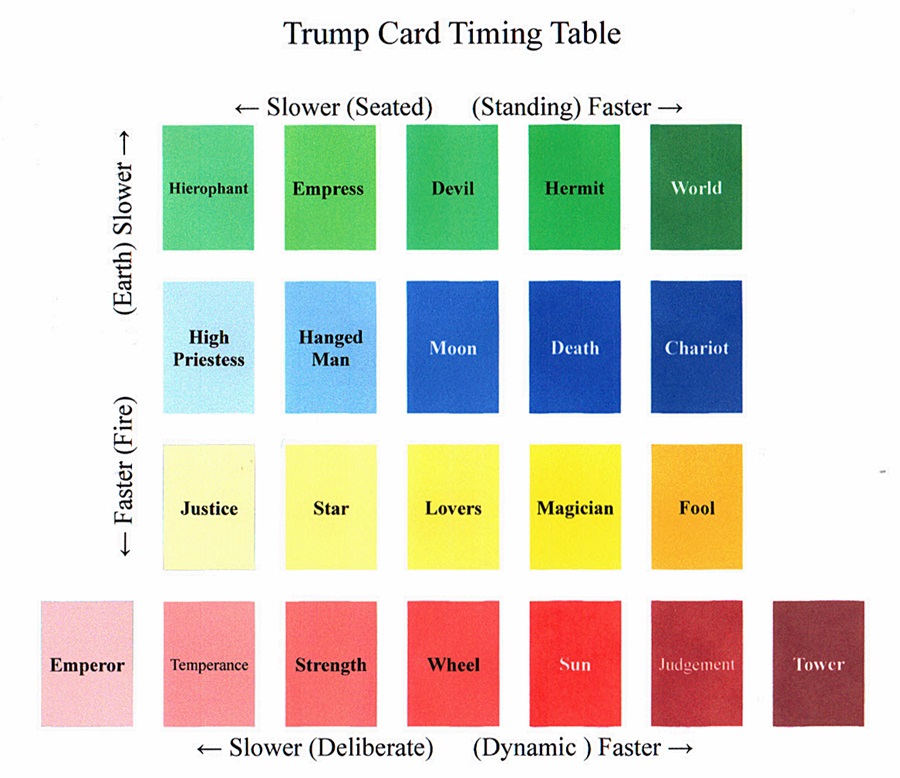
This is something the seeker can work with because it passes the “giggle test” for credibility. It works only for the numbered cards; for the court cards and trumps I’ve created less definitive tables that can be applied with a measure of elasticity in their temporal footprint, while acknowledging that some readers don’t use the Major Arcana at all for the purpose. In this regard, I sometimes employ only the “small” cards for timing predictions and there is a specific table for that methodology.
Here is an example. It uses trump-card elemental correspondences; horizontal or vertical (in most cases, sitting or standing) orientation of the figures or features; active/passive dynamics; and color-coding to paint a broad (i.e. non-quantifiable) picture of relative promptness. “Fastest” (or soonest to arrive) resides in the abrupt Tower at the bottom-right corner and “Slowest” (or most delayed in arrival) occurs with the restrained Hierophant at the top-left corner.