AUTHOR’S NOTE: I was just reading a passage in Dean Radin’s book Supernormal, in which he described a controlled “psi” experiment where subjects who believed strongly in extrasensory perception (ESP) scored significantly higher than non-believers on a blind symbol-recognition test conducted at a distance. Although Radin didn’t use the term, I’m wondering whether “auto-suggestion” on the part of the believers stimulated the acuity of their psychic cognition in an extraordinary way. We might turn the old cliche around by saying “believing is seeing” when it comes to clairvoyance.
Bringing this premise into the realm of tarot, it’s a given that many seekers arrive for a reading expecting to have their assumptions about the matter in question validated by the cards. (“I’m positive my husband is cheating on me. Don’t you agree?”) This anticipation is called “confirmation bias,” and it can skew the individual’s view of the testimony such that they latch onto only what they want to hear and ignore anything that doesn’t align with their private view of reality.
But suppose they apply the “power of suggestion” by asserting firmly that what they want most from the session (hopefully it’s the truth and not just self-serving “spin”) is in fact hidden within the cards even if those few that are cued up for the reading are likely to say otherwise, and all they have to do is concentrate on luring it out into the open so the reader can capture it in words. They must take this stance from the very beginning of the shuffle and not let it get away from them or they might wind up with a typically random, noncommittal answer.
This seems like a form of creative manifestation* where the cards that appear in the spread don’t just respond to subconscious induction in the usual way, they fall in line with the querent’s conscious intention to obtain the best guidance possible. Instead of asking blandly “What will happen in this situation?” the seeker can instead inquire “I know what I want. What must I do to get it?” Right out of the gate, the sitter is establishing the expectation that the tarot will cooperate with their “need-to-know” and cough up the most useful insights without pandering to their preconceptions. The seeker is no longer a pawn or “victim of the draw” but an active player in manipulating destiny by taking the action right to its doorstep. Although the bromide “You create your own reality” is not as simple as it sounds (see my post on the subject, linked below), this would be a good place to start.
Convincing our clients to see it that way and react accordingly will be the challenge since passivity is more common than motivation among those who consult the tarot. In their eyes, the reader is supposed to perform magic with the cards and the seeker’s only tasks are to nod in agreement at the appropriate times and then fork over payment. I’ve never operated that way, preferring to engage my sitters in a dialogue that flushes out what they’re really after. If I can see my way clear to that outcome during the interpretation I will give it to them; if not I will attempt to work the answer around to a parallel scenario that speaks to it in a different manner before giving up on the effort. I like to say that the tarot is infinitely adaptable, and this is a good opportunity to put that flexibility to the test.
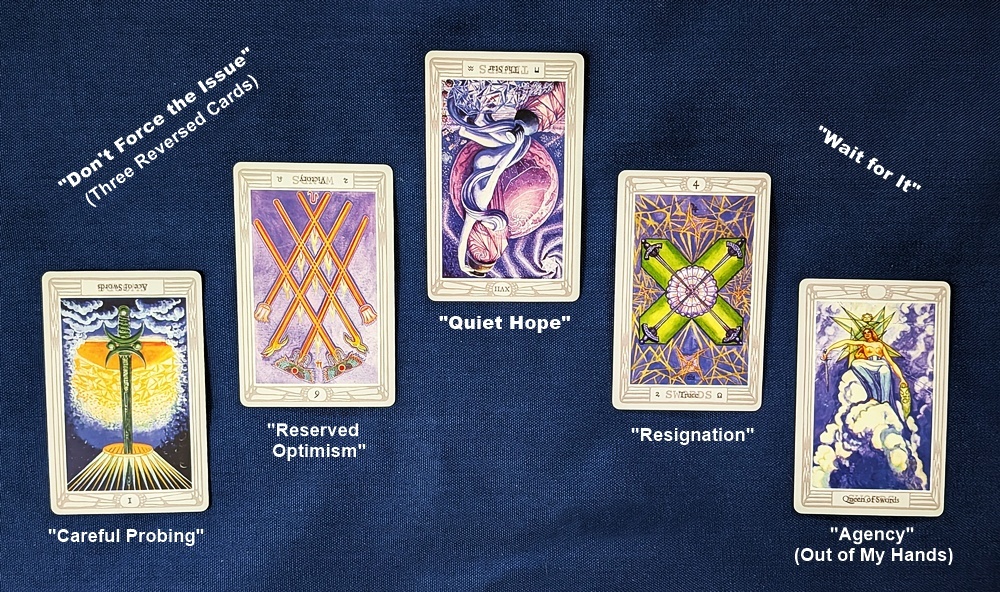
Here is an example reading. I asked the Thoth deck to give me it’s best projection regarding what I can do to get what I want in a situation that has been dormant for some time.
All of these cards except the 4 of Swords and the Queen of Swords are generally positive; the Four is neutral and the Queen keeps her own counsel. The three reversals at the beginning are telling me that the issue must proceed at its own pace and I am advised to avoid trying to force it.
The reversed Ace of Swords implies a delicate – even surgical – precision when probing my opportunities for achieving what I’m after. There is a certain secretive caution about its activities.
The reversed 6 of Wands (Victory) reflects a promise that is as yet unfulfilled. There is abundant potential but it is presently muted.
The reversed Star conveys the cliche “hoping against hope,” or clinging to my vision of the future when the situation is still very much up in the air.
The 4 of Swords (Truce) is the quintessential card of “lying down and avoiding” (to quote Monty Python). The wishful thinking of the first three cards has gone into hiding, which tells me to sit on my hands for the time being. Nothing will come of making waves.
The Queen of Swords is a card of “agency,” suggesting that the outcome will not be of my own making. The motivation that precipitates it will come from someone represented by the Queen (who is most likely biding her time as well).
Overall, these cards encourage taking a passive stance in the matter and letting it work itself out. I should remain alert for the intervention of the Queen of Swords and be prepared to meet her half-way.
*I’ve suspected that “manifestation” is the next “flavor of the month” in the self-help community, and a little sleuthing proved me right. It seems to have replaced attraction, mindfulness and “be-here-now” immediacy as the new super-power. The most interesting point I came across in my digging is that it relates to the “law of resonance,” not the Law of Attraction (other entrepreneurs have already claimed that one). The Kybalion calls this the “Principle of Vibration” through which we can attain self-mastery by attuning our cerebral frequency to a higher level of consciousness. It’s an act of alignment with the Universe in an “as above, so below” manner. All we have to do is determine what this larger reality is offering that we want to make our own and then aspire to it via a focused effort of Will. We don’t just wish for it, we create it through mental conditioning and appropriate action to realize the benefit. Empowerment does us no good if we don’t seize the power.

