AUTHOR’S NOTE: It’s a common practice, when a client arrives for a reading with no specific question or topic of interest in mind, for the reader to offer a “general life-reading” that explores the environmental theme or tone of the period for which it is performed. Some argue that this type of prediction is of little practical value since querents can make of it whatever they want, but I think there is more to it than that.
Suppose we think of it as a kind of “logic puzzle” that resembles one of those video-game riddles where we must push a series of buttons in a certain order to make a door open, but rather than trial-and-error applied ad nauseam until we get it right, we follow a defined sequence provided by a supplemental means of prognostication.
I sometimes view the consequences of a life-reading as being shoved in a particular direction and feeling compelled to push back. If we sense that we’re about to be crowded into a corner by circumstances, few of us with any gumption will sit still for it, but we may not have a clue how and where to apply our countermeasures to best effect. Take, for example, the typical five-card line. Normal procedure is to read it from left-to-right as a developmental scenario, with the final card as the “end of the matter.”
This is all-well-and-good as long as the cards behave and proceed in a coherent manner from beginning to end. But what if we have a scramble of mismatched combinations that defy being turned into a meaningful story? Rather than limping along as best we can, maybe there is a more imaginative way to approach it. I thought of rolling dice to change the order of the sequence, but they have six spots and I want to stay with the five-card model. Then I realized that dominoes have spots totaling from 1 to 5 in various combinations.
Using Joseph Maxwell’s theory of “isomorphs” (different pairs of numbers that add to the same value), I’m suggesting that, to increase randomness, we set aside, face-down, all of the tiles that meet the criteria: 0/1, 0/2, 0/3, 0/4, 0/5. 1/1, 1/2, 1/3, 1/4. 2/2 and 2/3, in as many iterations as the set contains. (Mine has 11 pairs of these number for a total of 22 tiles.)
Shuffle the tarot deck and deal five cards face-up from left-to-right. Reversals may be used.
Examine the spread for continuity of expression. If the flow of ideas is problematic (i.e. it is a meaningless jumble, clumps in non-intuitive ways, or “gets the cart before the horse”), turn to the pile of dominoes.
Mix the tiles around on the tabletop until thoroughly randomized. Then draw a tile, identify its number of spots, and move the card in the same numbered position to the first slot in a reconstituted layout.
Draw another tile. If its the same number as the first tile, cast it aside and continue drawing tiles until you get a different number. Take the card in the identified position (keeping track of the original order; I use “placeholder” base-cards), and place it in the second slot of the new layout.
Continue in this way to populate the third and fourth slots of the reordered series, discarding any tiles that have already appeared in one of their variations. The fifth slot will obviously hold the last remaining card.
Here is an example reading showing the final arrangement. I didn’t set out to intentionally create the worst array of cards possible, I just applied the above guidelines to a random pull for the purpose of demonstration. Consequently, it was possible that the new spread would be less decipherable than the original one although it didn’t turn out that way.
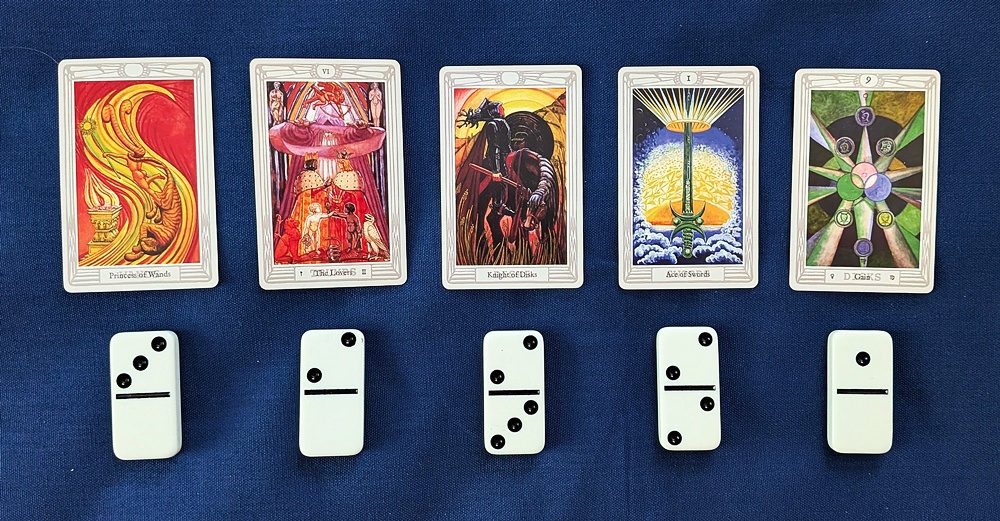
A Reconstructed “Thumbnail” Narrative:
The arrival of an enthusiastic young person (Princess of Wands) portends a momentous decision (Lovers), and a pragmatic older man (Knight of Disks) sees a clever way (Ace of Swords, the “bright idea” card) to make the most of it (9 of Disks, “Gain”).
You may have noticed that the fifth card (the 9 of Disks, signifying the bountiful harvest of Venus in Virgo) was originally the first card in the spread, which would have made no sense as a “cart-before-the-horse” situation. In the last position it bodes well for a successful conclusion.
 Parsifal's Wheel Tarot & Astrology