“One explanation for (human sentience) is that consciousness emerges as a result of the complexity and self-reflective recursion that is built into the circuits of the brain, like a hall of mirrors.”
– Dean Radin in Supernormal
AUTHOR’S NOTE: A commonly-help opinion among tarot practitioners is that the random cards pulled for a reading “mirror” the seeker’s mental/emotional state at that particular time, and by extension his or her subliminal awareness of the future that is also induced by the shuffle. In the best cases we will identify our previous station, our current point-of-departure and evidence of our destination in the spread.
As French tarot author Joseph Maxwell put it: “Coming events cast a shadow before them; each individual has a presentiment about his own destiny, which may remain latent: the normal processes of consciousness do not include such presentiments.” He went on to say: “What is loosely termed the subconscious is actively interleaved with the astral levels; the mental and intellectual processes, emanating from the intelligence, link themselves in a living web to the spiritual levels.”
This seems like a reasonable approximation of “how tarot works” across the psycho-spiritual divide until we contemplate just how many millions of possible permutations can occur in only a handful of the 78 cards when we combine them in a layout like the Celtic Cross. The reader’s task in matching the images to their subconscious origins in a way that produces accurate insights about the querent’s situation can resemble looking into a fun-house mirror due to the distortion that can creep into the outlook. The source of this disparity is often a jarring conflict between individual cards that resists being smoothed over with inspired rhetoric. How are we to interpret the presence of the harsh 10 of Swords in the middle of an otherwise delightful scenario without tainting the whole thing?
I like to say that creatively confronting such challenges is how we earn our fee as professional diviners. But it can be a difficult bind to escape when nothing jells into a coherent narrative and we are left with little to say that makes sense under the circumstances. We can keep talking to fend off an awkward silence, bur we risk falling back on our own biased preconceptions and anecdotal experiences rather than making a legitimate effort to grasp what the cards are trying to mimic in the sitter’s life. This kind of “filler” reminds me of the unintelligible adults in a Charlie Brown cartoon who are just making meaningless noises, but rather than embracing Charles Schulz’s “child-shaped world” we are trying to penetrate a “client-centric” one without knowing the language.
This compensatory action amounts to retreating into our comfort zone, which enables regrouping and redirecting the session but may not give the sitter anything useful with which to mount a tenable response going forward. On the other hand, if our goal is merely to “tick all the boxes” touched on by the cards as we plow through the interpretation, we may be guilty of mindless completionism that pays no attention to the nuances of subconscious “mirroring.” Somewhere in the middle lies the sweet spot that accommodates both literal observations with an outward thrust and impressionistic reflections of inward reality. Both spring from the same place as Maxwell surmised but the latter are much more elusive.
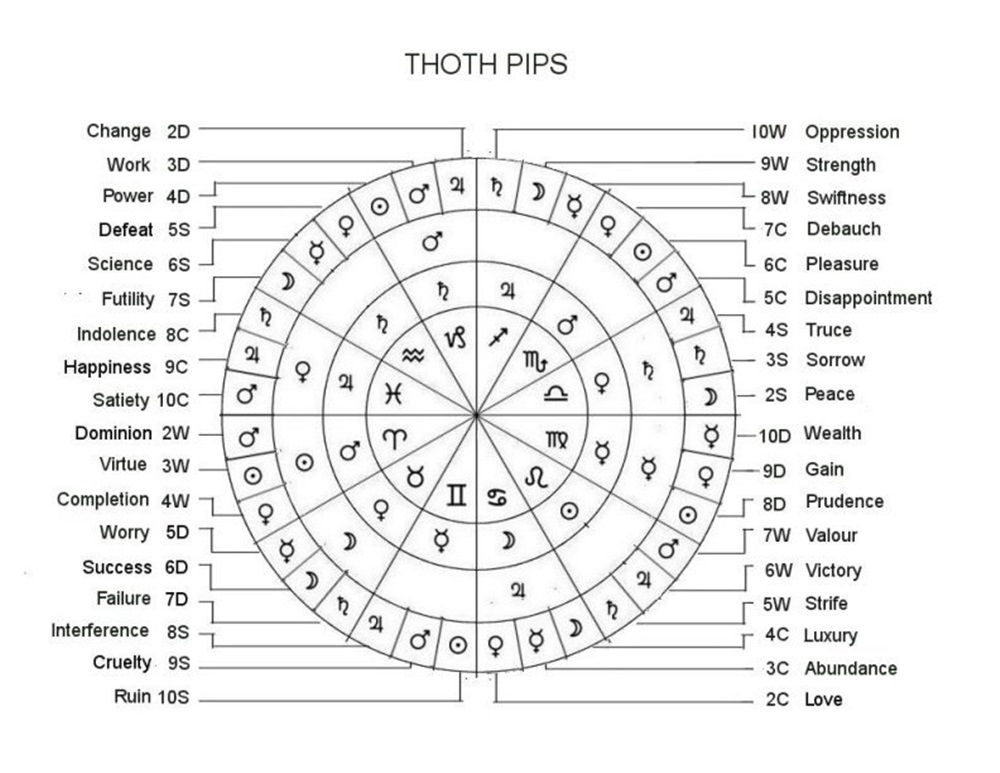
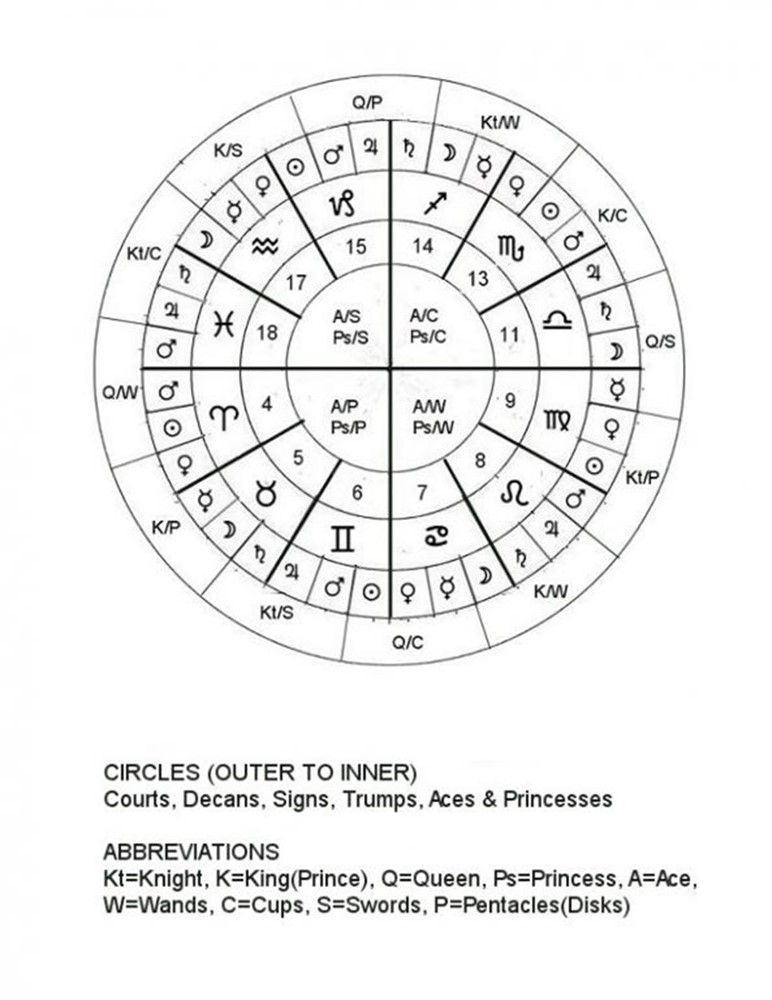
One experimental approach to the “hall of mirrors” that I’ve tried is the “Chaldean” wheel of astrological correspondences created by the Hermetic Order of the Golden Dawn (see the diagrams below), in which 68 of the cards have a direct correlation to the 36 individual decans, the 12 signs or the four celestial quarters (and broadly to all three, as in the 2 of Wands relating to the Mars decan of Aries in the Northeast quadrant of the Northern Hemisphere).
Each of the cards has a counterpart directly opposite it on the wheel, and it’s interesting that the diametric pairs – although often of different temperament – are of the same polarity and compatible element, while (except for the trump cards) they are also of the identical number or rank. The other ten cards (all Major Arcana) aren’t present but can be brought into the picture via planet, sign, element and/or polarity, although I won’t go into that here.
Consider the 10 of Swords. It is opposed by the 10 of Wands; one is Air and the other is Fire, two “friendly” elements, and both are Tens of positive polarity, suggesting that these cards could be more complementary than contradictory if properly aligned. Metaphorically, by swapping in its counterpart we could say that the victim of the fatal stabbing in the 10 of Swords can “beat the blades into staves,” transforming them into a burden that can be shouldered as shown in the 10 of Wands and not merely suffered. In this instance, the secondary card is more encouraging than the primary one, presenting a way out of the dilemma.
But the terms of recovery wouldn’t be as agreeable if the sequence were reversed, and pairs like the 5 of Pentacles and 5 of Cups offer little in the way of benefit from which to choose regardless of the order of their appearance. On the other hand, with the 9 of Cups and the 9 of Pentacles we can take our pick of pleasures. As one would expect when mixing-and-matching 68 instances of planetary, zodiacal and elemental energy to create allegorical mirrors, the result is a miscellany of fair and foul indications.
It’s also intriguing to suppose that, depending on the qualities involved, the secondary card could exhibit characteristics of the reversed orientation of its primary partner (a concept I explored in a previous essay). Regarding the last example above, some mystics will tell us that emotional satisfaction (9 of Cups) will decrease in direct proportion to any increase in the quantity of our material possessions (9 of Pentacles). I haven’t seen it happen yet, so I guess I don’t own enough to feel as jaded as the reversed 9 of Cups would imply (unless we’re talking about tarot decks).