AUTHOR’S NOTE: The prior experiences a seeker brings to a tarot session are often exceedingly complex. Promises of favorable conditions are turning out “too good to be true” while those that warned of misfortune now appear to be “not half as bad as they seemed;” in the most challenging cases the two are mingled
This scrambled state of affairs is not uncommon, and the purpose of the reading is to sort everything out so the querent has an idea where life is headed in the near future. But tarot cards are not always effective at handling this duality and can be “all over the map” in a spread. Here I’m proposing a way to dial in the picture and deliver a sober, clear-eye outlook on the reality of the situation.
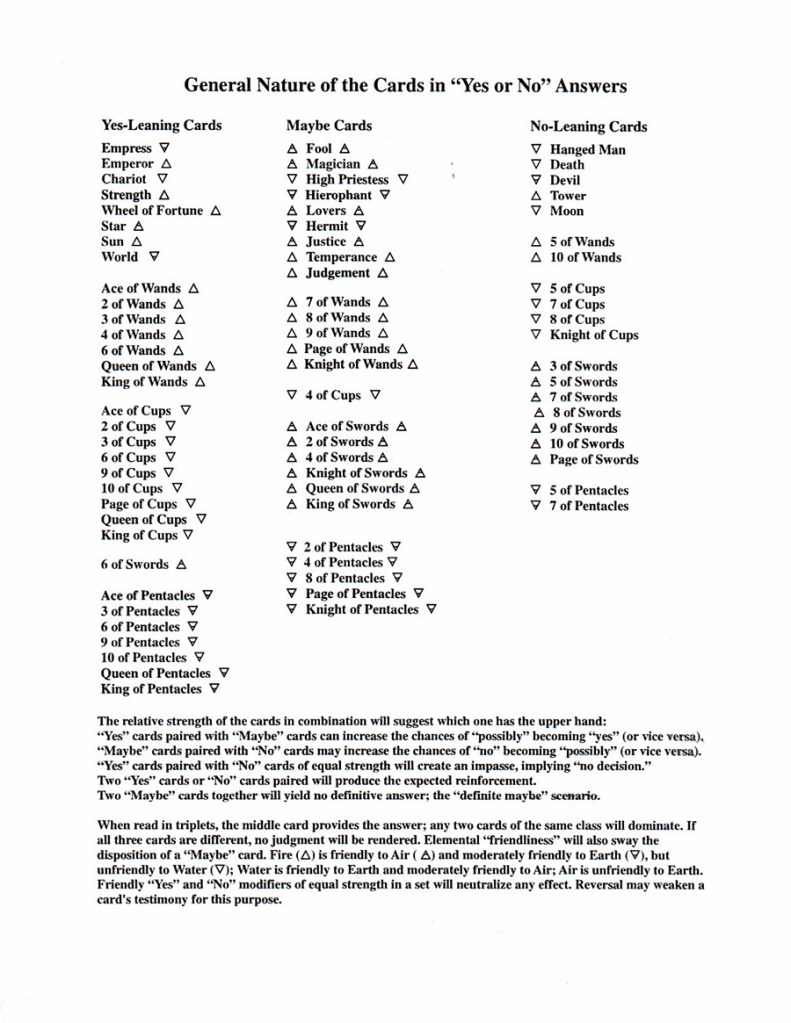
This reading requires two decks. The first one is left in random order and shuffled as usual before dealing. The other is separated into three subsets, one of generally positive cards; one containing traditionally negative cards and one with cards of a neutral character. The attached table is my attempt to make this cut and can be considered a baseline, but you can apply your own distinctions if you like. The cards of the second deck are used to adjust the “good, bad or indifferent” nature of the cards pulled from the first deck to populate the spread. They will tweak the original impressions as described in the next paragraph.
The idea is that a ” good” supplemental card will alleviate the negativity of a “bad” original card; a “bad” addition will dilute the positivity of a “good” one; and a “neutral” expansion will either deepen the ambiguity or redirect the focus of an undeclared one. With the exception of the special case involving neutrality (more on that later), this will serve to flatten the curve in a way that offsets any unrealistic expectations or apprehensions the sitter may have brought to the session. The aim is to minimize overreaction.
I decided that the five-card line is the best layout to use for this because it offers a “bell-curve” profile with a turning-point or crisis position in the middle that the first two cards build up to and the last two retreat from, with the cards at either end as the starting gate and the finish line.
To begin, set the reading deck aside for the moment and separate the supplemental deck into the three sub-packs as described above.
Shuffle the reading deck and deal five cards face-up from left-to-right. Reversals may used if that is your usual practice.
Examine these cards to determine which category they fall into. In the example reading below I’ve used the “+” (plus), “-” (minus) and “~” (tilde) symbols to designate positive, negative and neutral status.
Next, shuffle the three supplemental subsets individually. (Once again, reversals may be introduced.) For each original “+” card, randomly draw a card from the negative subset and place it above that position. Repeat this step for each original “-” card, pulling a card from the positive subset and placing it as indicated. Do this again for each original “~” card, drawing from the neutral subset.
Study each positive/ negative and negative/positive pair to see if blending of the two cards moderates the effect of the original card in a meaningful way. Introducing a strong negative card can largely obliterate the benefit of a weak positive card, while adding a powerful positive card can greatly diminish the detriment of an anemic negative card to beneficial effect.
The neutral cards require a more thoughtful approach. They can be a mixed bag, with some leaning optimistic while others are more pessimistic. If the supplemental card “doubles up” on either quality, the combination can be re-binned into the positive or negative population. If not, the emphasis can be viewed as inconsequential to the outcome and the original card will prevail.
Read the ten paired cards as a story describing how the adjusted circumstances will play out for the querent.
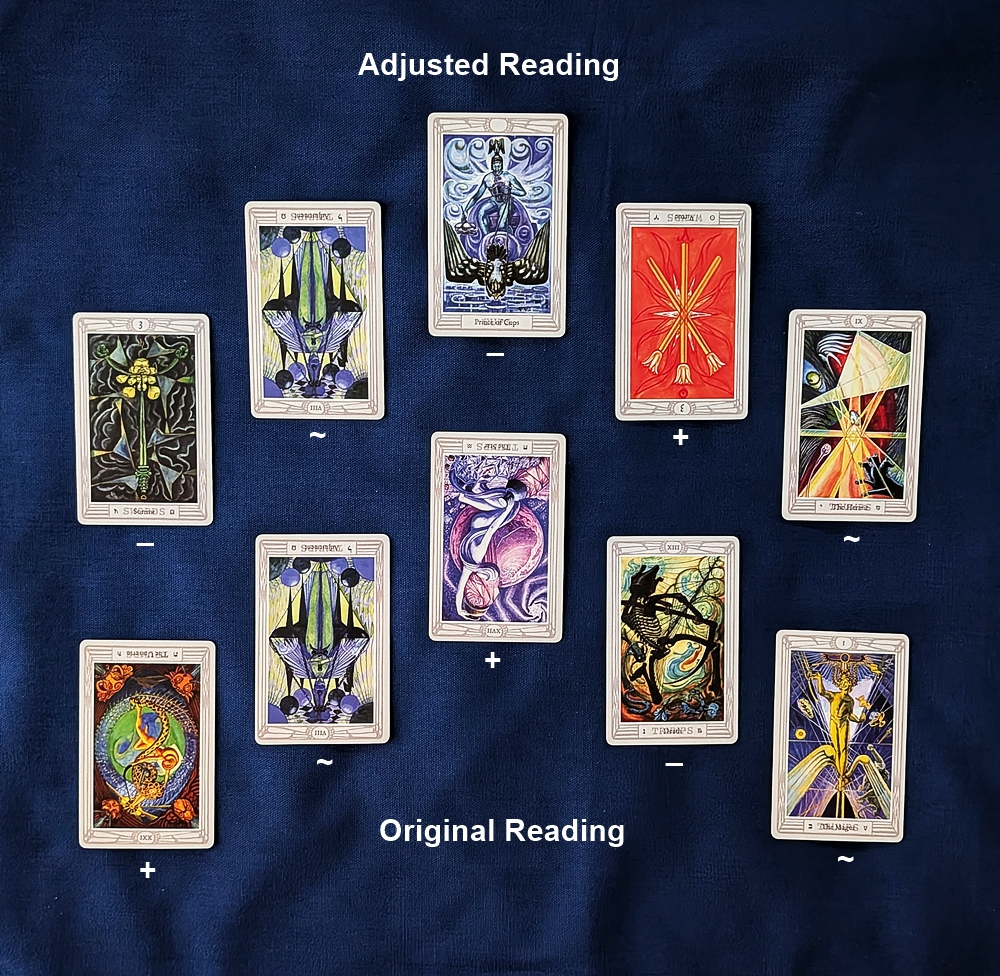
This example reading is for a hypothetical male querent who is involved in matters that exhibit a number of significant pros and cons related to his aspirations.
In the original reading, the Universe reversed shows that he is prepared to accommodate an unseemly compulsion to overturn his whole world in the hope that it will become something closer to his liking. But the reversal is making him hesitate, and adding the 3 of Swords to the mix indicates that he is experiencing mental anguish over the likely consequences. Interestingly, the number of the Universe (21) reduces numerologically to “3” and the reversal lends it an uncomfortable quality that echoes the 3 of Swords; note also that Earth and Air are unfriendly elements.
Adjustment (Justice) reversed in the original reading suggests unsettling legal implications, and the fact that this same card with the identical orientation turned up randomly in the supplemental pull can only mean that the unpleasantness will escalate into full-blown complications if he proceeds.
The Star reversed in the turning-point position reveals that he is hoping against hope for encouraging developments, but the sleazy Prince of Cups as the “adjustment” card implies that his underhanded actions will cause the advantage to slip away from him. (It could also mean that a devious younger man will steal his thunder, dashing his hopes.)
The original Death card seems to be putting a decisive end to his plans, and augmenting it with the reversed 3 of Wands (compromised “Virtue”) does nothing but punctuate the downfall signified by the corrupt Prince of Cups. I also notice that the hierarchical number of the Prince (12) reduces numerologically to “3,” thus conspiring with the tainted 3 of Wands and the unhappy 3 of Swords.
The Magus conveys the idea that he will be “flying solo” and must fall back on his own resources if he continues down this road (the image looks like he escaped Death without even the clothes on his back). Including the Hermit makes it obvious that he will wind up completely alone and isolated, thus retiring to contemplate his folly. I’m reminded of the closing verse from Coleridge’s Rime of the Ancient Mariner:
He went like one that hath been stunned,
And is of sense forlorn:
A sadder and a wiser man,
He rose the morrow morn.
The advice for the seeker is to think twice before overthrowing his current lifestyle for an elusive hope that will result in his being legally lambasted and cut loose from the thing he wants most. I don’t see any winning combinations here. When the two series are read in tandem, at the end of the day he will be disabused of his ambitions for a better world and kicked out of it to boot, mainly due to his own actions. The extraordinary doubling of Adjustment reversed is difficult in the extreme and is the primary stumbling block here. His just desserts will start to plague him before he gets very far along the path; from there it’s all downhill.