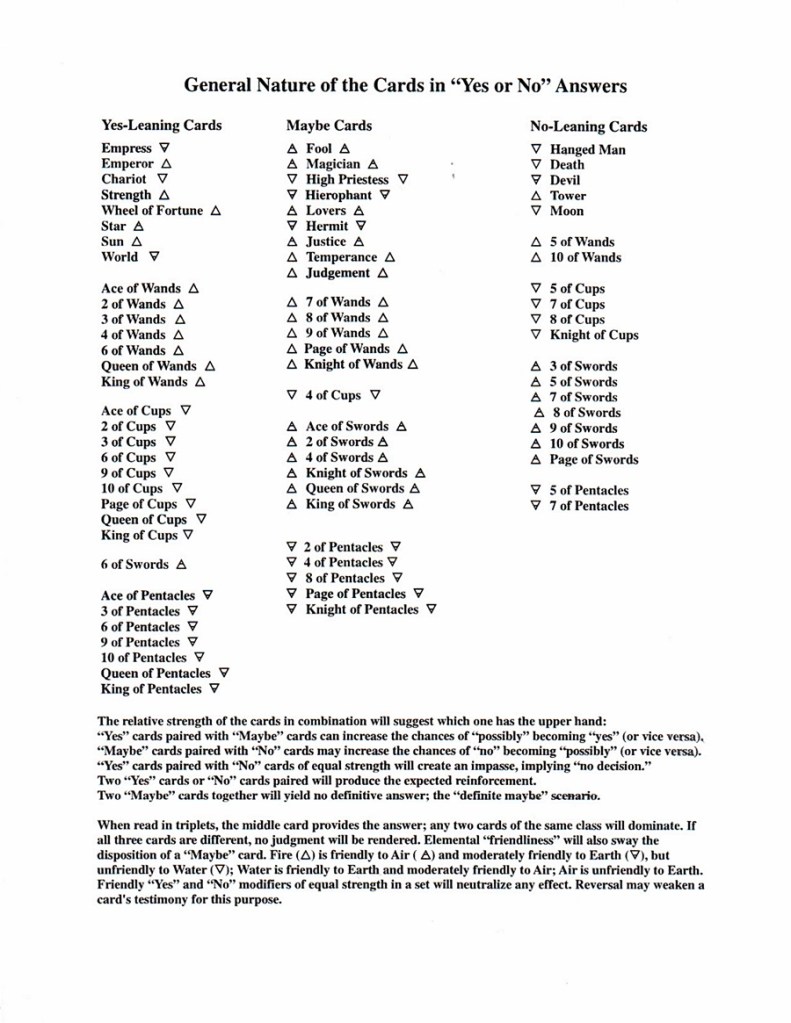
AUTHOR’S NOTE: In her 1971 book, Mastering the Tarot, Eden Gray presented a three-card “yes-or-no” predictive model that had the four Aces as its key feature. (Benebell Wen’s Holistic Tarot pointed me at it and I do in fact own a copy.) I’ve adapted Gray’s approach in developing this spread, but I won’t offer a thorough comparison of the two and will instead provide my own expanded method for your consideration. At the bottom of this essay I’ve included a table of “Yes-leaning, No-leaning and Maybe” cards that I’m proposing for this application rather than the Aces of Gray’s design. If you have something similar with which you’re more comfortable, use that.
In her estimation, one upright Ace among the three “answer” cards generated a “Yes” conclusion but when reversed it delivered a “No.” A pair of Aces gave a two-part prediction but she didn’t say what they conveyed in “yes-or-no” terms so I’m assuming they meant “yes” if both appeared upright and “no” if they both turned up reversed; when the first one was upright and the second reversed, an initially encouraging answer might shift toward pessimistic, while in the opposite order a doubtful outcome could shape up to be more favorable. If all three cards were Aces, the outcome would be an emphatic “Yes” and any reversals would only imply delays or complications in getting there.
Gray’s premise was to shuffle the deck (including reversals) and deal cards face-up into a pile until either an Ace emerged or a 13-card limit was reached, whichever occurred first. This was repeated for two more subsets. No Ace in a stack after thirteen pulls meant no answer from that location, and no Aces at all ended the reading without resolution. My way is a little more open-ended.
Begin by shuffling the cards in a way that will introduce reversals while concentrating on the question or subject, and cut the deck if desired.
Deal a single card face-up from left-to-right into each of the three positions.
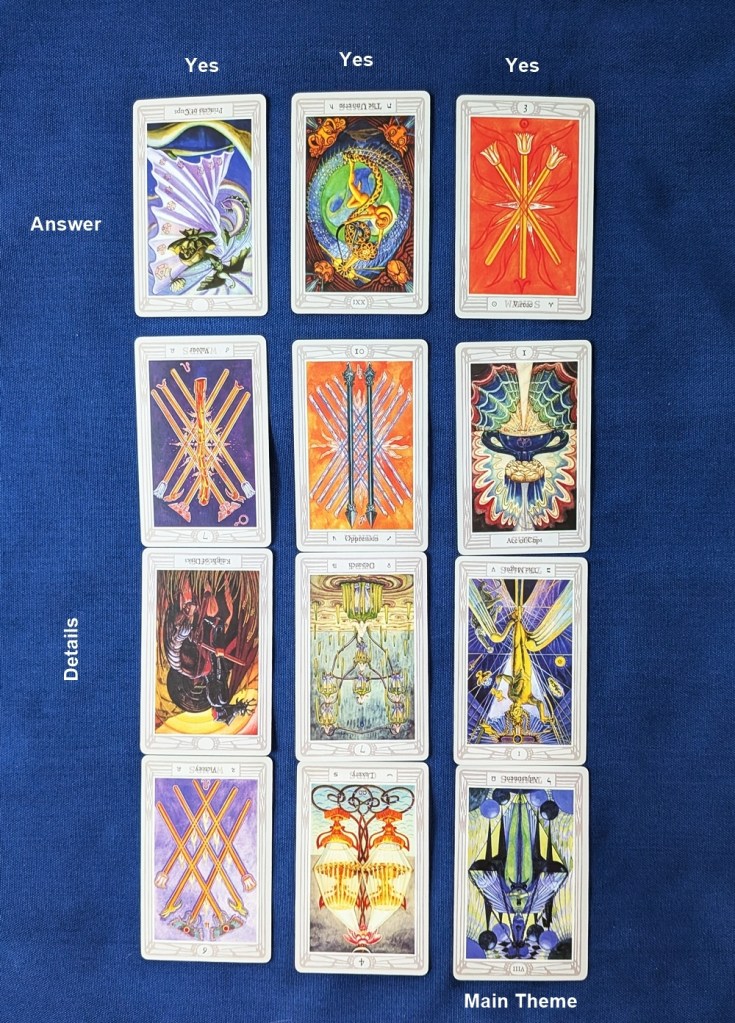
If a more detailed outlook is desired beyond a simple yes-or-no answer, continue dealing cards left-to-right until you have the required population, placing them in order beneath the original yes-or-no cards. (I recommend no more than three additional cards in each stack.) In that case, the top cards would reveal the composite yes-or-no complexion of the reading and the rest would describe why they responded that way. I would read only the subset (the “Main Theme”) that underlies the most conclusive of the “answer” cards, either yes or no, since too much information could potentially cause conflict and confusion. Judgement will be required to select which it is, but rank is usually a reliable determinant along with orientation.
Examine the three top cards and make a yes-or-no decision according to their “binning” as shown in the table. Assuming there are no “Maybe” cards in the mix, a single “Yes-leaning” card would yield to two “No-leaning” cards, producing a “No” answer, and vice-versa for a single “No-leaning” card, resulting in a “Yes” answer. As always, the rank and inherent nature of each of the cards can aid in establishing which one exerts the most leverage when it is necessary to choose between them. The only difference is that if there are any “Maybe” cards present, their input would be ambiguous and they should be excluded from consideration, leaving fewer options to analyze.
With one “Maybe” card, the other two could be deadlocked, and if so the more powerful of the two should be given the nod (for example a trump card – whether positive or negative – would outrank a court or pip card). If there are two “Maybe” cards, the testimony of the third card would be uncontested. If the three “answer” cards are “Maybe,” no confirmation is possible at the time of the reading although the cards beneath them can still be reviewed to explain what is going on in the situation. If all of the cards are “Yes-leaning” or “No-leaning,” the answer is definitive and needs so further evaluation other than assessing the minor impact of any reversals.
Here is an example reading to illustrate the process. The question involved what is likely to happen in a decision-making scenario if I attempt to pursue the most ambitious course of action. Would I receive a “green light,” a “red light” or a “yellow light?”
In this spread, all of the answer cards are “Yes-leaning,” giving a resounding “thumbs-up” to proceeding. However, two of them are reversed and one in particular is a highly significant trump card, so the advice is to exercise discretion by not being too forceful. The suggestion of the reversed pair is that the object of the initiative, although approachable in theory, is in a sequestered world that doesn’t invite intrusion. Even the enthusiastic 3 of Wands is titled “Virtue” and seems uncommonly fastidious, although it is still more insistent than its reversed peers.
I see this as a cautionary “yellow light” that may change to “green” as soon as I take a step forward, but I shouldn’t count on it happening immediately. The verdict is identical to those I received from several more elaborate readings on the subject: patience is a virtue. The narrative cards under the 3 of Wands include one potent “Yes” card followed by two reversed “Maybe” cards, suggesting a viable but dicey opportunity. One overly clever misstep (Magus reversed) could cause repercussions in the form of unpleasant “just desserts” (Adjustment reversed).