AUTHOR’S NOTE: I’ve been getting a bit bombastic lately, so here is a “palate-cleanser.”
I often employ both tarot cards and dice in what I call mixed-media readings. While I use the odd-and-even faces of the dice mainly as binary “pointers” in multi-path spreads to indicate which of two or more series of cards should receive preference, here I’m applying them to show the progress of a trending condition from one extreme to the other, either “favorable” to “unfavorable” or vice versa, crossing adjacent “moderate” zones and traversing a central “neutral” zone as it goes. Where the last card lands shows the seeker’s final standing in the matter.
After a random draw of the first card (the nature of which will dictate the starting point for the trend), the remaining four cards are placed in the matrix sequentially based on the roll of a single six-sided die with no regard for the good or ill status of the card pulled for each position. The numerological assumptions I’m using come from French tarot writer Joseph Maxwell’s 1933 book, The Tarot.
For the purpose of this experiment, the numbers One and Six are considered neutral. One is the unitary “root” of the numerical series and in Pythagorean number theory it is represented by the massless and motionless Point. Six expresses both positive and negative qualities via the multiplication of “2×3” (Maxwell described it as countervailing passivity and opposition). Rolling either one does not move the trend line up or down so the status quo of the previous card prevails.
Two and Four are harmonious numbers that will cause a trend to rise one notch in the favorable direction, while Three and Five are discordant numbers that will degrade a trend, driving it downward one position. For Maxwell, odd numbers were active and unbalanced; even numbers were passive and promoted equilibrium. In this exercise I see one as “digging a deeper hole” and the other as levitating out of it.
The nature of the cards pulled will describe the experience at each juncture on the trend line, and reversal will modestly adjust a card’s disposition to be less dynamic without altering its position in the matrix.
If a trend line reaches either extreme and can go no higher or lower, subsequent rolls will not budge it unless they move the trend in the opposite direction.
In this hypothetical example reading I asked what would have to happen in order for me to obtain what I want.
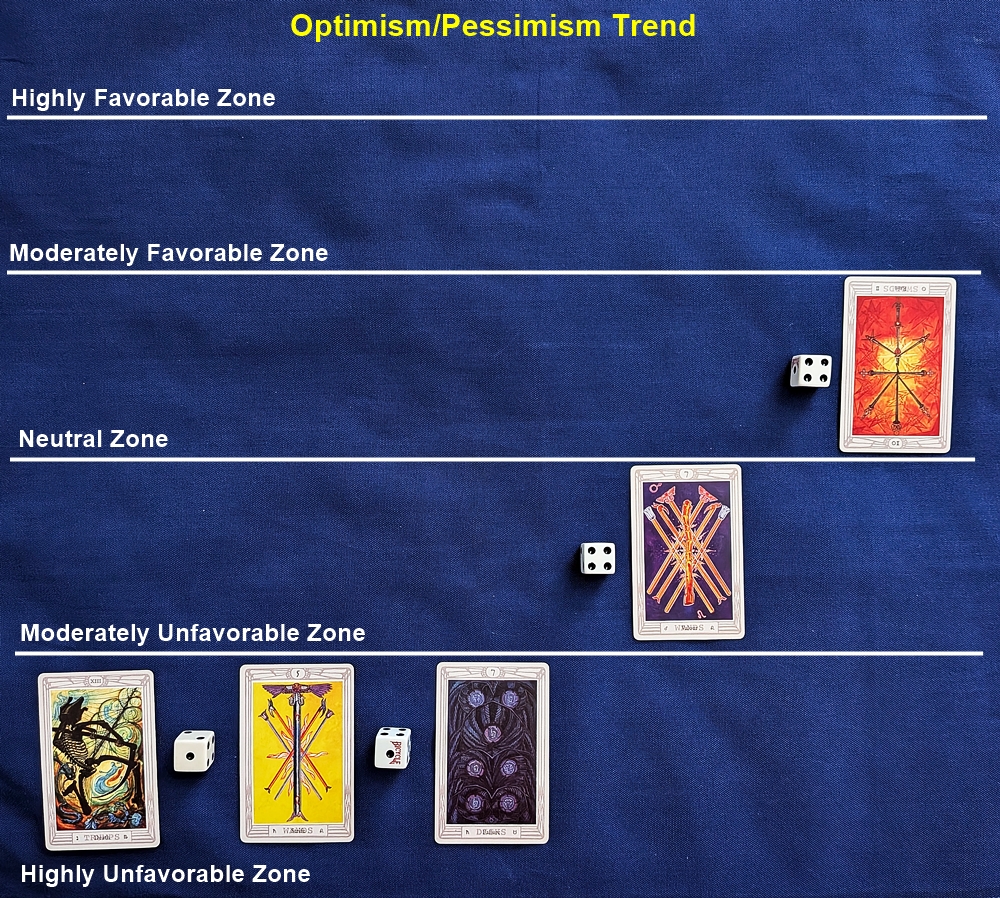
The random card I pulled to initiate the trend was Death, indicating that some kind of significant disruption will have to occur before anything will advance in the situation. It looks like I’m “behind the 8-ball” right from the start in the Highly Unfavorable Zone, and full recovery in pursuing my goal is unlikely.
Next, I rolled a neutral one-spot on the die, so the following card remains in the same zone. The 5 of Wands is titled “Strife,” and it implies that a good deal of antagonism will follow on the heels of whatever Death brings to an end. If Five is the “number of Man,” then this man could be headed for a showdown.
I rolled another one-spot, again leaving the trend line slack. (I’m running out of opportunities for things to evolve upward.) As the third discouraging card in a row sitting at the bottom of the heap, the 7 of Disks (“Failure”) could signify the pit of despair, or at best the Golden Dawn’s “success unfulfilled” or Waite’s incomplete harvest. Within the context of the question, I would expect the latter.
I then rolled a Four, which is the squared potential of Two, the binary root of harmony and equilibrium, so things are looking up as the projected trend improves one notch. The 7 of Wands (“Valour”) conveys holding the moral high ground and “fighting the good fight.” Its position reflects stepping out of the mire of the 7 of Disks with head held high even if there is still mud on my boots. Two Sevens in a row depict heading out decisively in a new direction, although without a lot of vigor.
Finally, I rolled another Four, again raising the trend line incrementally to bring it into the “Neutral Zone.” This is not where I had hoped to be at the end of the matter, but it is at least a stable place to fetch up and hopefully mount another initiative when things settle down. The 10 of Swords has been called “more of a ‘death’ card than Death itself,” but in less depressing terms I see it as a developmental “sticking-point” or “prickly situation.” The reversal could mean bottled-up anxieties and frustrations that will be more exasperating than debilitating, and I consider it one of the most mentally enervating indicators in the deck.
All-in-all, this is not a very optimistic group of cards so I won’t hold my breath for a happy ending and will most likely have to settle for neutralizing post-trauma stress reduction.
 Parsifal's Wheel Tarot & Astrology