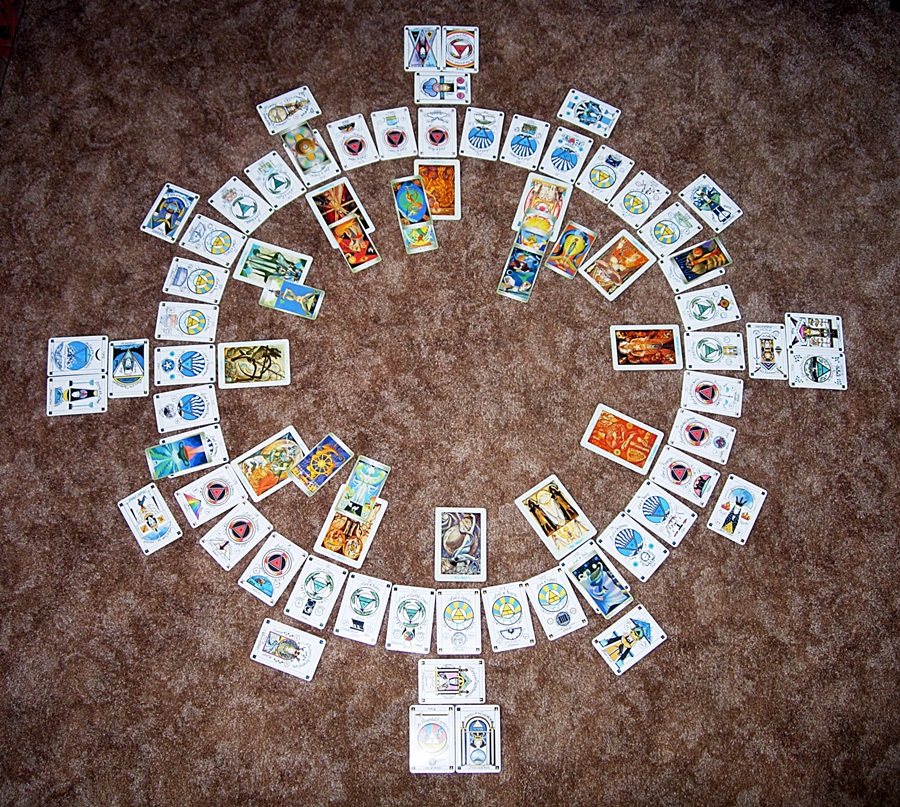
AUTHOR’S NOTE: The topic of ritual preparation for a tarot reading comes up frequently in the online community, and there is a wide range of practices from which to choose. It’s fair to say that my own opinion diverges substantially from the mystical assumptions of the average diviner. (For the more rational cartomancer, this essay approaches the borders of “gimme-a-break” territory, so take it for what it’s worth.)
It’s been many years since I systematically performed any kind of ritual operation before embarking on a reading. I’ve come to accept that the mode of intense concentration I enter at the start of a self-reading produces what Benebell Wen describes as the elevated state of mind that will “push it beyond ordinary consciousness.” For a long time I silently intoned a “white-light” invocation but eventually kept forgetting to do it and the lack of ceremony made no difference to my sensitivity and receptivity. At least for me, the cards generate their own aura of sanctity when approached with sufficient sincerity and respect, no magic words required.
When reading for clients, I could continue the practice while they’re shuffling the deck, but I no longer see it as necessary. If it is treated as a “received” vision and not just an intellectual construct, the reading itself constitutes a symbolic statement of faith in the source that needs no ritualistic embellishment; in the right hands, it is a talisman entirely on its own merit and may even serve as a mandala (both of which are present in an astrological chart; see my full-on stab at it below). I’m not at all religious so I don’t view the cards as vessels of spiritual wisdom, they are mainly tools to focus our attention that we might think of as “can-openers for the unconscious.”
A related subject involves the use of supplemental “props” to energize a reading by emotionally simulating both the reader and the client: crystals, candles, incense, etc. Once again, this is pure mysticism that might help to center novice readers and make them feel powerfully connected to the origin of their insights, but such trappings are mostly stagecraft for the sitter’s benefit and part of what I call the “theater of tarot.” They may hold a place of honor in the conduct of tarot as a performance art but they don’t add materially to its overall effectiveness except perhaps as a suggestive “tune-up” for the practitioner.
All that aside, I’m not completely immune to the charm. I do have a large quartz crystal that I can use to generate a positive energy field; a pewter bell that I can ring for “clearing;” various gemstone rings that have specific esoteric properties; and a variety of incense and essential oils to create ambiance. I just don’t use them because when I’m reading for myself I’m usually in “experimental” mode while testing a new spread, which doesn’t lend itself to arcane rigamarole, and when reading for other people the types of sitter I normally engage are decidedly not of the “woo” persuasion. After all, I have my public dignity and credibility to maintain if I want to avoid the stigma of “crackpot” (he says tongue-in-cheek, echoing Marty Feldman’s cheerful rejoinder to Gene Wilder’s “Damn your eyes!” in Young Frankenstein: “Too late!”).