AUTHOR’S NOTE: I recently began reading Robert Anton Wilson’s Prometheus Rising. I’ve dipped into his published work sporadically and randomly over the years with no clear chronology in mind, but as the old advertising slogan goes, you “can’t eat just one,” and in Israel Regardie’s introductory comments I encountered the food for thought that inspired this essay.
Regardie describes Wilson’s frequent reference to the euphemistic “Law of Three” in which every pair of opposites shares a midpoint that neatly reconciles the two extremes, mediating between “Severity” on one hand and “Mildness” on the other. There is an unmistakable allusion here to the three pillars of the Qabalistic Tree of Life, except that the outlying pillars of the Tree are labeled “Severity” on the observer’s left and “Mercy” on the right, while the interleaved Middle Pillar is assigned “Mildness” (which seems to make more sense to me even though I have yet to penetrate Wilson’s own thoughts on the subject). This three-fold partition is “old news” for most esoteric practitioners.
While I’m not yet familiar enough with quantum physics to know whether it holds true in current thinking (although I suspect it doesn’t), in classical physics it seems to be axiomatic that, before succumbing to friction, every mature phenomenon eventually finds its apotheosis in a state of equilibrium that is ideally harmonious and not merely exhausted, although total enervation leading to dispersal is not unknown. Assuming that no further energetic force is applied, the “clockworks” ultimately stop ticking and a period of rest ensues.
In a Newtonian rotational model, when radial, outward-thrusting centrifugal (“center-fleeing”) force – actually an apparent effect stemming from the speed and inertia of a moving object – abates as circular momentum slows, the inward-drawing and offsetting centripetal (“center-seeking”) force, a “tethering” influence that has heretofore been countered by the inertial, straight-line thrust, takes over and the impetus behind expansion dwindles toward the stationary axis as a Newtonian imperative (kind of like falling out-of-orbit).
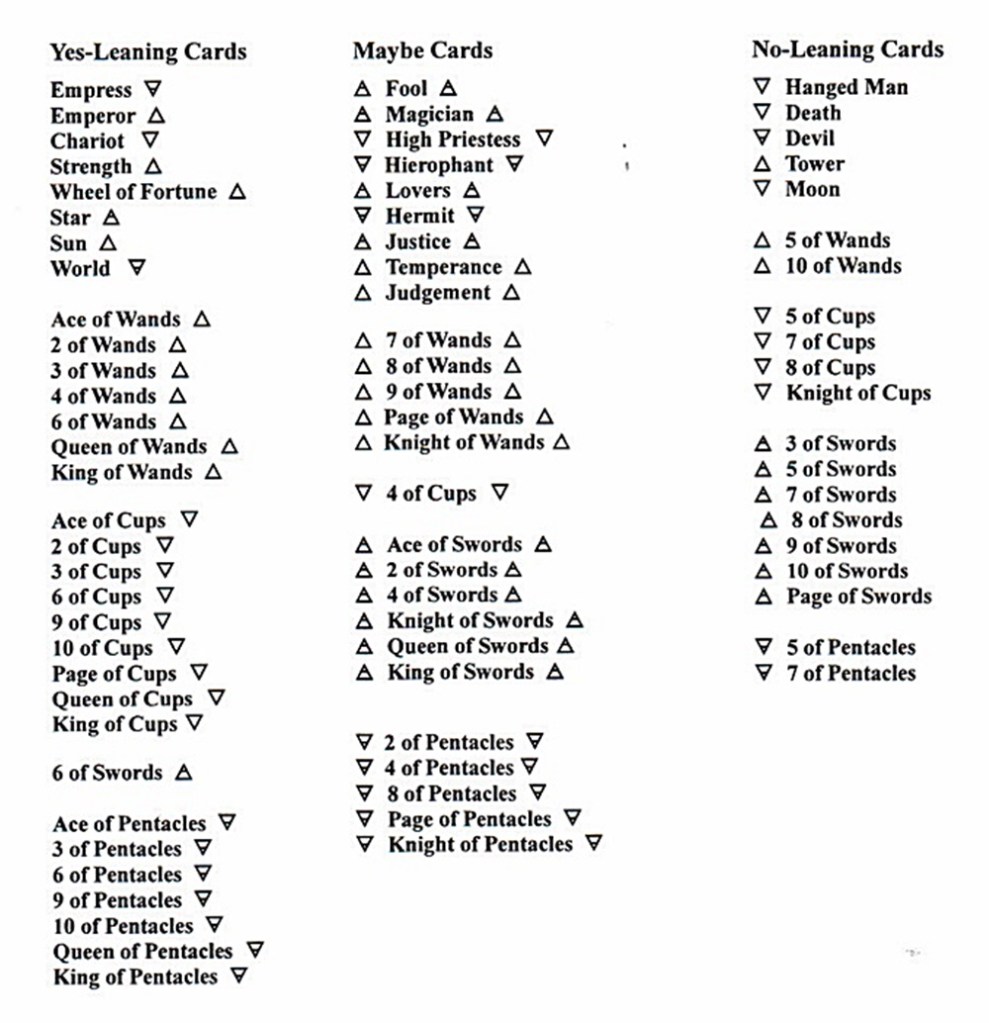
When it comes to reading the tarot cards, many years ago I separated the deck into three categories: “Yes-leaning” (which might be considered “centrifugal” in nature as an expansive “force for good” that in most cases inflates the sitter’s hopes in the matter); “Maybe” or neutral in their import with no bias either way; and “No-leaning” (a nominally equal-and-opposite “centripetal” and therefore constraining “force for ill,” in most instances exaggerating the seeker’s fears). While the split is not uniform since there are fewer “No” cards than their “Yes” or “Maybe” counterparts, in practice it makes little difference since the necessary emphasis will commonly appear when the conditions attending the reading demand it. On balance, “Yes-leaning” cards stimulate optimism; “No-leaning” cards foster pessimism and “Maybe” cards promote resignation and perhaps fatalism, but there are occasional exceptions. (Note that I don’t fully subscribe to the “no bad cards” paradigm, which in pragmatic terms doesn’t invariably hold water.)
The reader’s goal should be to strike a reasonable balance between any warring factors in the spread that will allow the querent to make progress in resolving the issues that led to the inquiry. In my own work I set out in that direction with a “gestalt” (aka “40,000-foot”) overview that fills me in on what I will have to deal with from the standpoint of reconciling opposites and charting a negotiable route between or around them. The correct term for my focus is “preponderance:” depending on the context of the reading, more “Yes” than “No” cards could bode well for the querent’s aspirations. Conversely, an in toto “No” complexion would most likely be unwelcome unless one craves a reversal of fortune, while an abundance of “Maybe” cards would be inconclusive.
Obviously, a majority of “Yes” responses regarding “Is my spouse going to leave me?” would not necessarily be for the best unless the querent happens to be Danny DeVito celebrating Bette Midler’s kidnapping and impending demise in the dark comedy Ruthless People. (We’ll disregard the old joke question that has no acceptable answer since “Yes,” “No” and “Maybe” would be equally damning: “Are you still beating your wife?”)
Once I confirm where the “Yes” peaks, the “No” valleys and the “Maybe” plateaus lie in the spread’s topography (whether at the beginning, near the middle or at the end), I can lay out a “roadmap” for their successful navigation. As always, this would be presented as informed advice for the sitter’s review, not as a prescription for remedial action. If numerous “Yes” indicators reinforce a negative prospect, the path forward would be much different than if a welter of “No” signals mitigates such an outlook, in which a compound “no” or “double negative” often yields a more favorable result. I can counsel, but it’s the seeker’s job to choose.
It becomes a matter of parsing the fine details and reformulating them into a coherent whole that produces a rational framework for implementation. Looking at it with unblinking impartiality, too many “Yes” cards could imply either an exhilarating but dangerously unstable “hot-air-balloon ride” or, alternatively, an unrelenting uphill slog in the face of “toxic positivity;” an excess of “No” cards might suggest a slough of inertia or a “slippery slope” that is all-too-convenient when present under tempting circumstances, and a raft of “Maybe” cards militates for the status quo in which the answer received is no answer at all if there happens to be a pressing need for change.
The bottom line for me is that I’m mounting a full-scale theatrical spectacle.and not simply moving the scenery around for the sake of aesthetics. If a casual sitter wants only the psycho-sociological “sizzle” and not the philosophical or practical “substance,” the plot-line I put together for a reading will almost certainly baffle them in its intricacy and profundity. It’s something I can’t help (nor do I want to), so I have to come up with medial language every time that occurs.
In my opinion, fluency in speaking to all levels of sophistication is the primary driver for developing a well-honed tarot vocabulary; mediation comes easily when the words are eminently scalable to the querent’s degree of comprehension. A love of tarot and a love of language make an ideal combination for finding the “sweet spot” in getting the implications for this kind of “midpoint mash-up” across to the querent.