– from Ain’t Wastin’ Time No More by the Allman Brothers Band.
AUTHOR’S NOTE: As a classical astrologer I don’t agree with the elemental assignments for the four “humours” (choleric, sanguine, phlegmatic and melancholic) presented in a slightly different form by Robert Anton Wilson in Prometheus Rising, but his fourfold model of human sociopolitical behavior can be put to good use with the tarot cards. As I’ve made quite clear in the past, I don’t find tarot particularly effective for psychological profiling when compared to astrology because it is too much like “mind-reading with props” that relies heavily on intuitive (aka “psychic”) speculation based on our subjective impressions of the cards. But here is an experimental way to approach the topic.
Wilson’s four types (he attributes them to Leary, and I’ve added my own sub-titles) are “hostile strength” (aka the Boss); “friendly strength” (aka the Facilitator or “lieutenant”); “hostile weakness” (aka the passive-aggressive Manipulator) and “friendly weakness” (aka the Enabler or “yes-man”),” each with its own preferred mode of engagement. In my own model I relate these respectively to Choleric (“hot and dry” = Fire); Sanguine (“warm and moist” = Air); Phlegmatic (“cool and wet” = Water) and Melancholic (“cold and dry” = Earth). Transferring these to the suits of the tarot, choleric Wands are restless, energetic, enthusiastic and ambitious; sanguine Swords are impartial, rational, abstract and cool-headed; phlegmatic Cups are emotional, sympathetic, sensitive and amiable; and melancholic Pentacles are instinctive, sensual, pragmatic and deliberate. The first two are active, positive and masculine while the others are passive, negative and feminine (without attaching any moral values to these distinctions).
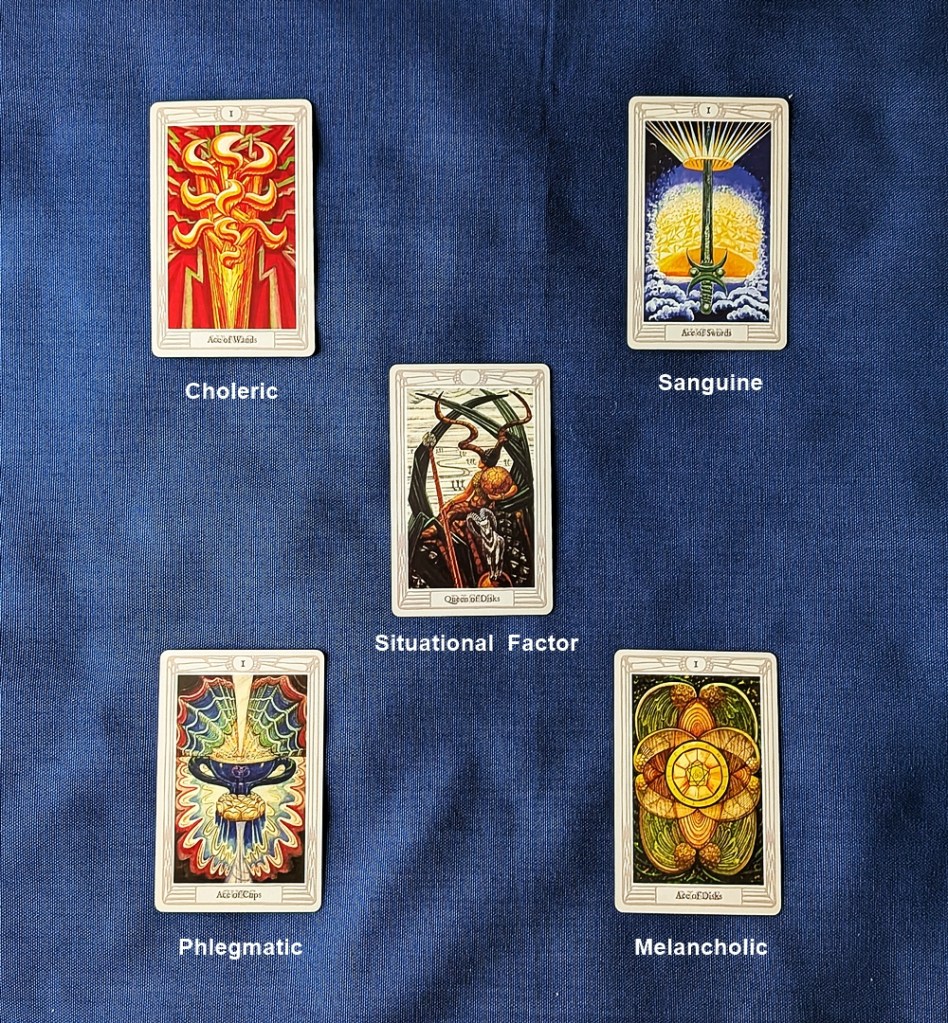
To set up the experiment, I first removed the sixteen court cards from a tarot deck, shuffled them and randomly selected one card to represent the subject of the reading. (This can be either an individual or a situational factor.) I set this card in the middle of the table and returned the rest of the court cards to the deck. (In the example reading I characterized the Significator as a “situation” rather than a “person,” and the Queen of Disks conveys a level-headed attitude that is not overly vulnerable to the vulgar pursuits of Earth.)
From a second deck, I removed the four Aces and arranged them in the following pattern around the Queen of Disks. (All images are from the Thoth Tarot, copyright of US Games Systems Inc, Stamford, CT.)
Next, I shuffled the first deck while concentrating on the matter at hand and dealt four cards on top of the Aces, moving clockwise from the upper-left.
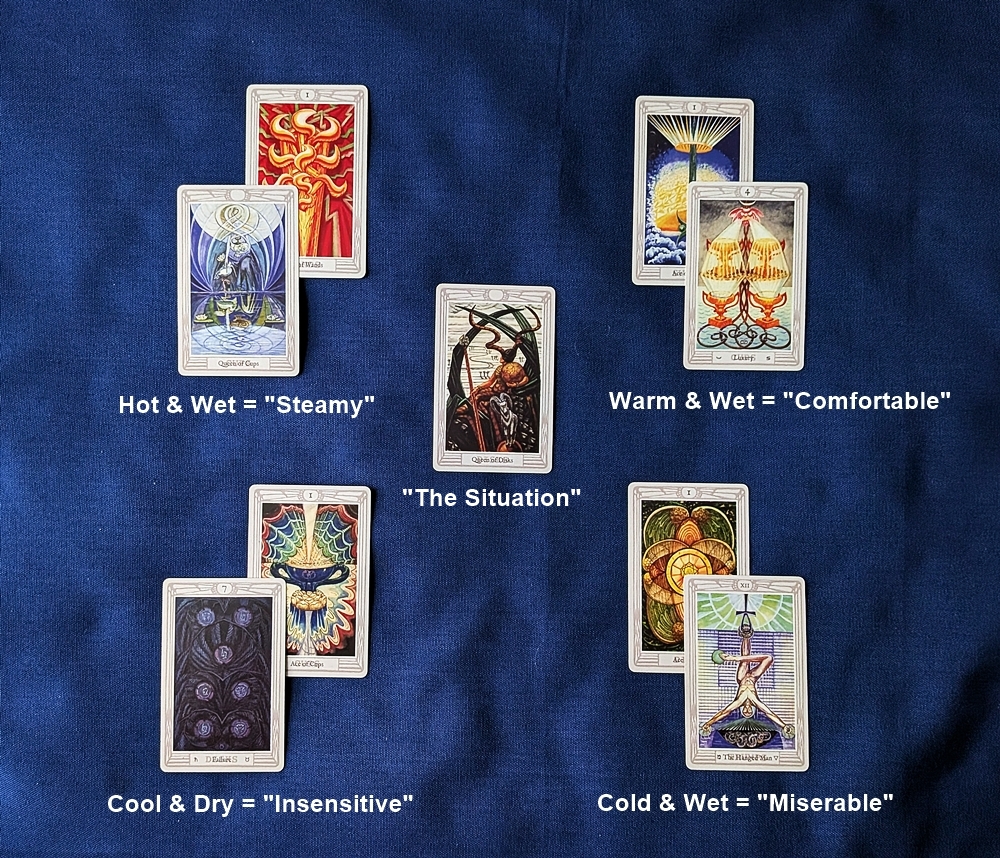
Next, I blended the elemental natures of the two cards in each set, also taking into account the inherent disposition of the random card, to come up with an “environmental signature” for the pair. These qualities are reflected in the caption for each position.
Using the convention of “facing, gaze or regard,” I took note of what the Queen of Disks is focused on: she is looking toward the “hot-and-wet” combination at the upper left, suggesting that she could be feeling “steamier” than she is willing to admit. (Earth is elementally friendly with Water and cooperative with Fire.) Because her head is raised, the implication is that she is reaching for her comfort zone and angling away from the less salutary conditions at the bottom of the array.
From a situational perspective, this reading holds a lot of promise for what the Atlanta Rhythm Section called a “Large Time” in one of their livelier songs. The Queen just needs to avoid “getting cold feet” by letting them trail in the negative vibes as she strives to ascend. Maybe she should be humming Earth, Wind and Fire’s “Keep Your Head to the Sky” as she rises.
Interestingly, if I perform the “numerical essence” calculation for the Queen of Disks and the two-card sets in the top tier, I come up with the Hermit as the “environmental theme” in both cases. This implies that, at the top of the arc, emotional unavailability and physical isolation could stand in the way of satisfaction.
*The Waite-Smith (RWS) deck is ideal for the “facing” determination because all of the court cards except the King of Swords exhibit a decisive direction of “gaze,” and the King is gesturing to the viewer’s left with his sword. I didn’t apply reversals in the example reading, but that would also redirect the Significator’s focus.

