AUTHOR’S NOTE: A few years ago I read that the numbers Three, Six and Nine represent the “Three Perfections” of Greek philosophy as espoused by Plato, Socrates and Aristotle. I finally pinned down where the idea came from, and it isn’t a direct quote from any of them. While an argument can be found in ancient Greek thought for these numbers being metaphysically perfect when examined individually, the premise that they form an integrated sequence of perfection came from Nikola Tesla in the 20th Century. That fact doesn’t degrade the legitimacy of the assumption, which makes a lot of sense numerologically, Hermetically and Qabalistically.
Applying this model to the tarot is most difficult in the suit of Swords since almost all of the cards are innately problematic in nature. As Waite said in The Pictorial Key to the Tarot when addressing the 2 of Swords, “The suggestion of harmony and other favorable readings must be considered in a qualified manner, as Swords generally are not symbolical of beneficent forces in human affairs.” Aleister Crowley described it as “the corruption inherent in Swords.” In other words, they basically suck, and this stands out prominently in the cards of the Thoth deck.
Numerologically, I’ve always viewed Three as symbolizing growth, expansion and opportunity following the reconciliation of duality (the Line becoming the Plane); Six is the number of harmony and equilibrium in the Hermetic Qabalah; and Nine signifies completion (or at least the “threshold of completion” presaging the “perfect number” of Pythagoras, Ten) and the restoration of balance on the Tree of Life. Regarding the Nine, Crowley quoted Zoroaster: “The number Nine is sacred, and attains the summit of perfection.” All of this aligns well with the other three suits, but in Swords it’s something of a “hard sell.”
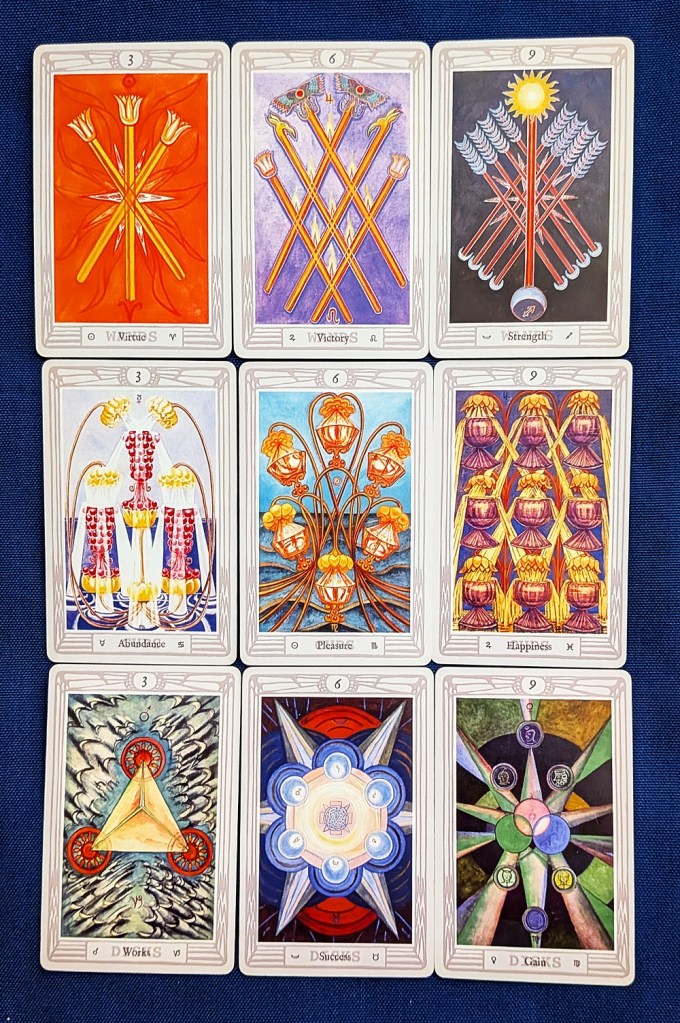
The Thoth titles for the Wands, Cups and Disks cards are sympathetic to this perspective: Virtue, Victory, Strength (Wands); Abundance, Pleasure, Happiness (Cups); and Work, Success and Gain (Disks). Crowley’s nomenclature was derived mainly from the Golden Dawn’s Liber T, with some minor adjustments, and the images created by Harris all exhibit a pleasing symmetry and color scheme. (All cards shown are from the Thoth Tarot, copyright of US Games Systems Inc, Stamford, CT.)
In the suit of Swords, most of the titles are discouraging, and the designs and color palette are predominantly discordant, so I decided to offset some of that negativity by showing the more nuanced state of affairs when the cards are reversed. (Note that Thoth convention has it that reversals are not to be used, but I find that viewpoint short-sighted since reversal and elemental dignity serve two different purposes: the former alters the delivery of a cards influence to become more indirect or oblique without changing its fundamental meaning, while the latter modifies the potency of the affected “principal” card by making it weaker or stronger.)
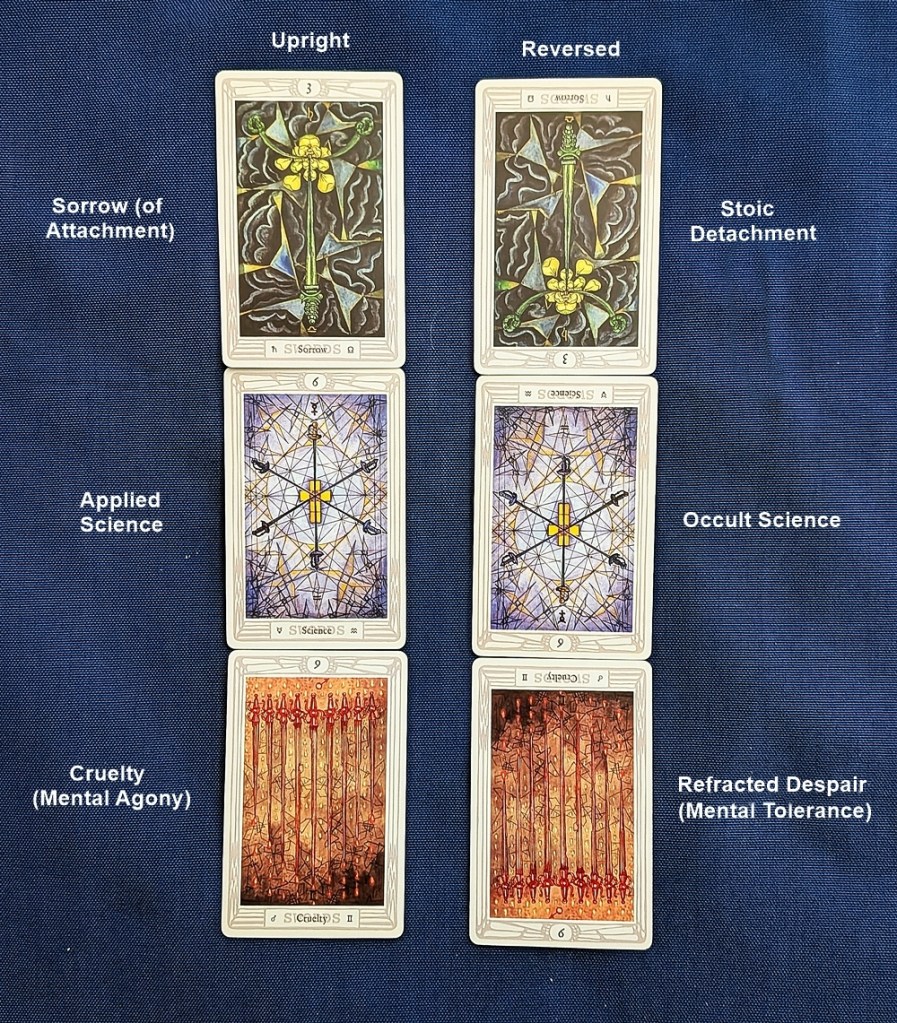
In attempting to reconcile the generally benevolent effect of the number Three with the “Sorrow” expressed by the Thoth version of the 3 of Swords, I settled on the Buddhist concept of the “sorrow of attachment to the world.” In other words, the characteristic expansiveness of the Three is held hostage by material constraints. One definition of the mobility of the Three assumes that the points of an equilateral triangle are put into motion, rotating around the geometric center of the plane to form a circle that is transitional between the triangle and the square. Combined with the “sorrow of attachment,” it could imply the “wheel of karma.” When the card is reversed, I see it more as stoic detachment from the immediacy of the distress.
Describing the 6 of Swords as “Science,” Crowley related it to “intelligence which has won to the goal,” but also “the perfect balance of all mental and emotional faculties, hardly won, and almost impossible to hold in an ever-changing world.” (His opinion of the number Six was that it represents a temporary respite from constant change, which becomes clear when we place it between the disruptive Five and the destabilizing Seven.) The Golden Dawn was not so philosophical about it, titling this card the “Lord of Earned Success,” which gave me the idea of “applied science” in the sense of practical uses for experimental results. When the card is reversed, I view this pragmatism as being abstracted into the disciplines of esoteric science (which have also been called “pseudo-sciences”).
Crowley does not mention the “completion” and “perfection” of the number Nine in the 9 of Swords, but assumes only a debilitating degeneration in Qabalistic terms: “The Swords no longer represent pure intellect so much as the automatic stirring of heartless passion” (on that point, consider Mars in Gemini). One of his secondary definitions for Cruelty was “mental agony,” while the Golden Dawn’s title was the “Lord of Despair and Cruelty.” When the card is reversed, I interpret it as “refracted” (i.e. deflected or “turned”) despair that brings the “long view” of mental tolerance to bear on the agony.

