AUTHOR’S NOTE: I just came across a fascinating observation in Robert Anton Wilson’s Prometheus Rising that could revolutionize my “gestalt” approach to analyzing a tarot spread. (I think about this stuff a lot, and it can take me to some strange places.)
“Intuition ‘is a way of thinking between and around data-points on the perceptual screen – sensing what total field the points must be part of.'”
According to Google AI (and also as I learned it in both high school and later in the nuclear power industry), a classical view of the atom is that it consists of a dense core of protons and neutrons circled by a number of electrons spinning in what is a comparatively vast void: “An atom is mostly empty space; if the nucleus were the size of a blueberry, the outer edges of the atom would span the size of a sports stadium.” (I won’t get into what quantum physics thinks about that.)
Something similar can be said of a tarot spread. Out of the 78-card population, only a random few of them participate in the reading; the rest of the layout consists of empty space between the selected cards. If I include in my “gestalt overview” the extra measure of executing a logical transition across the gap between sequential cards to best understand their interaction, I might suppose that the interstitial spaces are occupied by the invisible essence of all the other cards that didn’t make it into the pull, and I can wander among them looking for clues to how I might more precisely integrate the pair of physical cards for interpretation. This would of course require a profound grasp of which cards have a synergistic “tone” such that they cooperate to enhance the narrative and which “butt heads,” with increased coherence as the goal of the exercise.
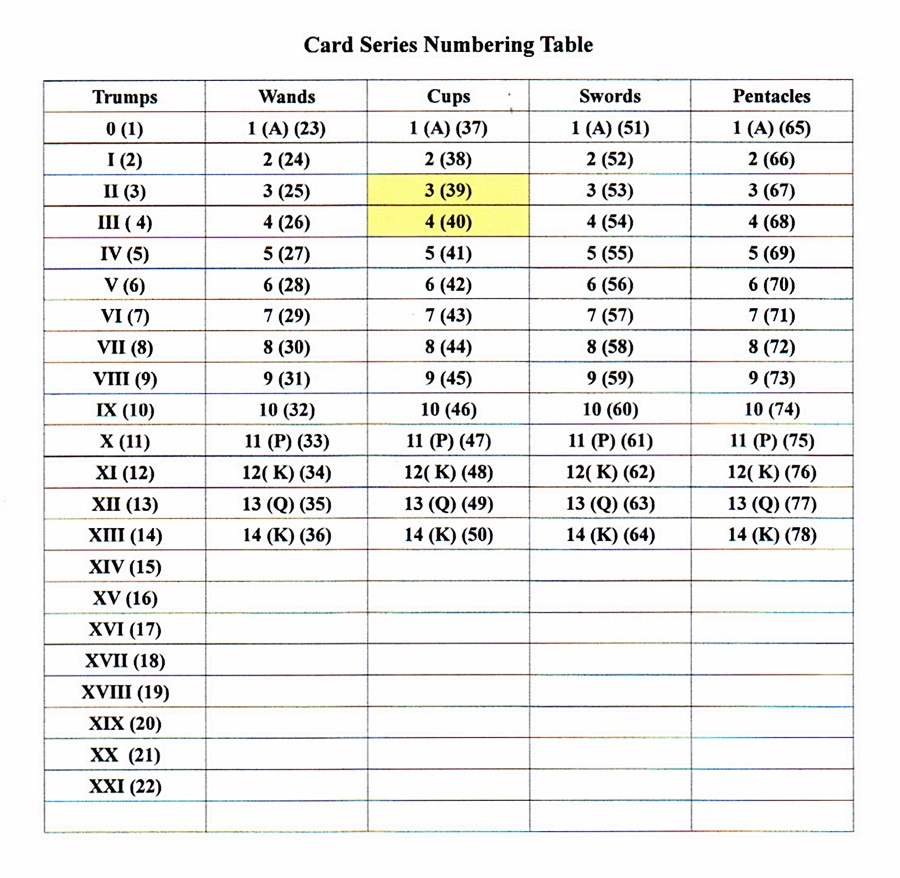
A more structured way to do it would be to identify the card that sits at the numerical midpoint between any two adjacent cards in the spread; see the table below. For example, the card sitting midway between the 5 of Swords and the 5 of Pentacles is a toss-up between the Page of Swords and the Knight of Swords, so intuition would have to choose based on the circumstances. We could think of either technique as putting a parallel plan in motion, but I would first make an intuitive stab at it to get the creative imagination fired up.
Let’s assume that I receive the 5 of Swords (Defeat) followed by the 7 of Swords (Futility). In the natural order they are separated by the 6 of Swords (Science) which introduces a “rationalizing” emphasis between them that mitigates the “agony of defeat” by turning it into more stoic resignation. But don’t write that down, the role could be played by any of the Sixes or perhaps by a court card or Ace that strikes off in a new direction or resets the paradigm, respectively, before getting back to the point. Intuition will therefore have a leg up on where to start fleshing out the story with a bit of “connecting tissue.”
It will seldom be that straightforward in any scattered series of cards, but this will transform every pair into a triplet by adding a “silent partner” that gives intuition something to chew on without leaving it completely untethered. It presents all kinds of opportunities for improvisation of the philosophical “what-if” kind. I don’t want to spook you, but I’m reminded of Walter de la Mare’s poem The Listeners with its host of phantom spirits thronging the stairs; we just have to give one of them the nod to step up and speak, filling the silence with its ghostly voice.
Here is a five-card example reading with “connectors.” I asked what the main route and the alternate. elliptical trajectories would be to my desired objective.
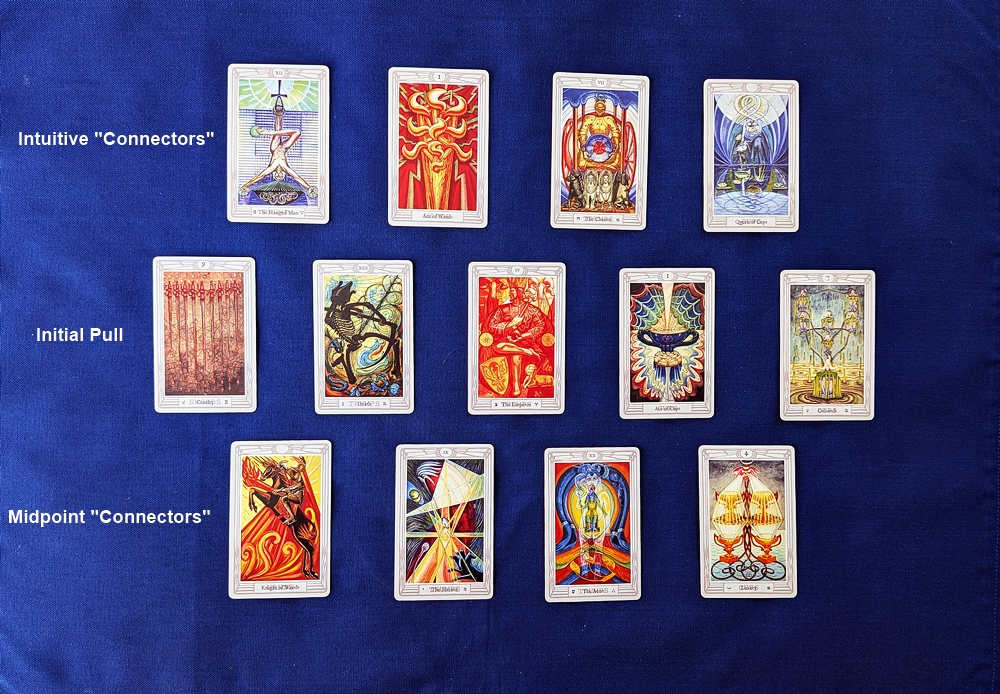
The initial pull was rather morose, although the 7 of Cups as “Debauch” can be read in two different was: as “debasement” or as the more salacious connotation of Venus in Scorpio. Obviously, if I had to choose I would go with Venus as showing temptation and not corruption (which the gracious, kind-hearted Queen of Cups would not tolerate anyway).
The “Intuitive Connectors” suggest delay and the need for patience in the face of change, giving way to an enthusiastic initiative and forceful movement that lead to a calm denouement no matter which way the 7 of Cups is taken. (Note that I stayed with Water and Fire as the overarching theme.)
The “Midpoint Connectors” are telling me not to give up but to exercise prudence and “wait for the call” that will flush the 7 of Cups of its taint.
In this case I like the numerical “gap-fillers” better than the intuitive ones, and I also appreciate the fact that no Swords appear in either of the parallel tracks, so controversy should be at a minimum.