AUTHOR’S NOTE: Although he was talking about the more mystical subject of “Gaia consciousness” as a neurosomatic phenomenon in Prometheus Rising, I’m going to stretch this Robert Anton Wilson observation to cover tarot reading: if used with purposeful precision and not just to satisfy our idle curiosity about the future, it can give us “a better eye to see (ourselves) and judge (our) trajectories than ever before.”
I try to embrace this principle of “precise trajectory” in all of the tarot spreads I create. I seldom stop at the “past/present/future” or “action/reaction/resolution” perspective, instead looking for hints of purpose in the cards’ testimony: the “Why” and not just the “What” and “How” of the answers they provide. If the querent has a handle on “why,” then getting to “Should I or shouldn’t I?” in a decision-making or problem-solving scenario will be much more straightforward.
Due to the slippery nature of forecasting when it comes to upcoming events and circumstances with their numerous variables, I tend to offer general guidance rather than specific advice in my readings, but it’s fair to say that every querent wants at least a “bird’s-eye view” of the landscape they will have to cross to reach the destination. So my aim is to turn the chosen spread into a “roadmap” with critical “waypoints,” such as “When you get here, you will have to decide whether to take this fork or that one.”
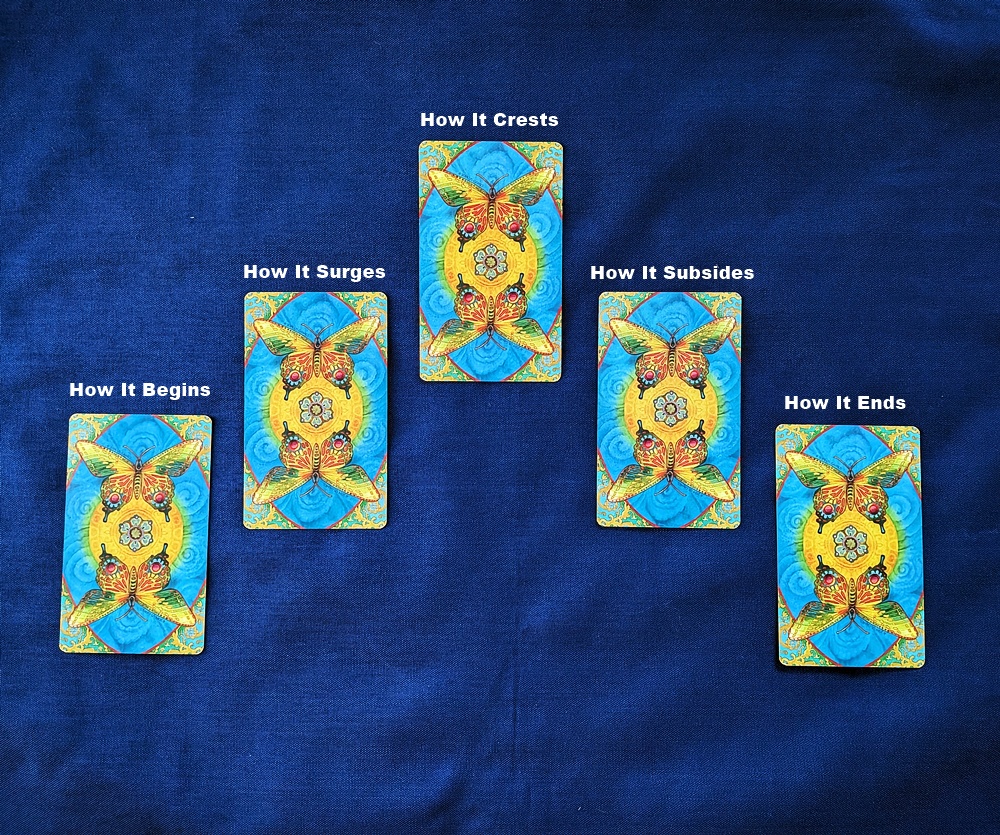
But as Alfred Korzybski said, “the map is not the territory,” so the seeker must still mentally populate the two-dimensional layout with three-dimensional features in order to envision navigating the realities of the situation. I like to tackle this by treating the spread as an “isometric projection” with conceptual peaks-and-valleys. One of the simplest models of this type is the “bell-curve” spread, in which the top of the arc shows the pinnacle of upward advancement – the climax, crisis or turning-point – that represents the crux of the matter.
The shape reminds me of a “cresting wave” (see the image below). The cards leading up to the crest convey “jockeying for position” while those following reveal the “fallout-and-recovery” phase prefiguring the outcome. Conversely, the “inverted bell-curve” can reveal the “low point” in an anticipated downturn in forthcoming conditions (as in “How low can I go?”), with the prefatory cards identifying the treacherous “banana-peel of fate” and the subsequent ones “How can I pick myself up and scramble out?”
Thus, I endeavor to transform the static line spread into an undulating, up-and-down progression that provides a more realistic overview of the “what, how and why” for event evolution. Moving beyond the linear array, there is a wealth of opportunity in the other common patterns – triangle, square, circle, etc. – but nowhere so much as in my fancier “three-dimensional” innovations (bottom-to-top or vice-versa in sequential stacks of cards). Most of the spreads I see online are uneventful in their directionality, like a stream or puddle of water spreading across a flat surface, with little or no imagination in their dimensional structure.
I’ve been doing spread creation for so long (with well over 300 unique designs to my credit) that I’m thoroughly bored with the usual options, so it takes something unique to get my attention. Still, new-spread crafting is my fallback when I run out of more intriguing essay topics, at least until I find something to inspire me in my constant metaphysical reading. You will have to suffer through Robert Anson Wilson quotes just a little longer while I sharpen my eye for different angles on the developmental “trajectory.” Then I’m thinking of moving on into Ouspensky’s tarot book.