AUTHOR’S NOTE: There is an opinion among critics of the “empowerment” approach to divination that, when performing self-analysis with the cards, tarot readers chance being duped by “auto-suggestion.”
Convincing themselves that they are being encouraged, they misread an inconclusive augury as affirmation for what may be only faint hopes or wishful thinking. There is a way to investigate an equivocal outlook by first setting a conscious intention with purposely-chosen cards and then keeping a tight rein on expectations in the random pull that follows, but it requires preparation. (See the link below for an example.)
With little justification, they firmly believe that the cards are giving them the go-ahead and they consequently act as if the forecast is unerringly factual, ignoring all evidence of confirmation bias to the contrary. This will sometimes inspire them to remarkable heights of self-realization, but it can just as easily point them down blind alleys of self-deception. Unwisely trying to manifest this dubious prophesy is a high-risk proposition and “look before you leap” is the best policy.
The tarot reader can therefore be misled by accepting only what is perceived as singularly supportive of their vision of the truth. If these assumptions are reinforced by constant repetition, there is no hope of being able to separate objective insight from subjective rationalizing. To use an archaic Shakespearean phrase, such practitioners might well be “hoist by their own petard” (blown up by their own bomb, like the careless reveler who holds onto a lit firecracker just a second too long).
I’m reminded of the funhouse “hall of mirrors”in which we confront our reflection looking at us from different angles in the labyrinth of “rear-view” and “side-view” panels . . . next we observe ourself from a little farther away in the multiplicity of images. . . then we spy our greatly-replicated self across an even-more-remote span . . . ad infinitum until the figures recede into the distance to the point they can no longer be clearly discerned. This can leave us with a queasy feeling of spatial disorientation, and the tarot-reading equivalent is the chaotic jumble of data-points requiring kaleidoscopic disambiguation at a level of minutiae that may confound any chance of rational uptake (the familiar “too-much-detail” dilemma in an overly complex spread).
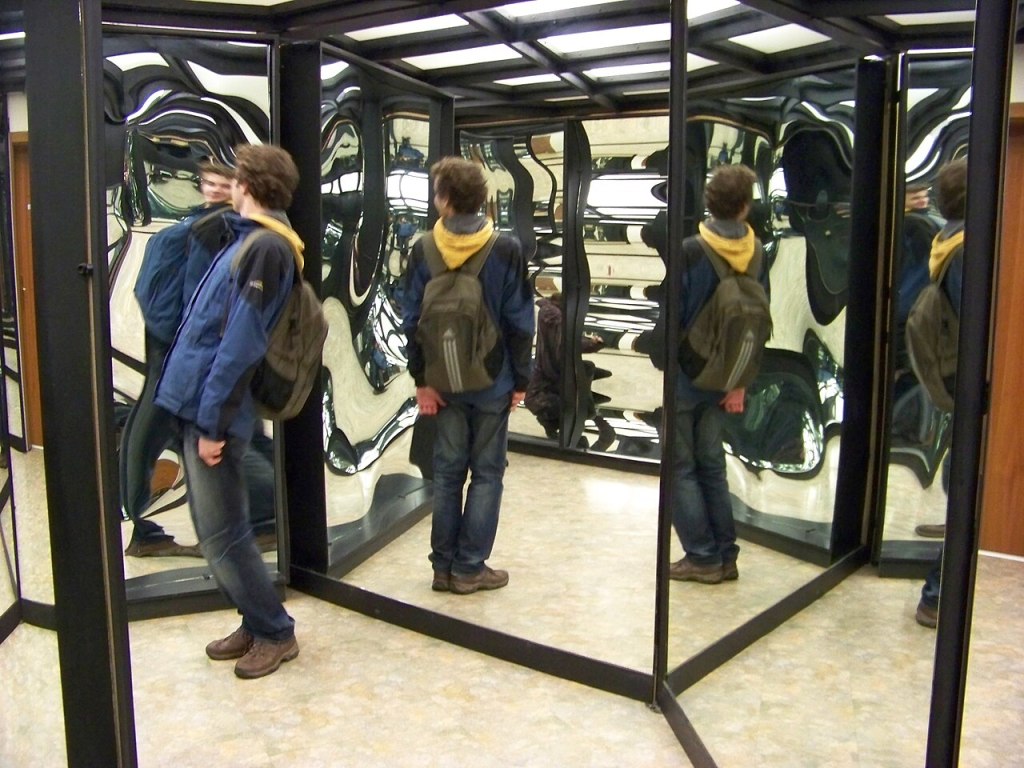
My own iconoclastic approach is to introduce into the analogy the “warp” of the concave-and-covex type of funhouse mirror that distorts the likeness so we see something entirely unexpected. In this sense the tarot reading echoes Robert Anton Wilson’s description of the human mind as “a conscious mirror that knows it can always reflect something else by changing its angle of reflection.” Distinctions of self and not-self are just a function of “brain circuitry” reflecting upon reality – the mind becoming aware of itself in a larger context or continuum, as proposed by various spiritual, philosophical and intellectual theories. This reflective quality of cognition is a premise that underlies tarot reading in general, and I often apply it to the “mirror-image” that appears in a reversed card; the same message can be communicated in oblique ways.
When reading for other people, we can break this chain of redundancy by inviting them to comment on the consistent impressions we’ve received from the same cards during innumerable previous readings. This interaction can bring unique understanding to the surface; as I’ve said before, the cards don’t know everything and, riding on their coattails, neither do I so I welcome the independent input. An effective reading requires two participants – a seeker and a practitioner – and the former should not be allowed to merely parrot the latter or, even worse, become a silent “nods-in-agreement” type with nothing personal to add. C’mon, folks, it’s your reading, not mine!
My aim in divination is always engagement, not merely oracular presentation. When reading for myself I seldom take anything for granted without dissecting it, and when divining for others I expect them do do the same on their own behalf, particularly since I often speak in storytelling “tropes” like metaphors and analogies that have to be unraveled like riddles to get at their significance to the matter at hand. But I always throw them a lifeline when I set them adrift in those waters.
Perhaps it could be said of me what Byron said of Wordsworth: “I wish he would explain his explanation.” (Once again I’m indebted to Wilson’s Prometheus Rising for that quote.) But I try to offer motivation as a corollary to illumination so the sitter has something to ponder after walking away from the session.

