AUTHOR’S NOTE: During my constant metaphysical reading I once again came across the common belief that we are all “artists who create our own reality” and, as Robert Anton Wilson would have it, we are “better artists than we realize” because we can trap ourself in our own illusions (or in his words, our private “reality-tunnel”).
As I think about it, one such snare is present in the astrological birth-chart, by which we are “encoded” (Wilson dubs it “imprinted” and I recently used the term “gifted”) with specific psychological traits conveyed by ten planet-and-sign duets (with a couple of supporting cameos) that are enacted in a 12-room “playhouse” (more specifically, a schematic of topical “life-areas”). The “creative” part is choosing our moment of birth.
If we steer clear of convoluted philosophies and religions, this epistemological framework is what we have to work with in our present incarnation, and the only relief we have from its mandate occurs when the natal roles are “visited” by the original cast in the form of transits, progressions and returns that modify the baseline profile for a spell before moving on. In the meantime, we can do little but obey the behavioral urges of its psycho-biological content, unless we subscribe to the aphorism “The stars incline, they don’t compel” attributed to Thomas Aquinas and others. (But if we do so knowing how lazy human beings are, we may never fulfill the promise of our horoscope.)
In general usage, the planets describe the active forces powering the configuration, the signs portray how those energies manifest in the native’s life, and the houses define where all of this takes place in topical terms. Each planet has characteristic functions that it oversees in a general way. Here is a partial list:
The Sun (ruling Leo) is associated the ego, the creative drive and the vitality;
The Moon (ruling Cancer) is associated with the emotions;
Mercury (ruling Gemini and Virgo) is associated with the intellect,
Mars (ruling Aries) is associated with the ambitions and desires;
Venus (ruling Taurus and Libra) is associated with human rapport and romance;
Jupiter (ruling Sagittarius) is associated with generous impulses and expansiveness
Saturn (ruling Capricorn) is associated with structures, strictures and restraint;
Uranus (ruling Aquarius) is associated with innovative thinking;
Neptune (ruling Pisces) is associated with mystical inclinations ;
Pluto (ruling Scorpio) is associated with “seismic” upheavals of the transformative kind.
While inborn, these qualities are spontaneously activated when triggered by the aforementioned contacts, and the last three (not used in classical astrology with its temperaments and “humours”) are mainly “generational” rather than specifically individual in their impact (i.e. they have a societal effect on a broad cross-section of people born over a.considerable span of time, and they often reflect global paradigm shifts).
In addition to the planetary placements, there are a few critical points-in-space that contribute to the geometry. The Ascendant is the zodiacal degree on the ecliptic (the Sun’s diurnal path through the sky) where it rises on the horizon on the date of birth, and the Midheaven is the position on the ecliptic where the Sun reaches it zenith around noon on the birthday. (The former portrays the native’s “private face” as projected to others on a one-to-one basis (if and when we “take the mask off”), and the latter reflects the native’s “public face” as presented to the world-at-large
Each of these has a directly-opposite partner (specifically the Descendant – the interactive “relationship” principle – and the Imum Coeli – the “home-and-family” architecture) that complements its fundamental meaning. There are several other factors that are less prominent on an immediate basis, such as the Moon’s Nodes, various calculated Arabic “parts” and the so-called “fixed” stars that I won’t go into here.
As a blueprint or roadmap, these features are static and internally-oriented until they are activated by the “moving tableau” of the planets as they continue to revolve after birth. Some of these travelers can take a very long time to make a meaningful appearance, and a few move so slowly that their stimulus will be experienced rarely (and faintly) when they enter a new sign or house (a “planetary ingress”). But there is another way to “goose” the natal properties into more timely action: the corresponding tarot cards.
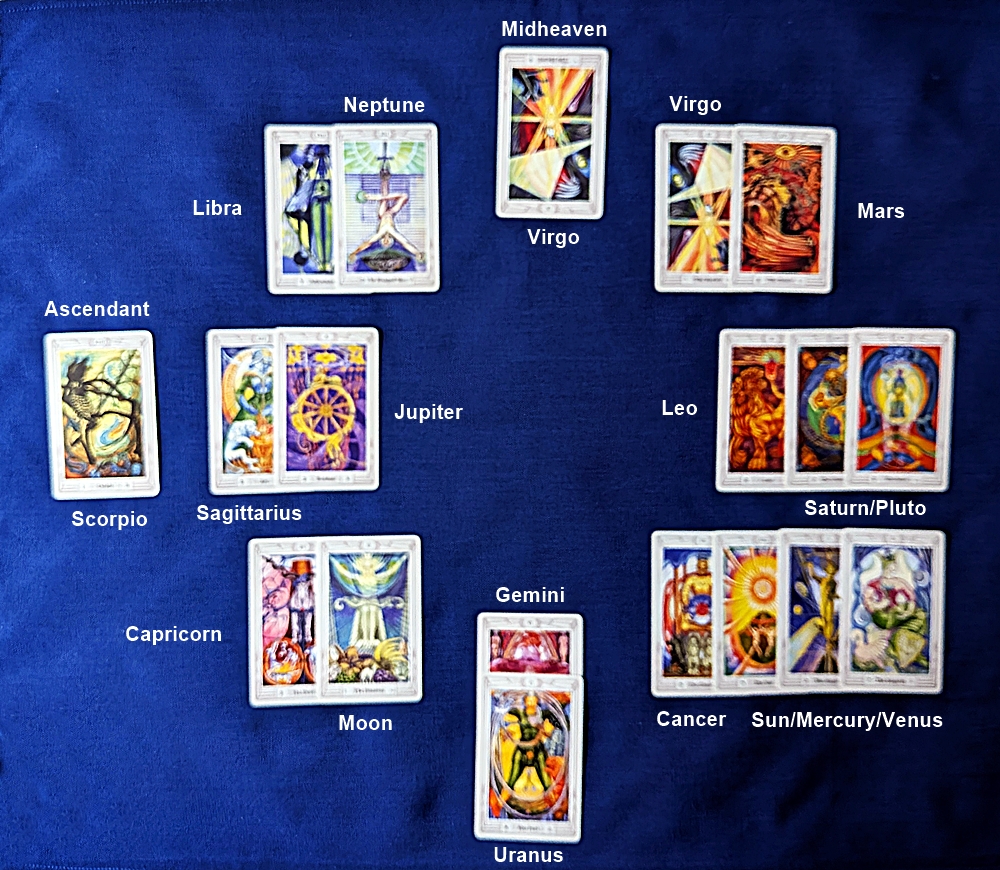
Each of the twelve signs and ten planets has an associated set of tarot cards, headed (for my purpose here) by one of the 22 Major Arcana or “trumps.” When the ten “modern” planets are placed in an actual birth-chart, the designated planetary trump card joins with the trump related to the sign of placement to create a dyad. Below I’ve laid out the cards corresponding to the signs and their resident planets for my own natal chart without regard for the irregular spacing of the house cusps.
However, these combinations are still inert. I decided to use this layout as a spread template on which to lay an additional random card in each position, with the intent of nudging the latent energies into a contextual role as inputs to situational awareness. (To avoid clutter, I separated each group from the pattern and placed it in its own row.) The objective of the reading was to assess how the querent might leverage natal personality factors in the pursuit of self-realization. It isn’t necessary to populate all of the positions every time; they can be selected according to the aim of the reading (i.e. when exploring a business opportunity we might focus only on Mars, Jupiter, Saturn and the Midheaven).
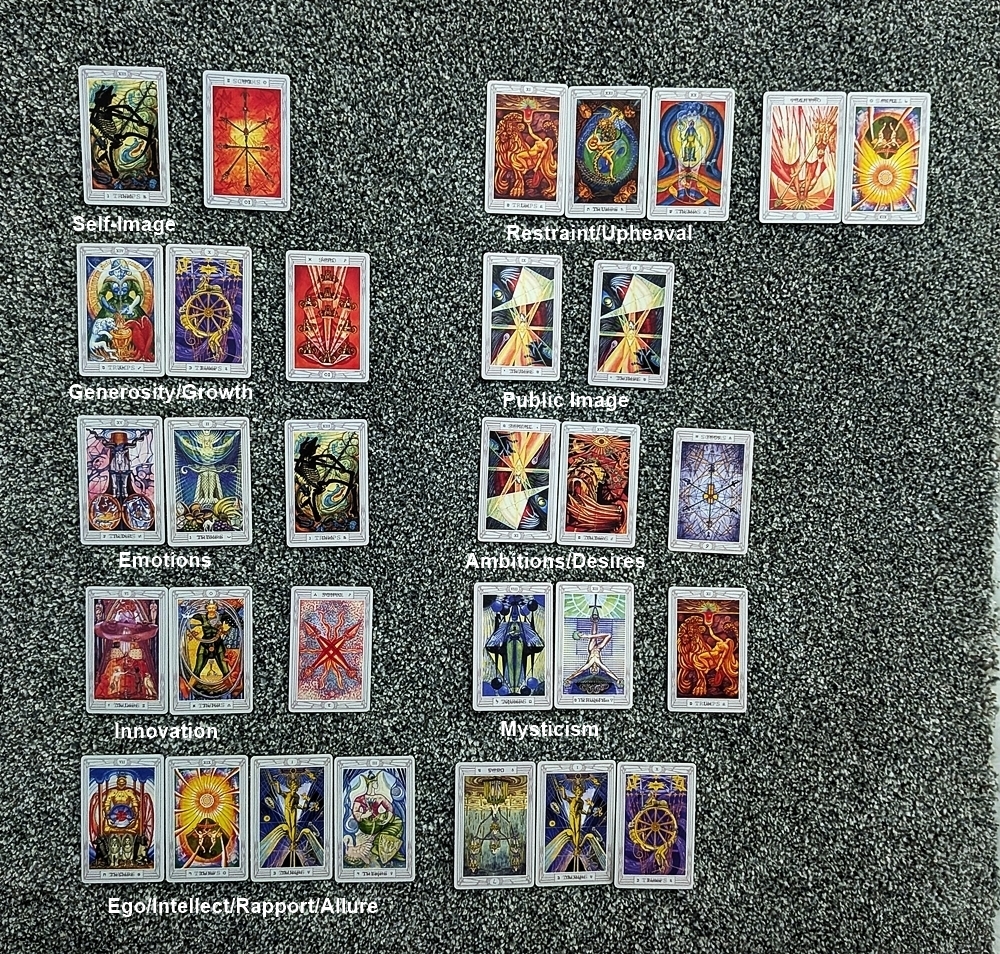
The Scorpio Ascendant is not outgoing to begin with, and overlaying Death with the reversed 10 of Swords suggests even more vigorous “denial of access.” There is a “shut-off-and-shut-out” quality to the combination that speaks of self-removal from close contact with other people..
Jupiter in Sagittarius is represented by the Wheel of Fortune, which captures its essence as the “Greater Benefic.” The reversed 10 of Cups displays a more retiring nature that evolves quietly behind the scenes, fiddling with emotional equilibrium as implied by Art/Temperance, but the combination seems salutary overall.
The Moon is the harbinger of feeling, but it is more than a little “strait-jacketed” in Capricorn. Death, which is the trump card of Scorpio, gives it a perspective that is inherently jaundiced, but it also brings the emotions under the control of the self-disciplined Scorpio Ascendant. I wouldn’t expect much sentimentality out of it.
Uranus (which was not represented in classical “seven-planet” astrology and did not have an assigned trump card) is associated with the Fool by some esoteric tarot experts due to the shared emphasis on elemental Air. In modern astrology it rules Aquarius, and in this array it is in Gemini (the Lovers), bringing another double helping of Air into the mix. The reversed 2 of Wands imparts self-mastery to what could easily become a frenzy of “shoot-from-the-hip” experimentation.
The Sun, Mercury and Venus are in a tight conjunction in Cancer, another sign of reserved self-reflection. In this case, the ego, the intellect, the innate humanity, and the “love” nature are all bound up in the service of sensitive introspection (which may eventually feel like a too-tight pair of shoes). With the repetition of the Magus, the Mercury position displays a strong cerebral bent, while Venus – the “Lesser Benefic” – picks up the influence of Jupiter from the Wheel of Fortune, amplifying its harmonious presence. Only the Sun seems slightly tainted, but the 7 of Cups echoes the Scorpio Ascendant, so the perverse attitude comes naturally. The Chariot contributes a resolute sense of direction and momentum.
Neptune is another planet that does not have a classical presence or a corresponding trump card, but in modern astrology it rules Pisces, which corresponds to the similarly nebulous Moon in tarot. Due to the association with elemental Water, the Hanged Man has been assigned to Neptune by some occultists. Here it is in Libra (Adjustment or Justice), showing a judicious application of mystical principles to rational deliberation. Lust (aka Strength) gives this combination a boost of self-righteous fervor, creating the unfortunate impression of a religious fanatic. (Don’t look at me. I’m “devoutly non-religious.”)
Virgo brings a methodical veneer of technical prowess to the brash “hit-and-run” tactics of Mars, and it also sits on the Midheaven. The three-way combination creates a great deal of industrial acumen and energy. The reversed 6 of Swords (titled “Science”) injects a low-key deductive rigor into what is one of the three “scientific” signs (Virgo, Scorpio and Aquarius). This is a perfect match for the technological career that is indicated by this birth-chart placement.
I randomly drew another instance of the Hermit to go with the Midheaven placement for the same card. If there was any doubt about what the stand-offish Scorpio Ascendant means for self-projection, it is ramified in spades when a similar reluctance shows up in the public arena of the 10th House. (The Hermit is too reserved to take part in PowerPoint presentations.) However, Virgo is more willing to engage than Scorpio as long as it doesn’t feel patronized, and this position installs the Virgoan Hermit at the pinnacle of public recognition. I would say the coincidence was a clear case of “well-met.”
Saturn and Pluto are conjunct in Leo in this array. The merging of restraint and upheaval sounds like an invitation to a debilitating episode of constipation and diarrhea rolled into one. They have “wet blanket” and “loose cannon” written all over them. The noble Leo doesn’t have a lot of patience for either morose drudges or volatile hotheads, and would give Saturn and Pluto the boot if it could. The reversed Queen of Wands and Sun are “holding their fire” on the pair in hope that something useful will arise phoenix-like from the ashes. If they wind up having to render judgment, it won’t be pretty. Consider what might happen if Saturn and Vulcan walked into a metalworking shop: they would probably create some kind of “infernal engine. (I know, a voting machine!)

