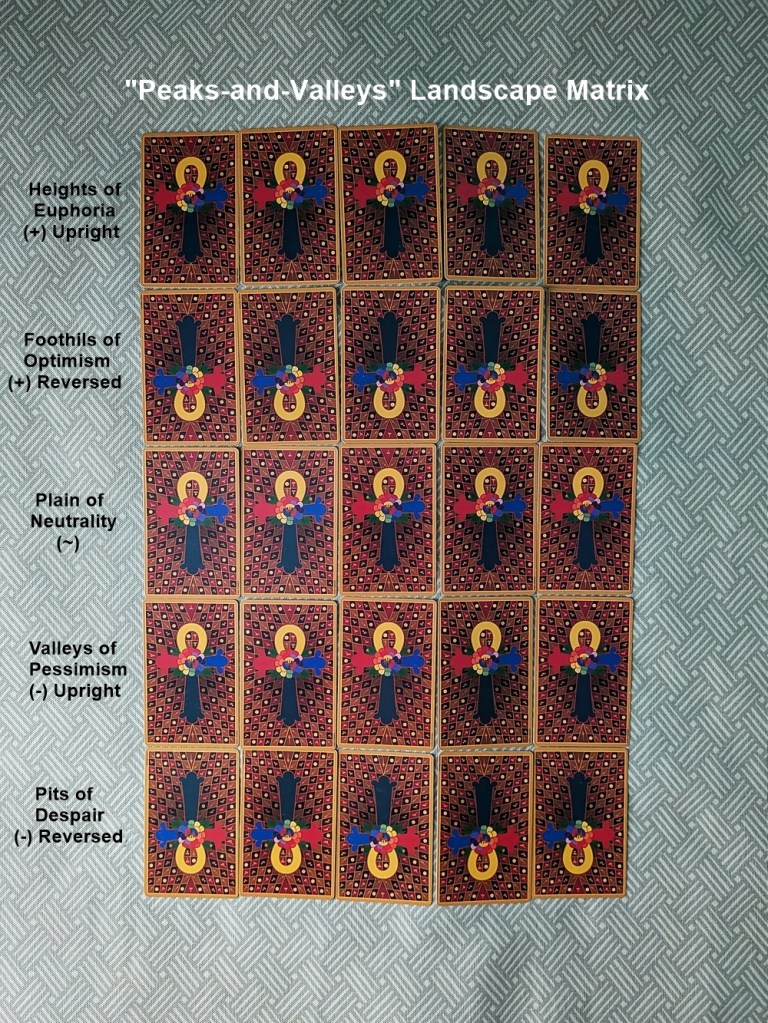
AUTHOR’S NOTE: The most common way to read a tarot line spread is as an unbroken flow of cards from left-to-right (and typically from past to future) with occasional “bumps in the road” caused by less-fortunate or reversed cards. In my own practice, I first examine the whole layout, looking for peaks and valleys of significance that may warrant special attention. Here I’m formalizing that idea into a 25-card matrix that produces a winding five-card sequence. The matrix can be used as a face-down template on which to lay the cards pulled for the reading, which allows the reader to keep track of “what-goes-where.” I recommend using a second deck for this.
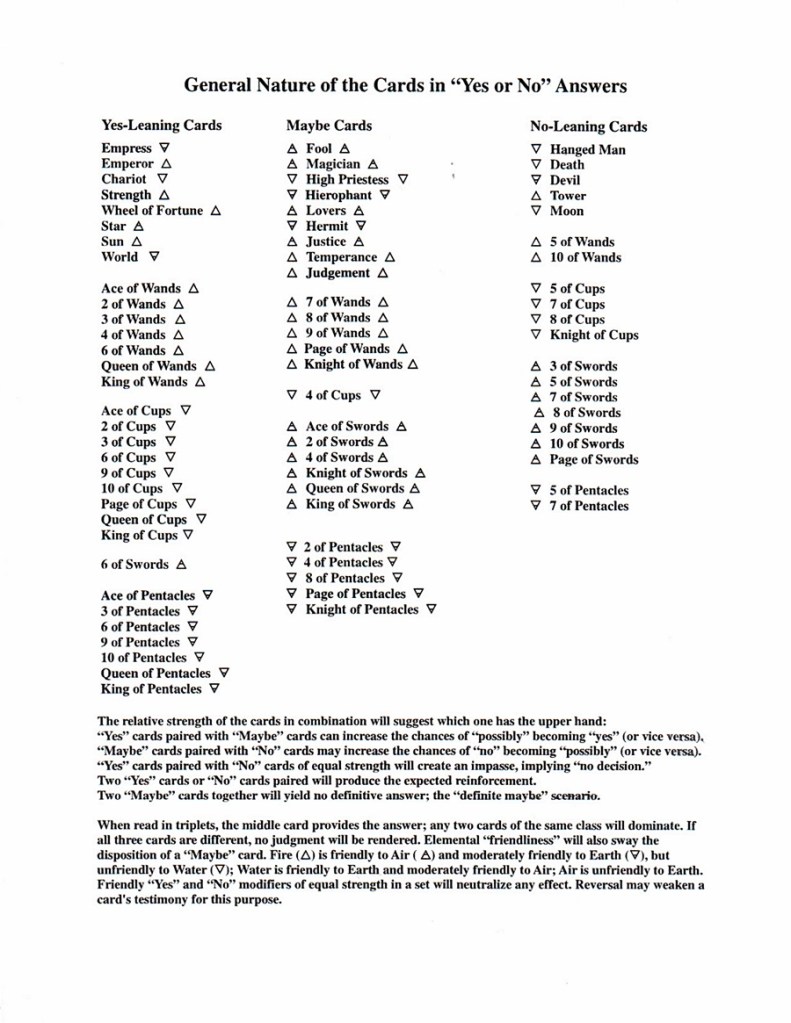
Below is a table in which I separated the cards into positive (“Yes-leaning”), negative (“No-leaning”) and neutral (“Maybe”) subsets. I’ve used the (+), (-) and (~) symbols in the matrix and example reading to show favorable, less favorable and neutral positions and cards. If you have a personal way to create this distribution, go ahead and use it
In general, positive upright cards will be the most fortunate while negative reversed cards will be the most unfortunate. (I don’t subscribe to the idea that reversal makes a negative card better or a positive card worse in its operation, just more conflicted or oblique and difficult to get a handle on.) Upright neutral cards are intended to show a steady-state environment of uneventful events or circumstances, while their reversal can mean that background conditions are slightly skewed in the pessimistic direction (think of them as a shallow depression and not quite a valley).
If using a second deck as a template, lay 25 face-down cards as shown in the pattern. If not, try to keep the rows and columns straight in your head when positioning the face-up cards for the reading. (If you’re ambitious, you could draw a grid on a large piece of cardboard, but then you would need a place to store it.)
Shuffle the reading deck in a manner that introduces reversals while concentrating on the question or topic. (The “wash” or “casino shuffle” followed by a brief overhand shuffle works well for this purpose.) Cut if that is your usual practice.
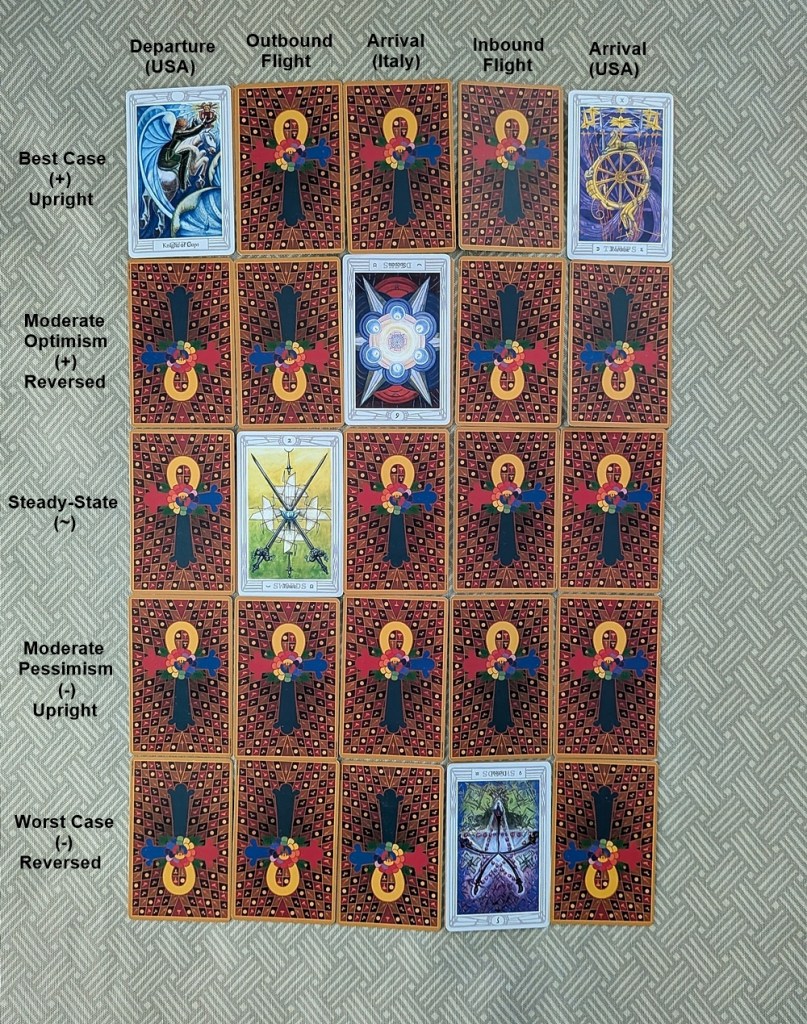
Pull the first card for the spread and consult the table if necessary to determine its “good, bad or indifferent” status, then place it in the appropriate spot in the first column at the left. Continue by drawing and placing four more cards in the applicable columns working from left to right until all five contain one card. (See the second image below.)
Examine the populated spread to determine whether there is an abundance of any one quality and make that the overall theme for the prediction. (My example reading is largely favorable with one glaring exception.)
Read the undulating line of five cards as a series of rising-and-falling influences and advise the querent whether to expect smooth progress in the matter or a “roller-coaster ride.” Come up with an answer that takes into account any preponderance or shortfall of these qualities and their location in the developing scenario. The fifth card can be read as the near-term outcome, or a “numerical essence” card can be calculated from the face values of all five to show long-range consequences of a “big-picture” nature. (This will always be a trump card, and its derivation is explained elsewhere in this blog).
Here is an example reading. The question involved what I can expect from the travel experience on our upcoming trip to Italy.
The Knight of Cups is an upright, positive card and was my personal Significator card back when I still used them. It bodes well for departing out of Boston on our journey.
The 2 of Swords (“Peace”) is a upright, neutral card indicating an uneventful outbound flight, but the fact that it’s Swords could give it a nervous edge. (I don’t care much for flying.)
The 6 of Disks (“Success”) is a reversed, positive card, suggesting that there will be no serious complications leading up to our arrival in Italy. (The last leg of the trip will be a Mediterranean cruise from Barcelona to Rome, so the reversal could mean that we will literally be “unmoored” until we land.
The 5 of Swords (“Defeat”) is a reversed, negative card that is cause for concern on the return flight (but at least the pentagram isn’t inverted so the plane should stay aloft). It could mean missed connections, annoying seat-mates, lost luggage, etc, all predictable minor hardships but perhaps more irritating than usual. (In social settings, the Fives can identify difficult people and in the suit of Swords it can mean a “bad attitude.) Aquarius is the sign of air travel and Venus is fussy about etiquette, so there could be some aggravation or hard feelings en route.
The Wheel of Fortune is an upright, typically positive card that implies a happy return to the USA after what will most likely be a stressful trip from Florence via Barcelona and Portugal.
Overall, 80% of the cards in the spread are either positive or neutral, which tells me that it should be an agreeable experience. We will just have to brace for a challenging return flight.