AUTHOR’S NOTE: The typical way to read a line spread is as an unbroken sequence from one end to the other. I’ve found that this approach does not always reflect the “redirection” that can be caused by reversal of any of the cards.
Here I’m proposing that reversal can cause a detour along the way, with a compensating “guardrail” card to keep it from veering too far off the path and going over a cliff. (The guardrail cards are pulled from a “positive” subset of a second deck and are always read as upright.) A reversed card at the end of the line will show which of two exits from the intersection will be preferred. I decided that a five-card line is best for offering a number of “detour” opportunities, with a sixth card to show “arrival at the destination” (i.e. outcome).
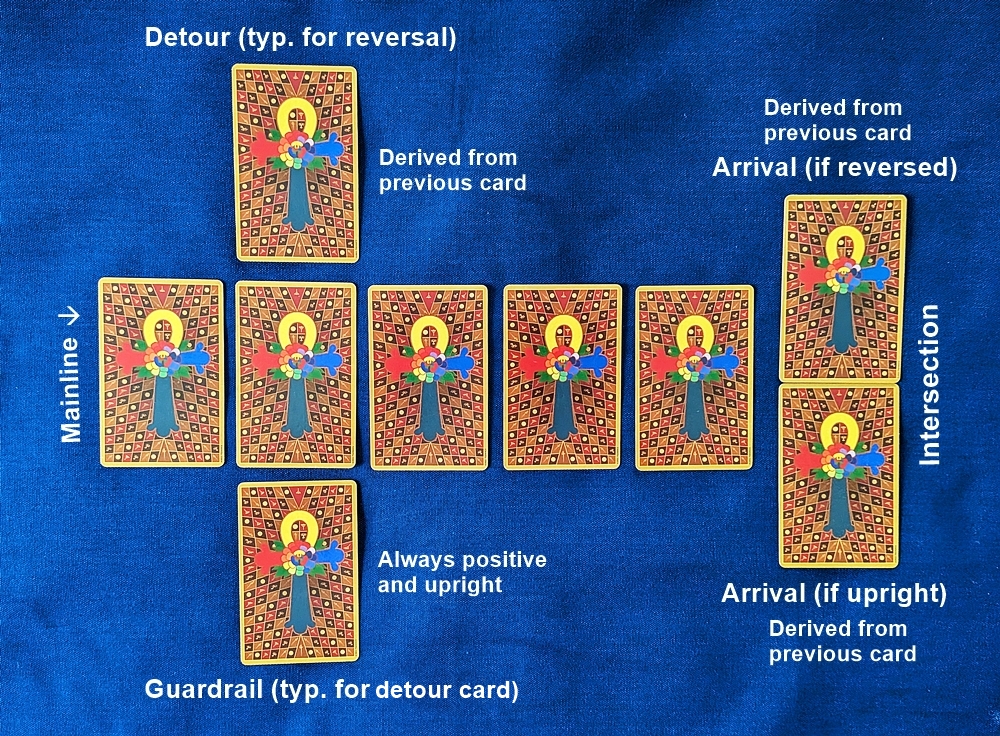
This spread resembles my old “bow-and-arrow” design, but it accommodates more than one “bow” configuration. The “arrow” is the straight-line path from beginning to end that will apply if there are no reversed cards in the pull, in which case the reading will be a “standard” progression until the last card that provides a choice of destinations. If a reversed card is followed by an upright card, the flow returns to the mainline with the next position; if another reversal occurs, the series will remain on the “detour” trajectory attended by another guardrail card, which provides a compensatory influence. The layout is to be read as a linear run with “meanders” caused by reversal and the potential for an alternate outcome.
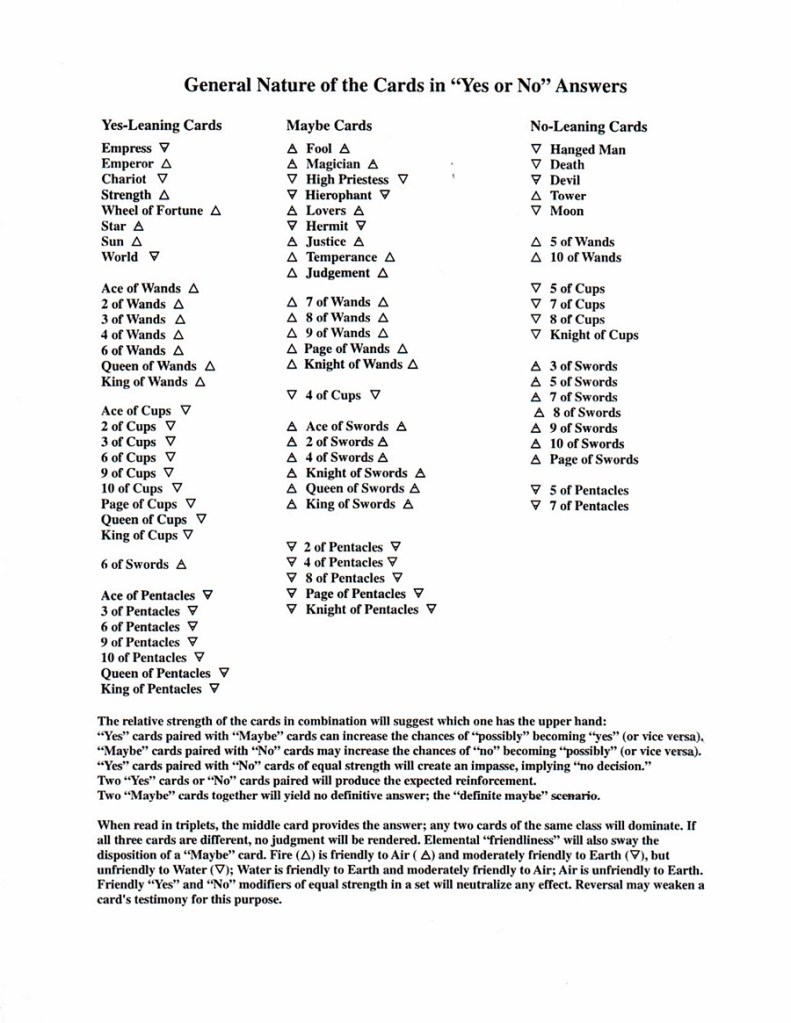
Begin by removing the subset of “positive” cards from a second deck, to be used whenever a reversal occurs in the main reading. (The table below provides my own cut at what I call “yes-leaning” or fortunate cards.)
Shuffle the reading deck (cut if desired) and deal a card into the left-most position. If the card is upright, deal the next card to its right on the “Mainline” path. If it is reversed, deal the next card into the “Detour” position above the “Mainline,” then shuffle the positive subset and pull a card for the “Guardrail position in the same column below the “Mainline.” (If it turns up reversed, reorient it as upright.)
If the next card pulled from the reading deck is also reversed, place it on the “Detour” path next to the previous card and pull another “Guardrail” card to go with it on the “Guardrail” path. If, however, the next card is upright, place it on the “Mainline” path as a return to normal.
Repeat this process for each position, detouring and returning as indicated by subsequent reversed and upright cards.
If the card in the fifth position is upright, place the sixth card in the lower “Arrival”position; if it is reversed, the sixth card goes in the upper “Arrival” position. Read the “Arrival” cards as the “end of the matter.”
Here is an example reading. The question involves a situation that may diverge to a greater or lesser extent over time, and the cards pulled confirm that but end on a note of stability with three upright Earth cards.
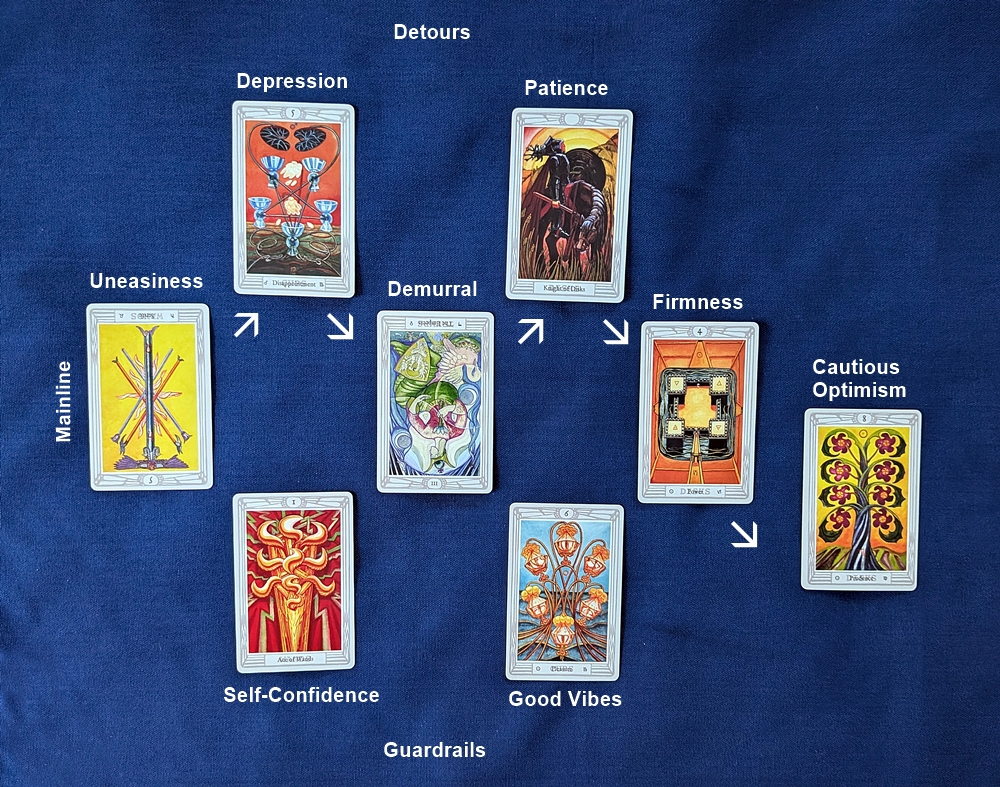
The reading begins on a sour note, with uneasiness and a detour into depression that must be held in check by empowering self-confidence. The middle card of the spread, which I read as the turning-point in an odd-numbered line, shows some reservation or withholding of cooperation (“demurral”) about continuing on the “Mainline,” but the Knight of Disks with his infinite patience and the “good vibes” of the “guardrail” card bring the reluctant atmosphere back down to earth. The scenario concludes with a firm statement of “wishes most likely granted.”