AUTHOR’S NOTE: It has been common knowledge when working with the Celtic Cross spread that the horizontal card sitting atop the first vertical one – “crossing” it – always indicates an obstacle to the flow of events or circumstances, but that premise falls apart when a positive card is pulled for the crossing position.
This scenario requires a good deal of narrative tap-dancing by the reader to twist the traditionally favorable meaning of a crossing card like the Sun into something that even remotely resembles an obstacle. (“You’re gonna get sunburned, kid.”) My impression has been that the inconvenience is more-or-less glossed over, as in “maybe it’s just a little bit obstructive.” There’s really no escaping it . . . or is there?
Many years ago when I was rethinking Eden Gray’s Celtic Cross design, I questioned why a positive card should become a negative influence for the purpose of contravention simply because the spread position demanded it. I decided to broaden the position meaning from “Obstacles” to “Major Motivators” that would offer either a challenge or an opportunity (and sometimes both at the same time) for querents to take some kind of action on their own behalf. The type and strength of that stimulus would depend on the potency of the crossing card for good or ill.
In this model, a “good” crossing card would galvanize the seeker, conferring the ambition to make the most of whatever was represented by the “”heart of the matter” (aka covering*) card beneath it. If the underlying card is unfavorable, the crossing card would deliver an antidote in the form of a proposed recovery plan that corrects or at least offsets the imbalance. If the “covering” card is favorable, the “good” crossing card would further burnish its honorable intent by offering an alliance to make the pair a dynamic – and unstoppable – force for achievement. A “neutral” crossing” card (see the first example below) would have little effect.
A “bad” crossing card would satisfy the conventional definition of an obstacle that would either erode any benefit inherent in a fortunate “covering” card or steer an unfortunate one further down the road toward disaster. In the first case (once again based on the severity of the crossing card), it would be a “slow bleed” type of debilitation while in the second it would be more like a “hemorrhage.”
In all situations, reversal would further complicate the picture. If it affects one or both of the cards, the approach to the challenge or opportunity could become oblique and not as easily navigated. A discouraging outlook could be rendered more confounding, while an encouraging one could require a more subtle touch for it to work out for the best.
Here are a couple of random examples:
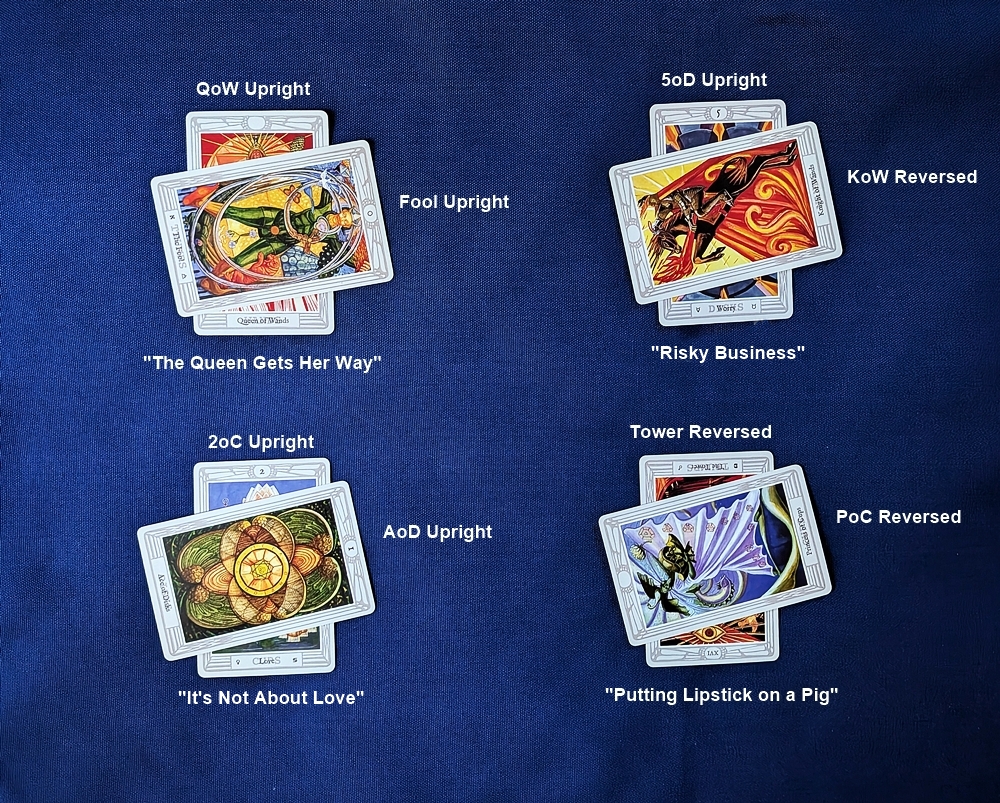
The Queen of Wands is a positive card and the Fool is neutral; both are upright. The Fool will stand off to the side and say nothing while the self-confident Queen reigns supreme.
In social settings, the Fives can describe difficult people, so the reversed Knight of Wands crossing the 5 of Disks could mean an especially contentious adversary who should not be underestimated (or, as in this example, trusted).
The 2 of Cups and the Ace of Disks are both positive and upright, putting an opportunistic (or at least a physically stimulating) slant on romance. (If you look closely at the Thoth Ace’s foreshortened “member,” you’ll see what I’m talking about.)
The reversed Tower is dire, and the reversed Princess of Cups crossing it makes a futile attempt to rehabilitate it.
*The “covering card” terminology comes from A.E. Waite’s version of the Celtic Cross, in which the vertical card described here “covered” the Significator card representing the querent, although few people still use a Significator with the spread. As the initial card in the layout, its meaning as “the heart of the matter” or “the situation as it stands” remains unchanged.

