AUTHOR’S NOTE: After a long spell pursuing other divination-related interests, I’ve returned to reading Benebell Wen’s Holistic Tarot and was just examining her card-counting approach to populating spreads. She uses the Golden Dawn technique from the “Opening of the Key” method, but I find it counterintuitive so I decided to create my own based loosely on more traditional cartomantic concepts.
The idea is to randomly select a Significator card (so you don’t “pre-load” a target number) and use its numerical value as the increment for counting out the quantity of cards for whatever spread you’re using for the reading. I recommend taking it from a second deck (for reasons that will soon become obvious) and reading it as the overarching theme for the narrative. If you prefer, the target population can be limited to the trump cards to show the archetypal environment for the question or topic. Otherwise, any card except the Fool (when it is numbered zero) can be used.
First, decide how you want to treat the Fool numerically; if you see it as zero, remove it from the first deck and set it aside since there is no way to progress the count by “0,” but if you choose to renumber it as 22 it can be left in the deck.
Shuffle the cards while concentrating on the matter of interest, pull the Significator card in your normal fashion and set it at the top-center of the reading space. Reversal may be applied to all of the steps in this process. Set the first deck aside.
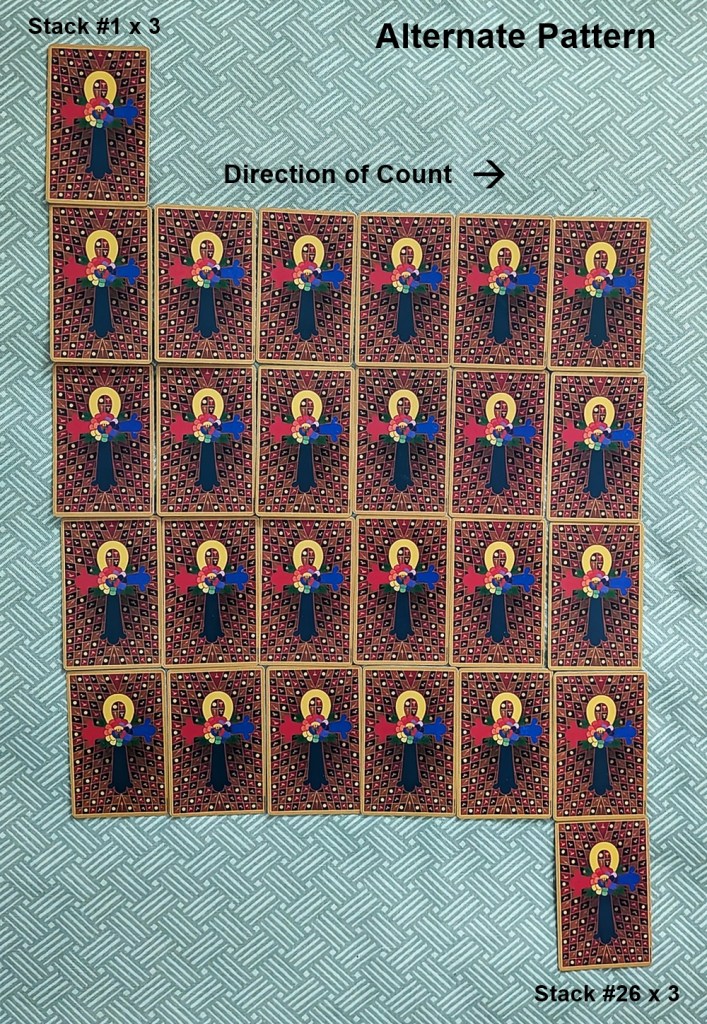
Shuffle a second deck, once again concentrating, and deal 26 stacks of three cards each, face-down, from top-left to bottom-right for a total of 78. You can deal three cards all at once into each stack or spread the deal out one-card-at-a-time from beginning to end, going through three iterations.
As shown in the photograph, I divided the stacks into two sections for further experimentation with past and future significance, but you can make one big rectangular array if you like. Having three cards in each stack will accommodate instances of an extended count landing on the same stack (plus it divides evenly into 78). As the first and fourteenth stacks in my design, the location of the two isolated piles at the top has no purpose other than keeping the pattern visually tidy. If I were to lay the cards in a single block, I would place those piles in Position #1 at the top-left and Position #26 at the bottom-right. (See the alternate pattern below.)
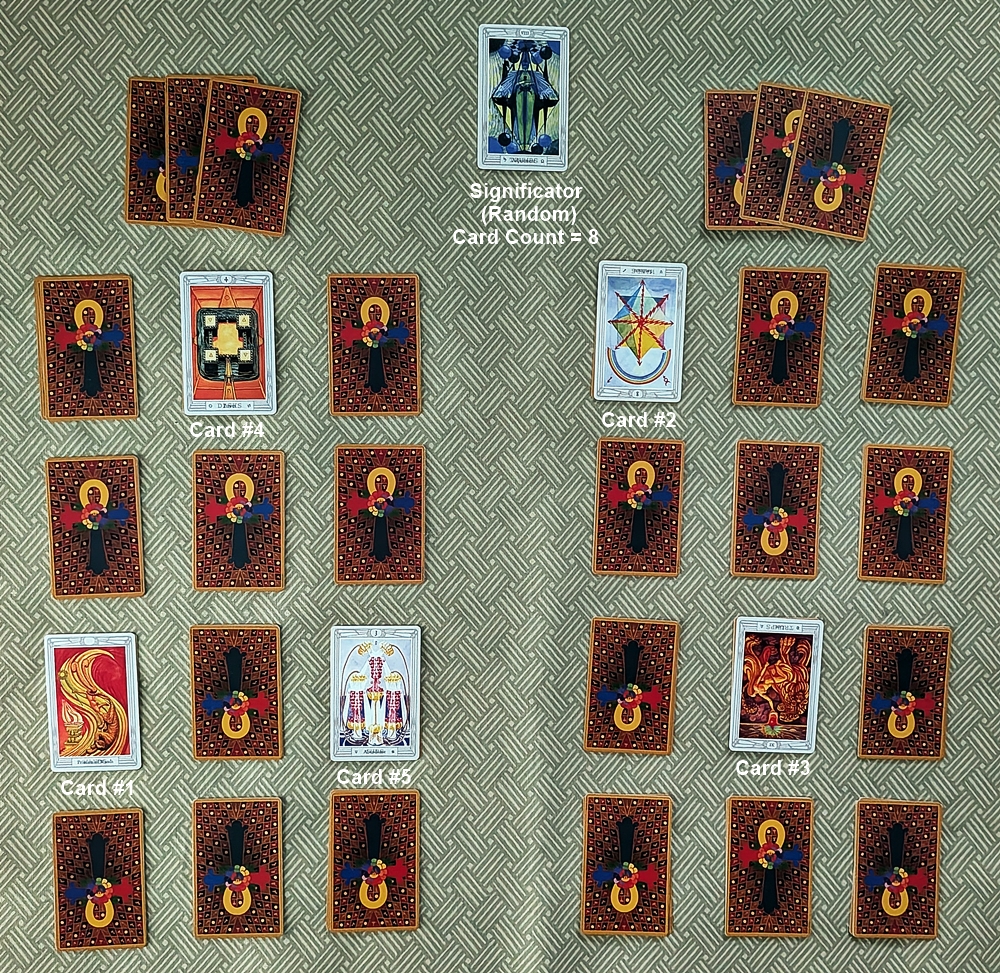
In this sample reading, which was a “cold” pull with no question or topic, Adjustment (aka Justice) was the Significator. Its number in the Thoth deck is “8.”
Beginning with the first stack at the top-left as “1,” count out eight stacks moving from left-to-right in each row. Turn the top card face-up (or if you want to get clever, pick any of the three using your judgment but no fair peeking). This is the first card in the reading spread, which in this case will be a five-card line.
Taking the last stack of the first count as the first stack of the second one (a Golden Dawn counting provision), count eight more stacks from left-to-right to arrive at the second position of the line spread and turn a card face-up.
Repeat this step three more times to populate the spread. If you reach the bottom-right corner of the tableau during any count, continue counting at the top-left corner as shown by Cards #4 and #5 in the image. (In his Golden-Dawn-based treatise on divination, Paul Foster Case arranged the cards in a circle, which made this straightforward.)
Transfer the five cards into the final sequence, which looks like this:
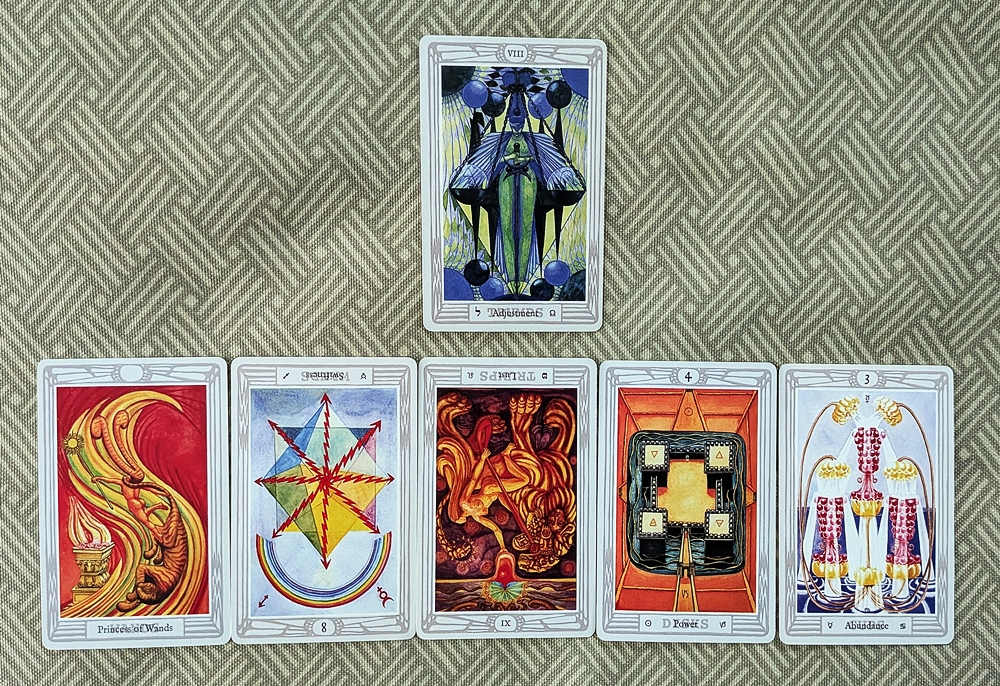
Read it as you would any five-card line, with the understanding that the background theme for the situation vibrates to the number Eight, which in my system of Qabalistic numerology relates to “a period of adjustment and reaction/overreaction.” This aligns perfectly with the definition of the Significator card, and the reversed Lust (aka Strength, numbered “8” in the RWS deck) in the middle, or “crisis,” position provides a focal point for this emphasis.
In concert with Justice, it could meet the legal definition of an “attractive nuisance” and the pitfall that poses for the unwary. On balance, though, three of the other cards compensate for the treacherous condition while the reversed 8 of Wands accentuates the precipitous decline of Lust. To my vivid imagination, it suggests a “slip hazard” like a banana peel on a sidewalk.
Perhaps the impulsive Princess of Wands will hastily embark (reversed 8 of Wands) on a covert sexual dalliance (reversed Lust as the “crisis”) but things simmer down when she realizes what it could do to her financial stability (4 of Disks), so to preserve that she decides to “kiss and make up” (3 of Cups). If this were a reading for a faithful, long-suffering husband, I would advise “Be patient, it won’t last. She has to stumble and fall before she sees the error of her ways.” (I wouldn’t mention how cynical and mercenary she is.)