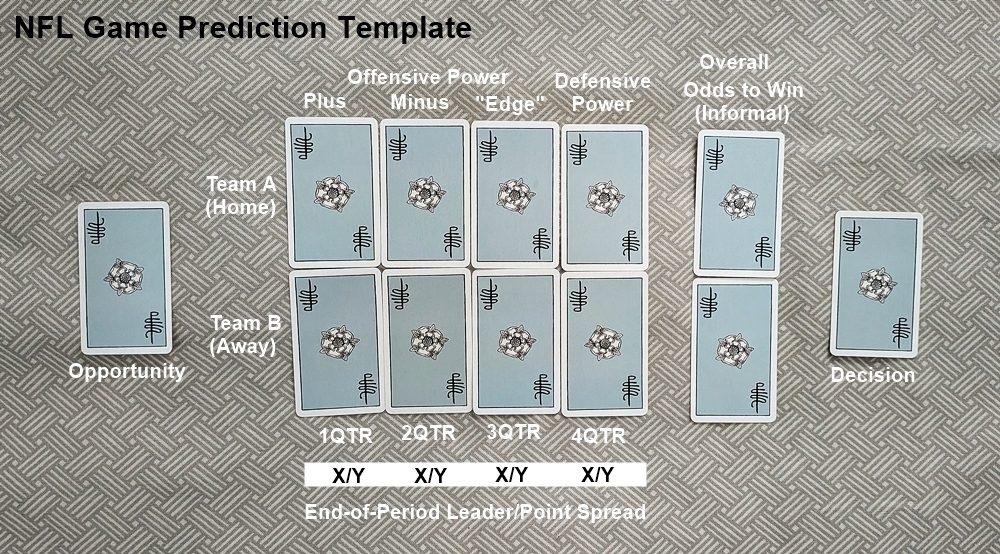
AUTHOR’S NOTE: It’s that time of year again, at least for US sports fans. Since 2018 I’ve been using my “Enemy at the Gate” conflict-resolution spread to predict the outcome of National Football League games. Over the years I’ve occasionally tinkered with the original design for that specific purpose, so I decided to formalize the changes in a dedicated template.
As before, the spread weighs a team’s offensive power against that of the opponent in the form of comparative strengths (the “Plus” column); weaknesses (the “Minus” column); and advantages (the “Edge” column) along with defensive effectiveness in the eponymous column.
The “Opportunity” card is intentionally selected from a second deck to identify the objective of the contest. I normally use the Chariot for this because it expresses triumph in physical terms.
The cards in the last three positions (“Overall Odds to Win” and “Decision”) are calculated using what I call the “numerical essence” method that rolls up the values of the rest of the cards in two ways: the “Odds” cards are an arithmetic aggregate of the four cards in their respective rows while the “Decision” card is a conflation of the two “Odds” cards. (These cards are always Major Arcana, and the contributing sums may have to be mathematically reduced to a number below 22 to derive them.) I also clarified that the odds underlying the projection are informal and not based on any statistical analyses. (I’m not a betting man so I don’t know the technical side very well.)
Finally, I codified the approach I’ve been using to forecast quarterly point spreads, interim leaders and eventual winners.
The eight random cards pulled for the reading do double duty: 1) they provide a comparison of the two teams’ physical prowess on both offense and defense, allowing for a subjective call on their relative merits; and 2) on a quarter-by-quarter basis, they show the likely leader and the number of points by which the leading team is expected to prevail, at least momentarily. Reversal can widen the gap, both in a reduced potential to dominate the game and in size of the point spread between the individual scores.
The first cut is to determine which team demonstrates the most promise in each of the four sub-categories as reflected in the cards of the “Power” series. Each of the four vertical pairs is then analyzed to confirm the dominant and subordinate cards and the size of the gap between their face values. The purpose of the quarterly scoring assessment is not to come up with a cumulative total for each team at that juncture but rather to identify the point spread between the scores at the end of the period. The Fourth Quarter differential will stand as the margin of record at the final whistle, and – although it’s not expected – the team with the superior “Power” profile may not be on the winning side of that conclusion.
The quarterly results are recorded in the “X/Y” format where “X” is the letter of the leading team (A or B) and “Y” is the size of the lead, which is derived from the difference in value between the two “Power” cards in each column. (Because tarot-card numeration doesn’t always mirror NFL scoring conventions, some standardized rounding up-or-down may be necessary to come up with a realistic result. Football scoring usually progresses in increments of 3 [a field goal] and 7 [a touchdown and extra point] with sporadic outliers due to missed extra-point kicks, two-point conversions, and safeties.)
Each team’s “Power” cards are matched to the “Opportunity” card to assess their mutual agreement according to whether there is shared “dignity” between them (common suit, element, number, polarity, rank, etc), with the nod going to the team that receives the most favor from the “victory” card.
Next, the calculated “Odds” cards are related to the rest of the cards in the associated “Power” series using “dignities” as above to identify the team with the most cooperative alignment, which will ideally translate into a win.
The “Decision” card is then run by the “Odds” cards in the same manner to see if it supports one team over the other.
These “soft” judgments are used to form an independent opinion regarding the likely victor, but the head-to-head comparison of the eight “Power” cards and the quarterly “leader-board” testimony should be considered the primary harbingers of success. The original spread included a numerical ranking based on these intuitive observations but I dropped it as being unreliable.
I’ve used the updated spread with encouraging results for NFL championships and Super Bowl games over the last few years but I’m still fine-tuning it. Given the competitive nature of professional sports, I’m sure it will never be perfect. Real-life examples of its application can be found in the “Sports Readings” sub-category on the homepage sidebar. There have been enough hits and near-misses to convince me that I should keep going.
I will post a sample reading tomorrow to test-drive this approach.