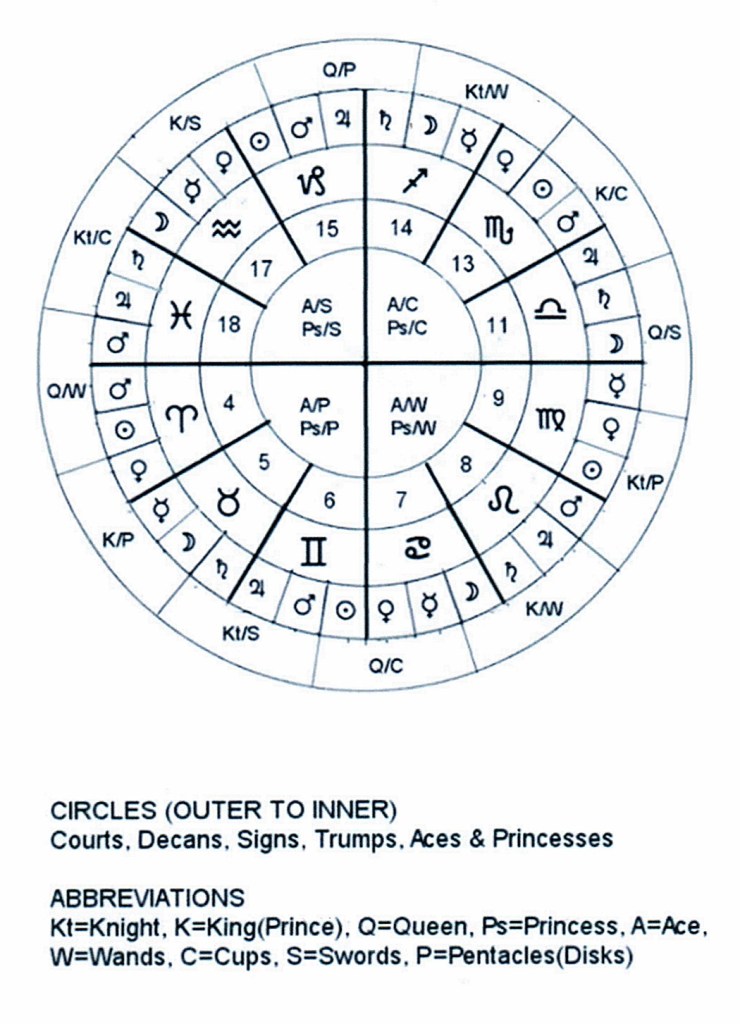
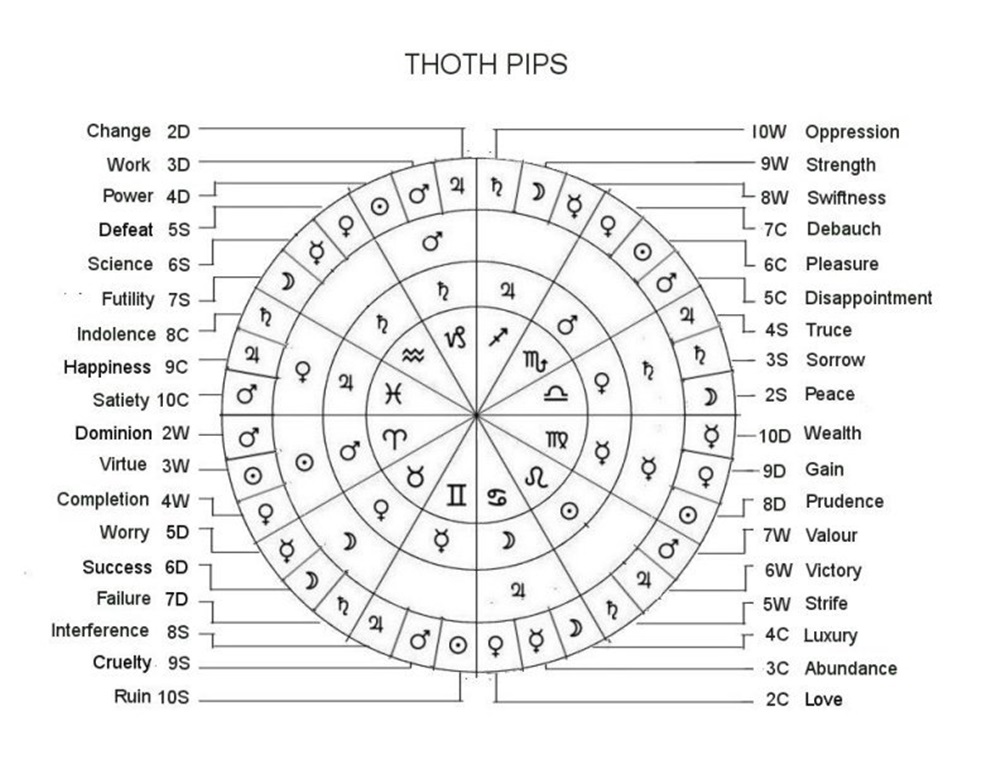
AUTHOR’S NOTE: In the “Chaldean” system of the Hermetic Order of the Golden Dawn, each of the twelve astrological signs was allotted a Major Arcanum (aka trump card) of the tarot, so an Aries Sun or Aries-rising individual would personify and project the assertive nature of the Emperor, which is a perfect fit. For each sign there are also three Minor Arcana (numbered “decan” cards) and their associated planets, along with three “elemental” court cards and one Ace (but I’m disregarding the last four because they would make this exercise too convoluted). See the “wheels of correspondence” at the end of the post for details.
Classical Greek astrologers assumed that the Ascendant (“horoskopos” or “hour-watcher”) of the natal chart referred to the whole figure as a time-based extrapolation from its zodiacal degree. But in modern terms its resident sign is only one of three major psychological “building-blocks” of the personality (the others are the Sun-sign and Moon-sign, with the rest of the horoscope factors adding nuance). It represents our fundamental self image – “how we see ourself” – and also the outward projection of that portrait to our immediate surroundings, thus reflecting “how other people see us” on a personal level. It can be both a totem of self-promotion (aka “calling-card”) for gregarious natives and a portable shield for more reticent types.
Taken in combination, all of these symbols produce an aggregate profile of sign-and-card meaning that injects considerable depth into character analysis with the birth chart. Here is the “Ascendant” array of cards for my own Scorpio-rising natal chart. Only the four cards to the right are of immediate interest for my purpose here. (All images are from the Thoth deck, copyright of US Games Systems Inc, Stamford, CT.)
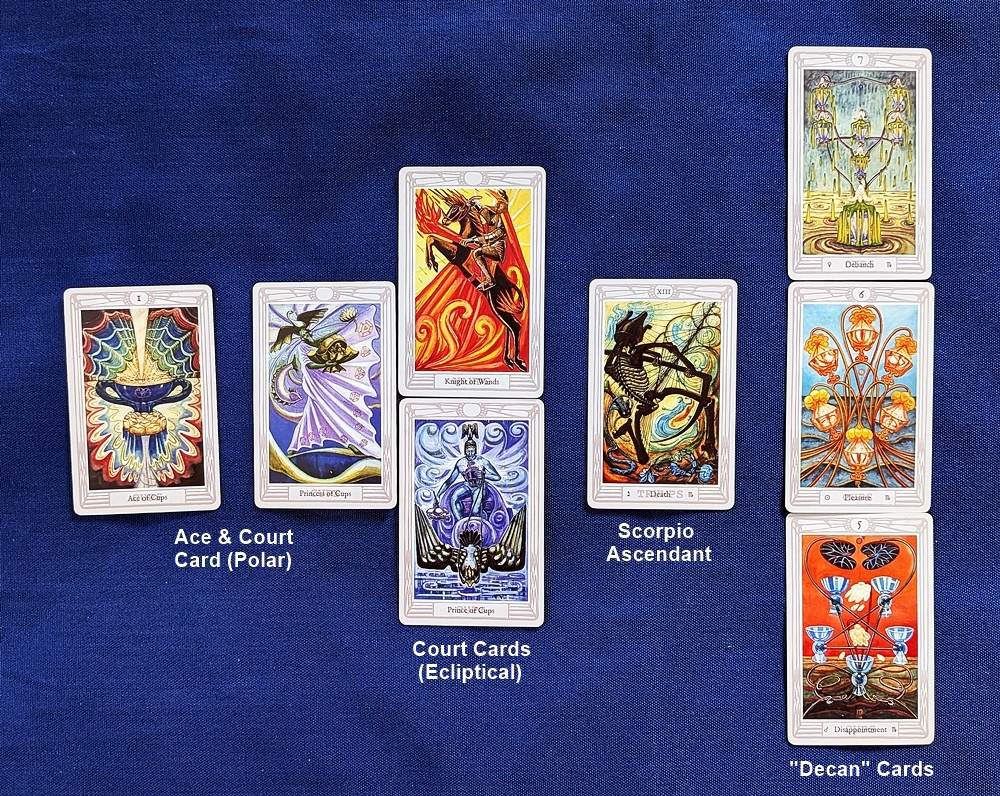
The Scorpio personality (and particularly the Scorpio-rising specimen) can be quite secretive and often remains inscrutable in its private affairs; thus, any unflattering facts about the individual, to the extent they can contained, will be withheld from disclosure. As one of the “scientific” signs (along with Virgo and Aquarius), Scorpio can be meticulously unsparing in its criticism of the things it finds wanting, as well as skeptical, cynical and even a little perverse in its general mistrust of just about anything that doesn’t seem “quite right.” Thus, when provoked it can be the most contrarian of the Fixed signs.
The Death card as the corresponding trump accentuates (and ultimately punctures) that hyper-inflated air of suspicion with its all-knowing grin (not visible in the Thoth card), while the three “decan” cards (“Disappointment;” sensual “Pleasure;” and “Debauch” or abasement) are scarcely ingratiating since they reinforce the Scorpio’s conviction that “something smells rotten.” The principal life-challenge of this configuration is to eventually transcend nearly everything it represents (if only to dispel that permanent aura of irritation with the world-at-large).
To put this complex in motion, suppose that you, as a Scorpio-rising native like me, are engaged in a situation in which you want to impress someone with your nobler qualities. You are already “behind the 8-ball” with the troubling attributes described above unless you’ve had a lifetime to raise your sights and embrace a more auspicious paradigm (but of course, as the saying goes, “a leopard can’t change its spots”). If not, the best you can do is camouflage any deficiencies until the crisis of confidence has passed (and Scorpios certainly know how to do that). Here is one way you might go about it.
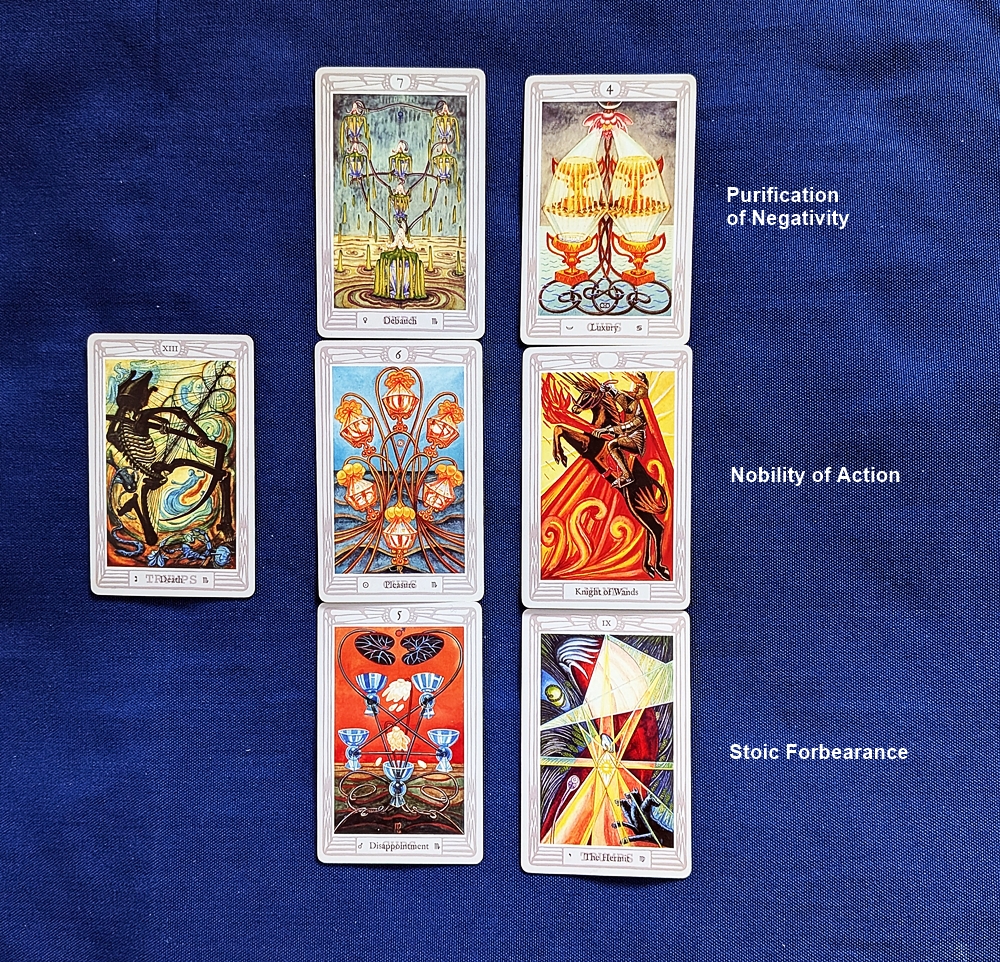
Lay out the right-hand set of four cards from the above pattern for your personal Ascendant as I have done below. (As long as you have a natal horoscope, the attached correspondence wheels will give you the specifics for the applicable sign of the zodiac; if you don’t have a birth chart, what are you waiting for? They’re free at a number of web-sites like astrodienst/astro.com.)
Shuffle a second deck while concentrating on what you want to accomplish in the matter.
Deal three cards from top-to-bottom next to the “decan” cards. (Reversals are permitted.)
Read these cards as behaviors or attitudes you can adopt to ease the conditions shown by the four “template” cards. (That’s assuming they require remediation; if everything is fine with them, you can instead explore how they might be made even better, but be aware that you may want to quit while you’re ahead.)
In this example reading I asked what I might do to make my best intentions clear given the unhelpful signals from the four “birth cards.” The 4 of Cups and the Knight of Wands are self-explanatory as shown by their captions. The Hermit advises patience rather than overt action. It’s looking calmly at the 5 of Cups and saying “This too shall pass.”
Except for the feisty Knight, who sneaked out from behind Death in the “master-pattern” and who makes his own rules, these cards are all elementally well-favored by Death and its entourage, so chances for success are reasonably good. We could even say that “the fix is in” as long as the Knight plays nice and doesn’t get too pushy.
As an aside, don’t you think Terry Pratchett’s stentorian “DEATH” character would be able to shout him down? Or perhaps a more cunning Death will let the Knight have a brief, steamy dalliance with the 6 of Cups in order to tame his unruly temperament by pouring Water on Fire.
To summarize, we’re stuck with whatever we’ve been “gifted” by the astrological moment of birth and can only sublimate it to a certain extent according to its inherent nature via the influence of transits, directions and returns. But adding a tarot-card projection as I’ve done here can offer new avenues of expression whenever we find ourselves in circumstances that can benefit from a more fluid perspective. Like any tarot reading, it can be applied to the natal template whenever necessary.